Haloa japonica
Japanese Bubble Snail
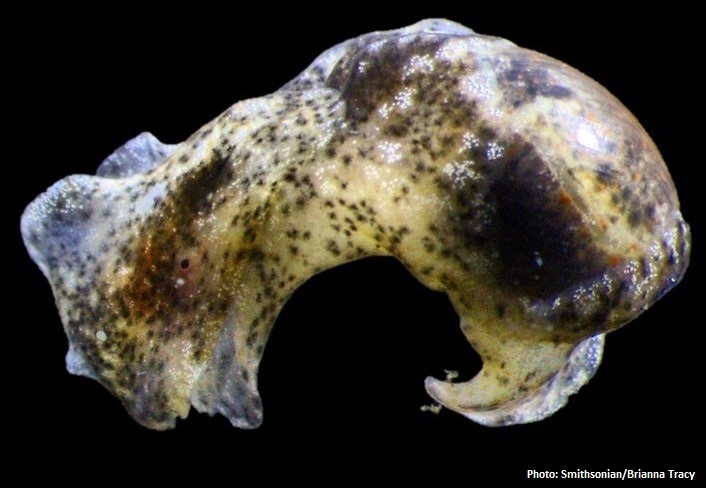
(c) Brianna Tracy-Sawdey, some rights reserved (CC BY) · licence
Family: Haminoeidae · Class: Gastropoda · Order: Cephalaspidea
Haloa japonica (Japanese Bubble Snail) is a California animal in the Haminoeidae family.
Haloa japonica, commonly known as the Japanese bubble snail, is a small marine gastropod mollusk in the family Haminoeidae. This cephalaspidean sea slug is characterized by its distinctive bubble-like shell morphology typical of the order Cephalaspidea. The species exhibits the elongated, soft-bodied form characteristic of opisthobranch gastropods, with a reduced internal shell that provides minimal external protection. Native to the Northwest Pacific region, Haloa japonica occurs naturally in waters around Japan, Korea, and other areas of the western Pacific Ocean (SERC Marine Invasions Database). The species has expanded its range through human-mediated transport, establishing populations in various marine environments outside its native range. In North American waters, this species has been documented as a marine invasive species, with California's Office of Spill Prevention and Response recognizing it as part of the state's marine invasive species monitoring program. The Japanese bubble snail inhabits shallow marine and estuarine environments, typically found in soft sediment habitats including mudflats, sandy bottoms, and areas with organic-rich substrates. The species demonstrates tolerance for varying salinity conditions, allowing it to colonize both fully marine and brackish water environments. This adaptability to different salinity regimes contributes to its successful establishment in non-native habitats. As a gastropod mollusk, Haloa japonica exhibits typical cephalaspidean feeding behavior, likely functioning as a deposit feeder or grazer on organic matter and algae present in sediment environments. Like other members of the Haminoeidae family, this species is hermaphroditic, possessing both male and female reproductive organs. Reproduction involves the exchange of sperm between individuals, followed by the deposition of eggs in gelatinous masses or strings attached to substrates. The species completes its life cycle through a planktonic larval stage, which facilitates both natural dispersal and human-mediated transport via ballast water and hull fouling. Currently, Haloa japonica lacks formal conservation status designations at federal, state, or international levels. As a non-native species in California waters, management focus centers on monitoring and prevention of further spread rather than conservation protection. The species' classification as a marine invasive species reflects concerns about potential ecological impacts on native marine communities, though specific documentation of such impacts requires further research. The California Department of Fish and Wildlife's Marine Invasive Species Program includes this species in monitoring efforts to track distribution patterns and assess potential ecological effects on native California marine ecosystems. Scientific documentation for certain aspects of this species' biology remains limited outside of taxonomic and invasion ecology contexts. The information presented here is based on available sources including the Smithsonian Environmental Research Center's Marine Invasions Database and California's marine invasive species monitoring program. If you have additional verified information about this species' detailed biology, distribution, or ecology, please contact us to help improve this species account.
Classification
Class: Gastropoda · Order: Cephalaspidea · Family: Haminoeidae
Frequently asked questions
How is Haloa japonica classified?
Haloa japonica belongs to class Gastropoda, order Cephalaspidea, family Haminoeidae.
What family does Haloa japonica belong to?
Haloa japonica is in the Haminoeidae family.
What is Haloa japonica?
Haloa japonica, commonly known as the Japanese bubble snail, is a small marine gastropod mollusk in the family Haminoeidae.
Is Haloa japonica found in California?
Yes. Haloa japonica is recorded in California in The California Species Project's catalogue.
Related species
Other California species in the same genus, family, or bioregion.
Data from The California Species Project — 14,000+ California species with verified data from CNPS, CDFW, USFWS, and more.