Halyomorpha halys
Brown Marmorated Stink Bug
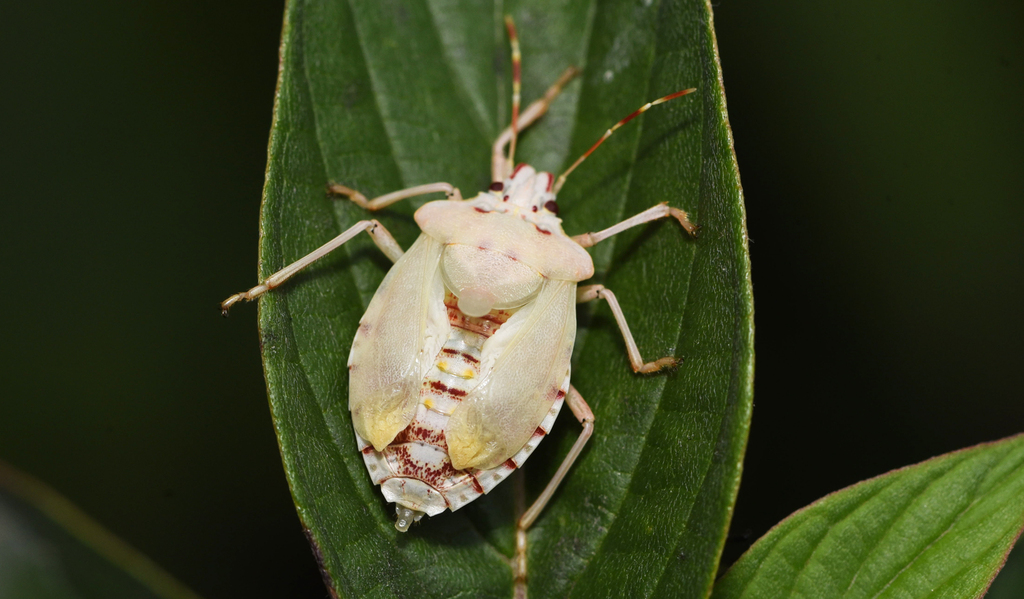
(c) Marcel_Pepin, some rights reserved (CC BY) · licence
Family: Pentatomidae · Class: Insecta · Order: Hemiptera
Halyomorpha halys (Brown Marmorated Stink Bug) is a California animal in the Pentatomidae family.
The brown marmorated stink bug is an invasive pentatomid measuring 12 to 17 millimeters (0.47 to 0.67 inches) in length. Adults display a distinctive marbled brown coloration on the dorsal surface, with alternating light and dark bands along the wing margins and antennae. The species is distinguished from native stink bugs by smooth shoulder margins lacking prominent spines and characteristic white banding on the antennae and leg segments. The scutellum exhibits a distinctive copper or metallic sheen, and adults emit a strong defensive odor when disturbed. Native to East Asia, including China, Japan, Korea, and Taiwan, the brown marmorated stink bug was first detected in North America in Allentown, Pennsylvania in 1996. The species has rapidly expanded its range across the continental United States, reaching California by 2005. Current distribution encompasses most states, with established populations documented from the Atlantic Coast to the Pacific Northwest. In California, the species occurs throughout the Central Valley, San Francisco Bay Area, and southern regions, with continuing range expansion. This species demonstrates broad habitat tolerance, occupying agricultural areas, urban environments, forests, and residential landscapes. During growing seasons, adults and nymphs feed on numerous host plants including fruit trees, vegetables, ornamental plants, and native vegetation. The species shows particular affinity for stone fruits, apples, soybeans, corn, and tomatoes. Adults seek overwintering sites in structures, rock crevices, dead trees, and buildings, often aggregating in large numbers. Brown marmorated stink bugs are polyphagous feeders, using piercing-sucking mouthparts to extract plant fluids from fruits, pods, stems, and leaves. Adults emerge from overwintering sites in spring when temperatures consistently exceed 20°C (68°F) (Rice et al. 2014). Mating occurs from May through August, with females depositing clusters of 20 to 30 barrel-shaped eggs on leaf undersides. Development includes five nymphal instars requiring approximately 35 to 45 days under optimal conditions (Nielsen et al. 2008). The species typically completes one generation annually in northern regions and up to two generations in warmer southern areas. The brown marmorated stink bug lacks federal or state listing status as it is considered an agricultural pest and invasive species rather than a conservation concern. Economic impacts exceed $40 million annually in the Mid-Atlantic region alone (Leskey & Nielsen 2018), with significant damage documented to apple, peach, soybean, and specialty crop production. Management relies primarily on integrated pest management approaches including pheromone trapping, biological control agents, and targeted insecticide applications. Native parasitoid wasps, particularly Trissolcus species, show promise for biological control, with Trissolcus japonicus approved for release in several states (Xerces Society 2018). The species' continued expansion and adaptation to new environments represent ongoing challenges for agricultural and urban pest management programs across North America.
Classification
Class: Insecta · Order: Hemiptera · Family: Pentatomidae
Frequently asked questions
How is Halyomorpha halys classified?
Halyomorpha halys belongs to class Insecta, order Hemiptera, family Pentatomidae.
What family does Halyomorpha halys belong to?
Halyomorpha halys is in the Pentatomidae family.
What is Halyomorpha halys?
The brown marmorated stink bug is an invasive pentatomid measuring 12 to 17 millimeters (0.47 to 0.67 inches) in length.
Is Halyomorpha halys found in California?
Yes. Halyomorpha halys is recorded in California in The California Species Project's catalogue.
Related species
Other California species in the same genus, family, or bioregion.
Data from The California Species Project — 14,000+ California species with verified data from CNPS, CDFW, USFWS, and more.