Hecatera dysodea
Small Ranunculus Moth
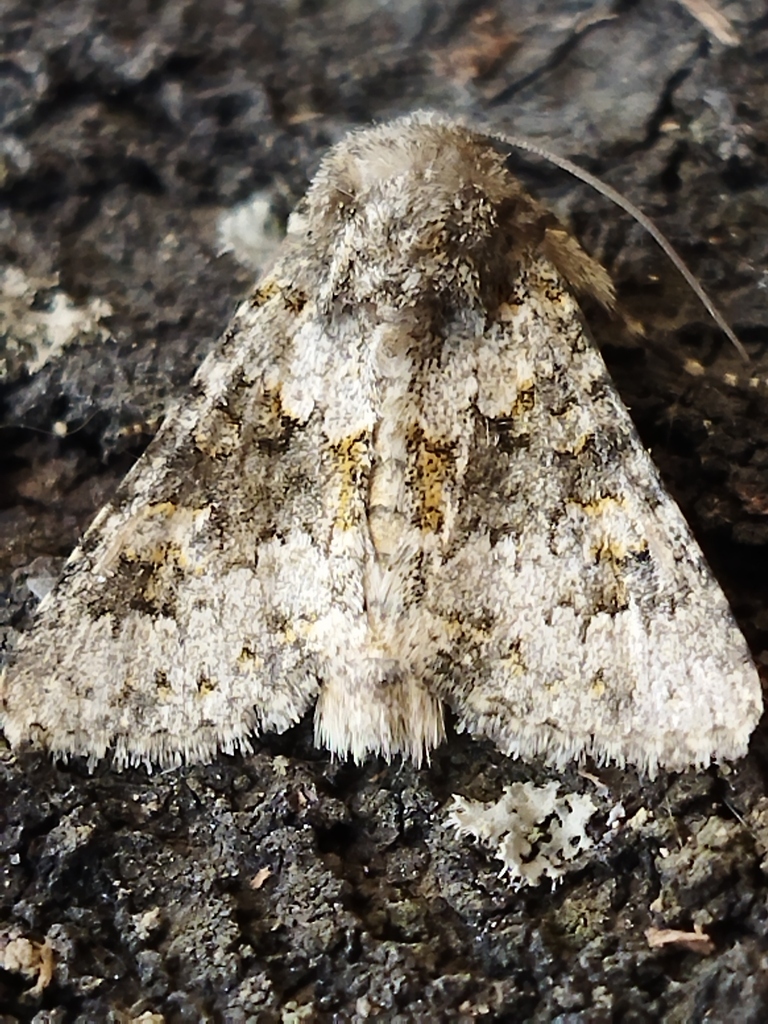
(c) SteveM4560, some rights reserved (CC BY) · licence
Family: Noctuidae · Class: Insecta · Order: Lepidoptera
Hecatera dysodea (Small Ranunculus Moth) is a California animal in the Noctuidae family.
The Small Ranunculus Moth (Hecatera dysodea) is a medium-sized noctuid moth with a forewing length of approximately 15-18 mm (0.6-0.7 inches). The forewings display a mottled brown and gray pattern with darker cross-lines and a distinctive kidney-shaped reniform spot. The hindwings are pale gray to white with darker marginal shading. Adults have a wingspan ranging from 32-38 mm (1.3-1.5 inches). The antennae are thread-like in both sexes, and the body is robust with a brownish-gray thorax and abdomen. This species is not native to North America, having been introduced from Europe. In North America, the Small Ranunculus Moth has been documented in Washington, Oregon, and Utah. The species' native range extends across Europe from the British Isles eastward to central Asia. Its establishment in western North American states suggests ongoing range expansion, though the full extent of its current distribution may not be completely documented. The Small Ranunculus Moth inhabits disturbed areas, roadsides, waste grounds, and agricultural edges where its host plants occur. The species shows a preference for open habitats with sparse vegetation and is often associated with areas of human disturbance. Elevational range in North America appears to correspond with the distribution of suitable host plants, typically in lowland to mid-elevation zones. Larvae feed exclusively on wild lettuce species (Lactuca spp.), including prickly lettuce (Lactuca serriola) and other members of the genus. The caterpillars are nocturnal feeders, consuming leaves and flower heads during their development. Adults are active from late spring through early fall, with flight periods varying by latitude and local climate conditions. The species is univoltine in most of its range, producing one generation per year. Females deposit eggs singly on host plant foliage, and larvae undergo five instars before pupating in soil chambers. Mating occurs during evening hours, with males attracted to pheromones released by calling females. Adults are nocturnal and come to artificial lights, making them detectable through moth monitoring programs. The species overwinters as pupae in the soil, emerging as adults when host plants begin active growth. As an introduced species, the Small Ranunculus Moth is not protected under federal or state endangered species legislation. Its conservation status is not assessed by standard conservation organizations, as it is considered a non-native species in North America. The moth's dependence on Lactuca species, many of which are also introduced weeds, suggests it may benefit from human-disturbed environments. Population trends in North America are not well-documented, though the species appears to be establishing successfully in areas where it has been introduced. Monitoring efforts focus primarily on documenting range expansion rather than conservation needs. The species' impact on native ecosystems appears minimal, as it feeds on largely non-native host plants.
Classification
Class: Insecta · Order: Lepidoptera · Family: Noctuidae
Frequently asked questions
How is Hecatera dysodea classified?
Hecatera dysodea belongs to class Insecta, order Lepidoptera, family Noctuidae.
What family does Hecatera dysodea belong to?
Hecatera dysodea is in the Noctuidae family.
What is Hecatera dysodea?
The Small Ranunculus Moth (Hecatera dysodea) is a medium-sized noctuid moth with a forewing length of approximately 15-18 mm (0.6-0.7 inches).
Is Hecatera dysodea found in California?
Yes. Hecatera dysodea is recorded in California in The California Species Project's catalogue.
Related species
Other California species in the same genus, family, or bioregion.
Data from The California Species Project — 14,000+ California species with verified data from CNPS, CDFW, USFWS, and more.