Helicoverpa zea
Corn Earworm Moth
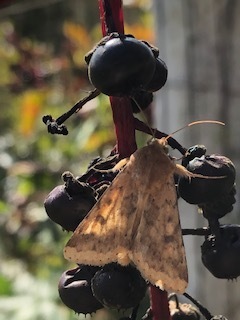
(c) William Harmon, some rights reserved (CC BY) · licence
Family: Noctuidae · Class: Insecta · Order: Lepidoptera
Helicoverpa zea (Corn Earworm Moth) is a California animal in the Noctuidae family.
The corn earworm moth (Helicoverpa zea) is a medium-sized noctuid moth with forewings measuring 13-20 mm (0.5-0.8 inches) in length and a wingspan of 30-40 mm (1.2-1.6 inches). Adult moths display considerable color variation, with forewings ranging from pale yellow to olive-green to dark reddish-brown. The forewings typically feature a distinctive dark kidney-shaped reniform spot and a circular orbicular spot, connected by a pale line. Hindwings are lighter in color, usually pale yellow to cream with dark borders. Males can be distinguished from females by their more feathery antennae and slightly smaller size. Corn earworm moths have a widespread distribution across North America, extending from southern Canada to northern South America. In California, the species occurs throughout agricultural regions from the Central Valley to coastal areas, with populations present year-round in warmer southern counties. The species is highly migratory, with northern populations supplemented by moths dispersing from southern breeding areas during spring and summer months. The species inhabits diverse agricultural and natural environments, showing strong association with cultivated crops and disturbed habitats. Adults are commonly found in agricultural fields, gardens, urban areas, and weedy lots from sea level to approximately 1,500 meters (4,900 feet) elevation. The moths demonstrate extensive host plant utilization, utilizing over 100 plant species across multiple families for larval development. Corn earworm moths are nocturnal and strongly attracted to artificial lights. Adults feed on flower nectar from various plants including tobacco, petunia, and four o'clock flowers. Mating occurs during night hours, with females capable of producing 500-3,000 eggs over their 10-25 day lifespan. Eggs are deposited singly on host plant surfaces, particularly on corn silks, tomato fruit, and cotton squares. The larval stage, known as corn earworm, bollworm, or tomato fruitworm depending on the host plant, feeds on reproductive structures including corn ears, tomato fruits, cotton bolls, and tobacco buds. Larvae typically complete development in 14-25 days through six instars, reaching 30-40 mm (1.2-1.6 inches) in length. The species overwinters as pupae in soil chambers 5-15 cm (2-6 inches) deep. In California, corn earworm moths typically produce 2-4 generations annually, with continuous breeding possible in frost-free areas. Peak flight periods occur in late spring through early fall, corresponding with crop planting and growing seasons. This species holds no special conservation status and is considered one of North America's most significant agricultural pests. Economic damage exceeds $1 billion annually across affected crops in the United States. Management challenges include the species' high reproductive potential, broad host range, and documented resistance to multiple insecticide classes including organophosphates, pyrethroids, and Bt toxins. Integrated pest management strategies combining biological control agents, resistant crop varieties, and targeted chemical applications are employed to minimize crop damage while preserving beneficial insect populations.
Classification
Class: Insecta · Order: Lepidoptera · Family: Noctuidae
Frequently asked questions
How is Helicoverpa zea classified?
Helicoverpa zea belongs to class Insecta, order Lepidoptera, family Noctuidae.
What family does Helicoverpa zea belong to?
Helicoverpa zea is in the Noctuidae family.
What is Helicoverpa zea?
The corn earworm moth (Helicoverpa zea) is a medium-sized noctuid moth with forewings measuring 13-20 mm (0.5-0.8 inches) in length and a wingspan of 30-40 mm (1.2-1.6 inches).
Is Helicoverpa zea found in California?
Yes. Helicoverpa zea is recorded in California in The California Species Project's catalogue.
Related species
Other California species in the same genus, family, or bioregion.
Data from The California Species Project — 14,000+ California species with verified data from CNPS, CDFW, USFWS, and more.