Heliolonche pictipennis
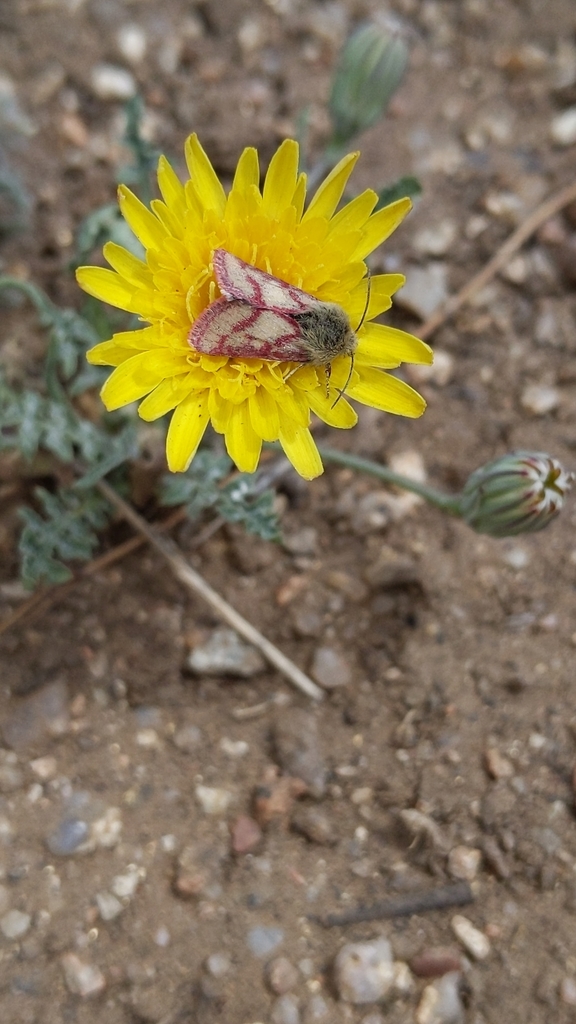
(c) James Weaver, some rights reserved (CC BY) · licence
Family: Noctuidae · Class: Insecta · Order: Lepidoptera
Heliolonche pictipennis is a California animal in the Noctuidae family.
Heliolonche pictipennis is a small noctuoid moth in the family Noctuidae, subfamily Heliothinae. Adults have a wingspan of 16-17 mm with a forewing length of 7-8 mm (BugGuide). The species was originally described by Grote in 1875 and is cataloged as Hodges number 11210 in North American moth classification systems. This species occurs in western North America, with documented records from California and other western states. The moth's distribution appears to be associated with areas where its host plants are found, though specific range limits within California have not been comprehensively mapped. Like many members of the subfamily Heliothinae, H. pictipennis likely has a patchy distribution corresponding to suitable habitat and host plant availability. Heliolonche pictipennis inhabits areas where its larval host plants grow. According to the Moth Photographers Group, larvae feed on plants in the family Asteraceae, specifically the genera Malacothrix and Rafinesquia (Shropshire & Douglas 2025). Malacothrix species, commonly known as desert dandelions, typically occur in sandy or gravelly soils in desert washes, flats, and disturbed areas. Rafinesquia species, or desert chicories, similarly inhabit sandy desert areas and washes. This host plant association suggests H. pictipennis occupies desert and semi-desert habitats where these Asteraceae occur. Adult flight period and specific behavioral patterns have not been well documented in the available literature. Like other Heliothinae moths, adults are likely nocturnal and attracted to lights. The larvae presumably develop within or on the host plants during appropriate seasons when the host plants are actively growing. Desert Asteraceae typically bloom in spring following winter rains, suggesting larval development may be timed to coincide with peak host plant growth. The conservation status of Heliolonche pictipennis has not been formally assessed. The species does not appear on federal or California state species of concern lists as of December 2025. However, like many specialized desert moths, populations may be vulnerable to habitat degradation from development, off-road vehicle use, and invasive plant species that displace native host plants. Climate change effects on desert precipitation patterns could also impact the availability of annual host plants that depend on winter rainfall for germination and growth. The taxonomy of H. pictipennis includes several synonyms: cresina (Smith, 1906), defasciata (Benjamin, 1936), and sabulosa (Smith, 1906), reflecting the complex nomenclatural history typical of many North American Noctuidae. The species belongs to a group of small, day-flying moths that are often overlooked due to their size and cryptic habits. Scientific documentation for this species remains limited, and additional research is needed to better understand its distribution, life history, and ecological requirements within California's diverse desert ecosystems.
Classification
Class: Insecta · Order: Lepidoptera · Family: Noctuidae
Frequently asked questions
How is Heliolonche pictipennis classified?
Heliolonche pictipennis belongs to class Insecta, order Lepidoptera, family Noctuidae.
What family does Heliolonche pictipennis belong to?
Heliolonche pictipennis is in the Noctuidae family.
What is Heliolonche pictipennis?
Heliolonche pictipennis is a small noctuoid moth in the family Noctuidae, subfamily Heliothinae.
Is Heliolonche pictipennis found in California?
Yes. Heliolonche pictipennis is recorded in California in The California Species Project's catalogue.
Related species
Other California species in the same genus, family, or bioregion.
Data from The California Species Project — 14,000+ California species with verified data from CNPS, CDFW, USFWS, and more.