Heliopetes ericetorum
Northern White-Skipper
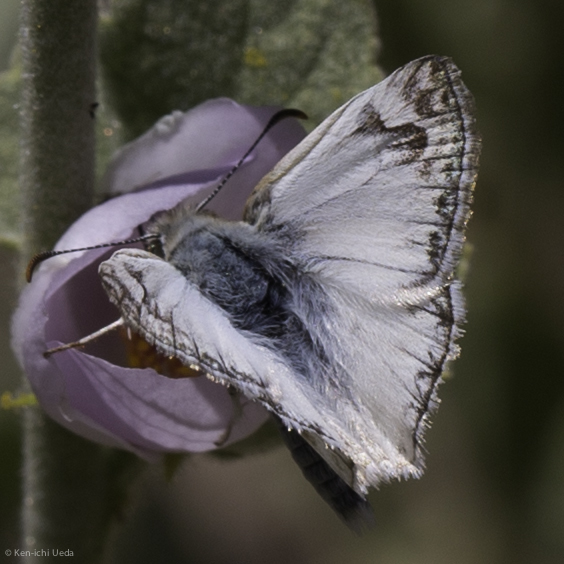
(c) Ken-ichi Ueda, some rights reserved (CC BY) · licence
Family: Hesperiidae · Class: Insecta · Order: Lepidoptera
Heliopetes ericetorum (Northern White-Skipper) is a California animal in the Hesperiidae family.
The Northern White-Skipper is a small butterfly belonging to the spread-wing skipper family Hesperiidae. Adults have a wingspan of 25 to 32 mm (1.0 to 1.3 inches), with males typically smaller than females. The dorsal wing surfaces are dark brown to black with distinctive white patches and spots. Males display a white patch on the forewings and smaller white spots on the hindwings, while females have more extensive white markings. The ventral wing surfaces are pale gray to white with darker veining. The head and thorax are covered in dense scales that appear grayish-brown, and the antennae are relatively short with curved clubs typical of skippers. The Northern White-Skipper occurs from eastern Washington south to western Colorado, extending through southern California, Arizona, Baja California, and into northwest Mexico. In California, the species is found primarily in desert and semi-arid regions, including the Mojave and Sonoran deserts, as well as inland valleys with suitable host plants. The distribution is generally patchy and corresponds closely with the availability of mallow family plants. This species inhabits open, arid habitats including desert washes, canyon bottoms, disturbed areas, roadsides, and gardens where host plants are present. Northern White-Skippers occur from sea level to approximately 1,500 meters (4,900 feet) in elevation. They prefer areas with full sun exposure and are often found in locations where water is occasionally available, such as near intermittent streams or irrigation ditches. Northern White-Skippers are multivoltine, producing multiple generations per year in warmer climates. Adults are active fliers that feed on nectar from various flowering plants, including desert willow, brittlebush, and other composite flowers. Males establish territories and engage in perching behavior, often selecting elevated positions on shrubs or rocks to watch for females. Females lay single eggs on leaves of host plants in the mallow family, including globemallows (Sphaeralcea species), hollyhock (Althaea), and various Malva species. Larvae construct silk shelters by folding or tying host plant leaves together, feeding within these protective structures. The caterpillars are pale green with darker stripes and can complete development in approximately one month under favorable conditions. Pupation occurs within the larval shelter or nearby plant debris. The Northern White-Skipper is not federally or state listed and appears to maintain stable populations throughout most of its range. The species benefits from human activities that create disturbed habitats where weedy mallow species can establish. Urban and suburban landscaping that includes ornamental mallows provides additional habitat in developed areas. Climate change may affect the species' distribution by altering precipitation patterns that influence host plant availability in arid regions. The butterfly's ability to utilize multiple host plant species and its tolerance for disturbed habitats suggest resilience to moderate environmental changes.
Classification
Class: Insecta · Order: Lepidoptera · Family: Hesperiidae
Frequently asked questions
How is Heliopetes ericetorum classified?
Heliopetes ericetorum belongs to class Insecta, order Lepidoptera, family Hesperiidae.
What family does Heliopetes ericetorum belong to?
Heliopetes ericetorum is in the Hesperiidae family.
What is Heliopetes ericetorum?
The Northern White-Skipper is a small butterfly belonging to the spread-wing skipper family Hesperiidae.
Is Heliopetes ericetorum found in California?
Yes. Heliopetes ericetorum is recorded in California in The California Species Project's catalogue.
Related species
Other California species in the same genus, family, or bioregion.
Data from The California Species Project — 14,000+ California species with verified data from CNPS, CDFW, USFWS, and more.