Heliopyrgus domicella
Erichson's White-Skipper
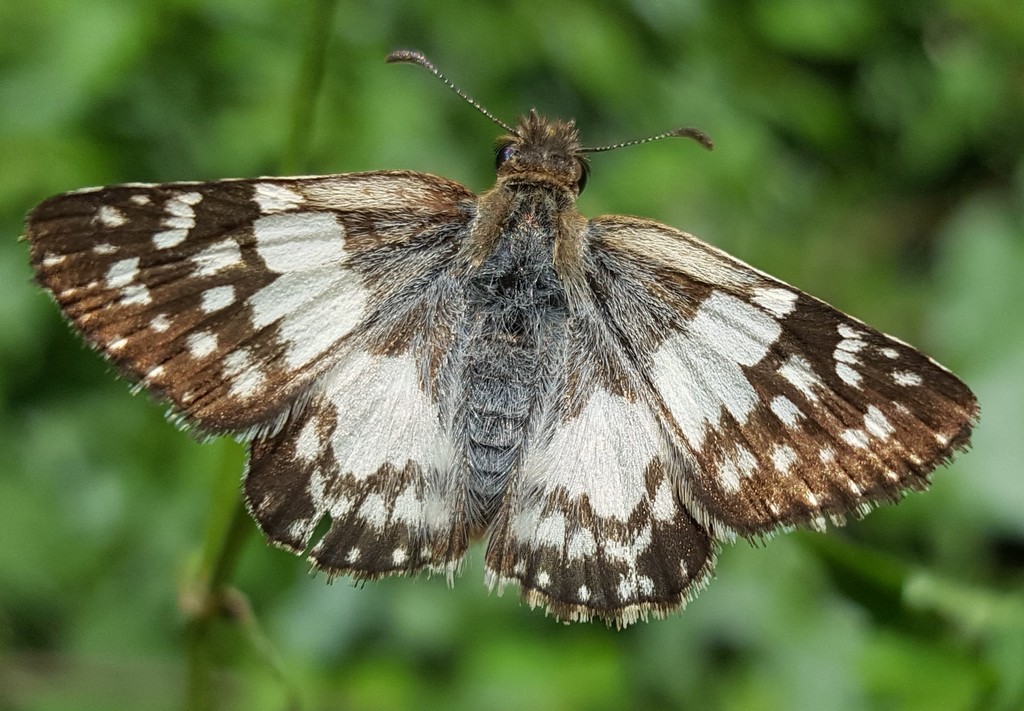
(c) alessandradalia, some rights reserved (CC BY-SA) · licence
Family: Hesperiidae · Class: Insecta · Order: Lepidoptera
Heliopyrgus domicella (Erichson's White-Skipper) is a California animal in the Hesperiidae family.
Erichson's White-Skipper is a small butterfly in the family Hesperiidae, characterized by its robust body and relatively broad wings typical of skipper butterflies. Adults have a wingspan of approximately 25-32 mm (1.0-1.3 inches). The dorsal wing surfaces are dark brown to black with distinctive white or cream-colored patches and spots. Males typically display more prominent white markings than females, particularly on the forewings. The ventral surfaces are lighter, often grayish-brown with pale spotting. The antennae are relatively short with hooked tips, and the body is thick and moth-like, distinguishing skippers from other butterfly families. Erichson's White-Skipper has a broad natural range extending from northern Mexico south through Central America to Argentina. The species appears as a regular stray north of its primary range, reaching southeastern California, southern Nevada, central Arizona, and central Texas. In California, documented occurrences are primarily in desert regions of Imperial, Riverside, and San Bernardino counties, typically during warmer months when atmospheric conditions favor northward dispersal. These vagrant populations do not establish permanent breeding colonies in California. The species inhabits tropical and subtropical regions, favoring areas with abundant flowering plants and appropriate larval host vegetation. In its native range, it occurs from sea level to moderate elevations in various habitat types including open woodlands, forest edges, scrublands, and disturbed areas with adequate nectar sources. Desert washes, riparian corridors, and agricultural edges provide suitable habitat for vagrant individuals reaching California. The species shows preference for areas with consistent moisture and diverse plant communities. Adult Erichson's White-Skippers are active during daylight hours, exhibiting the rapid, erratic flight pattern characteristic of Hesperiidae. They feed on nectar from various flowering plants, showing particular attraction to small, clustered flowers. Males establish territories in sunny areas and engage in patrolling behavior to locate females. Breeding occurs year-round in tropical portions of the range, with multiple generations annually. Host plants for larvae have not been definitively reported, though other Heliopyrgus species utilize various herbaceous plants and shrubs in families such as Malvaceae and Sterculiaceae. Eggs are laid singly on host plant leaves, and larvae construct shelters by folding or tying leaves together. Erichson's White-Skipper has no formal conservation status in California, as it is not considered a resident breeding species. The regular occurrence of strays suggests stable source populations in Mexico and Central America. Climate change may potentially alter dispersal patterns and the frequency of vagrant individuals reaching California. Habitat modification and agricultural intensification in source regions could affect population stability, though the species appears to tolerate some level of habitat disturbance. Conservation of riparian corridors and native plant communities in desert regions of southeastern California may benefit vagrant individuals during their temporary residence.
Classification
Class: Insecta · Order: Lepidoptera · Family: Hesperiidae
Frequently asked questions
How is Heliopyrgus domicella classified?
Heliopyrgus domicella belongs to class Insecta, order Lepidoptera, family Hesperiidae.
What family does Heliopyrgus domicella belong to?
Heliopyrgus domicella is in the Hesperiidae family.
What is Heliopyrgus domicella?
Erichson's White-Skipper is a small butterfly in the family Hesperiidae, characterized by its robust body and relatively broad wings typical of skipper butterflies.
Is Heliopyrgus domicella found in California?
Yes. Heliopyrgus domicella is recorded in California in The California Species Project's catalogue.
Related species
Other California species in the same genus, family, or bioregion.
Data from The California Species Project — 14,000+ California species with verified data from CNPS, CDFW, USFWS, and more.