Helminthoglypta sequoicola consors
Redwood Shoulderband
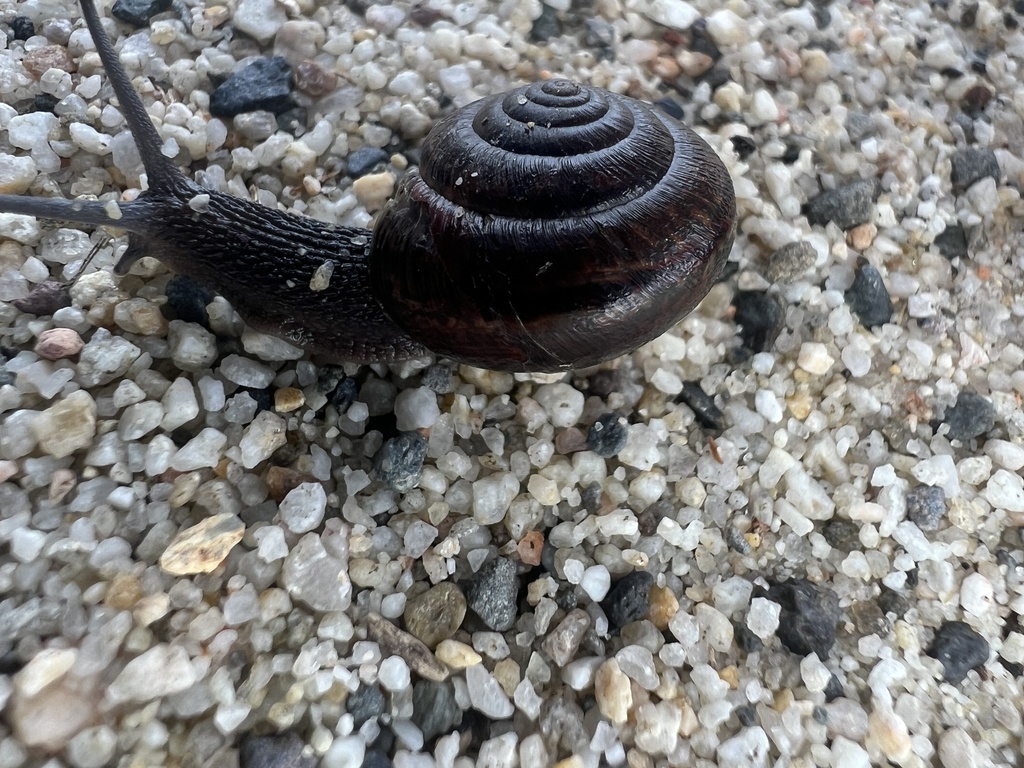
no rights reserved · CC0
Family: Helminthoglyptidae · Class: Gastropoda · Order: Stylommatophora
Conservation status: G2T1 S1
Helminthoglypta sequoicola consors (Redwood Shoulderband) is a California animal in the Helminthoglyptidae family.
The Redwood shoulderband (Helminthoglypta sequoicola consors) is a terrestrial gastropod mollusk endemic to California's coastal redwood forests. This subspecies belongs to the family Helminthoglyptidae, a group of air-breathing land snails native to western North America. Adult shells typically measure 15-25 mm in diameter and display the characteristic shoulderband pattern consisting of brown or reddish-brown spiral bands against a lighter background coloration. The Redwood shoulderband has an extremely restricted range within California's North Coast region. Historical records indicate the subspecies occurred in coastal redwood (Sequoia sempervirens) forests from southern Humboldt County to northern Mendocino County. Current populations are believed to exist in fewer than five locations, representing a significant reduction from the species' historical distribution. The subspecies is distinguished from the nominate form H. s. sequoicola by subtle shell morphology differences and its more northerly distribution. This subspecies inhabits the understory of mature coastal redwood forests, typically in areas with dense canopy cover that maintains cool, humid microclimate conditions year-round. The species shows strong association with specific microhabitat features including decaying logs, leaf litter accumulations, and areas with consistent moisture retention. Elevation ranges from near sea level to approximately 300 meters (984 feet) in the coastal fog belt. The subspecies appears to require the particular environmental conditions created by old-growth or mature second-growth redwood stands. Redwood shoulderbands are herbivorous, feeding primarily on decaying plant material, fungi, and occasionally fresh vegetation. Like other members of the genus, they are hermaphroditic but require cross-fertilization for reproduction. Breeding likely occurs during the wet season when moisture levels are optimal. The species exhibits typical gastropod reproductive behavior, with individuals depositing small clutches of eggs in protected locations within the leaf litter or soil. Activity patterns are strongly influenced by moisture availability, with increased activity during periods of high humidity and reduced activity during dry conditions. The Redwood shoulderband is classified as G2T1 S1 by NatureServe, indicating it is critically imperiled both globally and within California. The subspecies faces significant conservation challenges due to its extremely limited range and specialized habitat requirements. Primary threats include habitat loss and degradation from logging activities, even selective logging that alters forest structure and microclimate conditions. Climate change poses an additional threat through potential changes in coastal fog patterns and increased temperature extremes that could exceed the species' physiological tolerance limits. Urban development and recreational activities in coastal areas may impact remaining habitat fragments. The species' small population size makes it particularly vulnerable to stochastic events and genetic bottlenecks. No specific conservation measures are currently in place for this subspecies, though protection of remaining old-growth and mature redwood forests would benefit this and other endemic species dependent on these increasingly rare ecosystems.
Classification
Class: Gastropoda · Order: Stylommatophora · Family: Helminthoglyptidae
Conservation status
G2T1 S1
Frequently asked questions
How is Helminthoglypta sequoicola consors classified?
Helminthoglypta sequoicola consors belongs to class Gastropoda, order Stylommatophora, family Helminthoglyptidae.
What family does Helminthoglypta sequoicola consors belong to?
Helminthoglypta sequoicola consors is in the Helminthoglyptidae family.
Is Helminthoglypta sequoicola consors protected or of conservation concern?
Helminthoglypta sequoicola consors carries the following status: G2T1 S1.
What is Helminthoglypta sequoicola consors?
The Redwood shoulderband (Helminthoglypta sequoicola consors) is a terrestrial gastropod mollusk endemic to California's coastal redwood forests.
Is Helminthoglypta sequoicola consors found in California?
Yes. Helminthoglypta sequoicola consors is recorded in California in The California Species Project's catalogue.
Related species
Other California species in the same genus, family, or bioregion.
Data from The California Species Project — 14,000+ California species with verified data from CNPS, CDFW, USFWS, and more.