Helmitheros vermivorum
Worm-eating Warbler
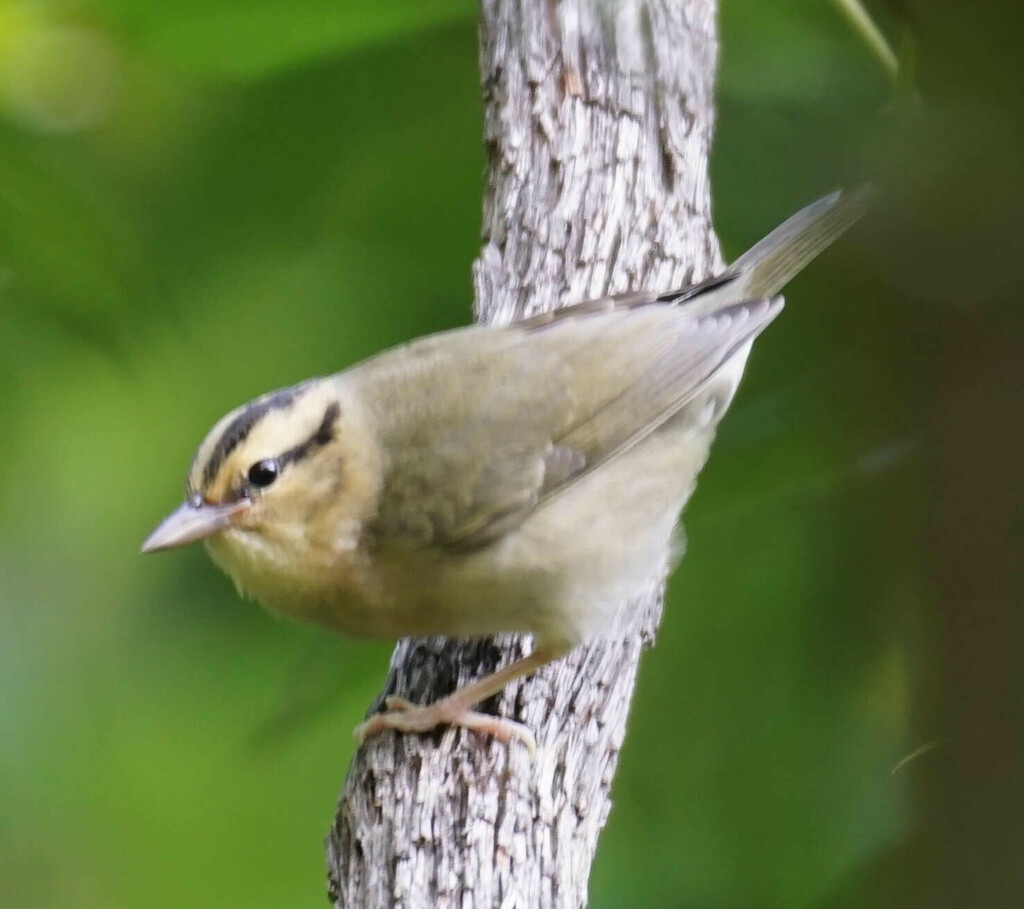
(c) Carrie Seltzer, some rights reserved (CC BY) · licence
Family: Parulidae · Class: Aves · Order: Passeriformes
Helmitheros vermivorum (Worm-eating Warbler) is a California animal in the Parulidae family.
The Worm-eating Warbler is a medium-sized songbird measuring 13 to 14 cm (5.1 to 5.5 inches) in length with a wingspan of 19 to 21 cm (7.5 to 8.3 inches). Adults weigh 13 to 15 grams (0.46 to 0.53 ounces). The species exhibits subtle but distinctive plumage with a brownish-olive back and wings, pale buff underparts, and a boldly striped head pattern. The crown and nape are buff with two distinct dark brown stripes, while a prominent dark eyeline extends from the bill through the eye to the nape. A pale supercilium contrasts with the dark eyeline. The bill is relatively long, straight, and pointed, adapted for probing into dead leaf clusters. Both sexes appear similar, though males may show slightly brighter plumage during breeding season. The Worm-eating Warbler breeds primarily in the eastern United States, from southern New York and southern New England west to southeastern Iowa and eastern Kansas, and south to northern Georgia and eastern Texas. The species winters in Central America and the Caribbean, from southern Mexico through Guatemala, Belize, Honduras, and the Greater Antilles. In California, the Worm-eating Warbler is an extremely rare vagrant, with fewer than 10 documented records statewide. Most California observations have occurred during fall migration along the coast, particularly in Point Reyes National Seashore and other coastal locations in Marin and San Francisco counties. Breeding habitat consists of mature deciduous and mixed forests with dense understory vegetation, typically on hillsides and slopes with 40 to 75 percent canopy cover. The species shows preference for areas with abundant leaf litter and dead leaf clusters hanging from branches, which serve as foraging sites. Elevation ranges from sea level to approximately 1,200 meters (3,937 feet) in Appalachian regions. During migration and winter, the species utilizes similar forested habitats including coffee plantations and mature secondary growth forests. Worm-eating Warblers are specialized insectivores that glean prey from dead leaf clusters, bark crevices, and live foliage. Despite their name, they primarily consume caterpillars, moths, beetles, and other small arthropods rather than earthworms. The species exhibits unique foraging behavior, systematically searching dead leaves by inserting their bills into curled leaf clusters and extracting hidden insects. Breeding occurs from May through July, with females constructing cup-shaped nests on the ground under dense vegetation or fallen logs. Clutches typically contain 4 to 5 white eggs with brown spotting. Incubation lasts 13 days, performed solely by females, while both parents feed nestlings for 10 to 11 days until fledging. The Worm-eating Warbler is not federally listed but has experienced population declines across portions of its breeding range due to habitat loss and forest fragmentation. Breeding Bird Survey data indicates a decline of approximately 1.5 percent annually since 1966. Primary threats include deforestation on wintering grounds, particularly in Central America, and loss of mature forest habitat in breeding areas due to development and intensive forest management. Climate change may affect the species through shifts in forest composition and prey availability. Conservation efforts focus on protecting large blocks of mature forest habitat and promoting sustainable forestry practices that maintain dense understory vegetation.
Classification
Class: Aves · Order: Passeriformes · Family: Parulidae
Frequently asked questions
How is Helmitheros vermivorum classified?
Helmitheros vermivorum belongs to class Aves, order Passeriformes, family Parulidae.
What family does Helmitheros vermivorum belong to?
Helmitheros vermivorum is in the Parulidae family.
What is Helmitheros vermivorum?
The Worm-eating Warbler is a medium-sized songbird measuring 13 to 14 cm (5.1 to 5.5 inches) in length with a wingspan of 19 to 21 cm (7.5 to 8.3 inches).
Is Helmitheros vermivorum found in California?
Yes. Helmitheros vermivorum is recorded in California in The California Species Project's catalogue.
Related species
Other California species in the same genus, family, or bioregion.
Data from The California Species Project — 14,000+ California species with verified data from CNPS, CDFW, USFWS, and more.