Heloderma suspectum
Gila Monster
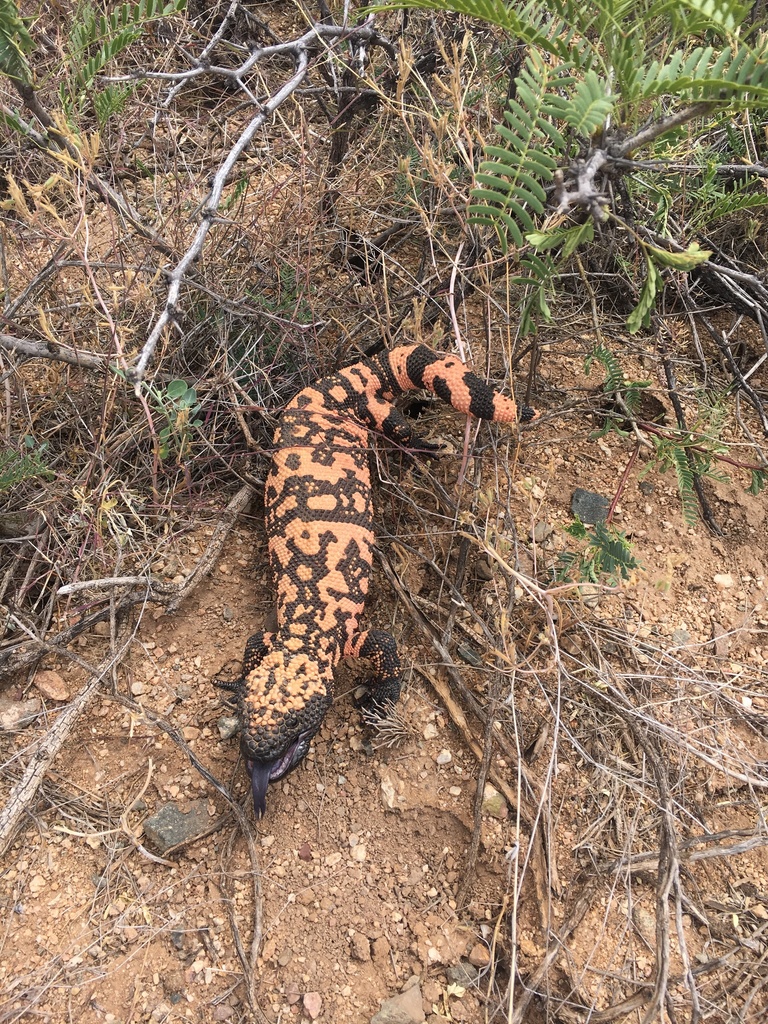
(c) Matt Berger, some rights reserved (CC BY) · licence
Family: Helodermatidae · Class: Reptilia · Order: Squamata
Heloderma suspectum (Gila Monster) is a California animal in the Helodermatidae family.
The Gila monster is North America's largest native venomous lizard, reaching lengths of 35 to 60 cm (14 to 24 inches) and weighing up to 2.3 kg (5 pounds). The species displays distinctive black and pink, orange, or yellow banded patterns across its thick, cylindrical body. The skin is covered in small, bead-like scales called osteoderms, which give the animal a rough, tuberculated texture. The head is broad and triangular, with small black eyes and a forked tongue used for chemical detection. The tail is thick and serves as a fat storage organ, becoming noticeably swollen in well-fed individuals. Historically, Gila monsters ranged across the Sonoran and Mohave deserts of southwestern United States and northwestern Mexico. In California, the species occurs in the extreme southeastern corner, primarily in Imperial and eastern Riverside counties. The range extends into the Chocolate Mountains, Chuckwalla Mountains, and areas adjacent to the Colorado River. Current distribution in California is limited and fragmented compared to historical records. Gila monsters inhabit desert scrubland, semi-arid grasslands, and oak woodland at elevations from sea level to approximately 1,500 meters (4,900 feet). They prefer areas with rocky outcrops, washes, and bajadas that provide shelter and foraging opportunities. The species requires access to underground refugia, including rock crevices, burrows, and packrat middens, where they spend up to 95% of their time. Suitable habitat includes areas with adequate prey density and thermal regulation opportunities. Gila monsters are primarily active during spring and early summer, with peak activity occurring from April through June when temperatures are moderate. They are opportunistic predators, feeding mainly on eggs and nestling birds, small mammals, and other reptile eggs. The species possesses a powerful bite and delivers venom through grooved teeth in the lower jaw. Mating occurs in spring, with females laying 2 to 12 leathery eggs in underground nests during summer. Eggs incubate for 9 to 10 months, with young emerging the following spring. Adults may live 20 years or more in the wild. The Gila monster receives protection under various state regulations throughout its range. In California, it is considered a species of special concern due to habitat loss, collection pressure, and limited distribution. Primary threats include urban development, recreational activities, vehicle mortality, and illegal collection for the pet trade. Climate change poses additional challenges through altered precipitation patterns and increased temperatures. The species benefits from habitat protection measures and education programs that reduce human-wildlife conflicts. Recovery efforts focus on habitat conservation, monitoring programs, and enforcement of collection prohibitions.
Classification
Class: Reptilia · Order: Squamata · Family: Helodermatidae
Frequently asked questions
How is Heloderma suspectum classified?
Heloderma suspectum belongs to class Reptilia, order Squamata, family Helodermatidae.
What family does Heloderma suspectum belong to?
Heloderma suspectum is in the Helodermatidae family.
What is Heloderma suspectum?
The Gila monster is North America's largest native venomous lizard, reaching lengths of 35 to 60 cm (14 to 24 inches) and weighing up to 2.3 kg (5 pounds).
Is Heloderma suspectum found in California?
Yes. Heloderma suspectum is recorded in California in The California Species Project's catalogue.
Related species
Other California species in the same genus, family, or bioregion.
Data from The California Species Project — 14,000+ California species with verified data from CNPS, CDFW, USFWS, and more.