Hemaris thetis
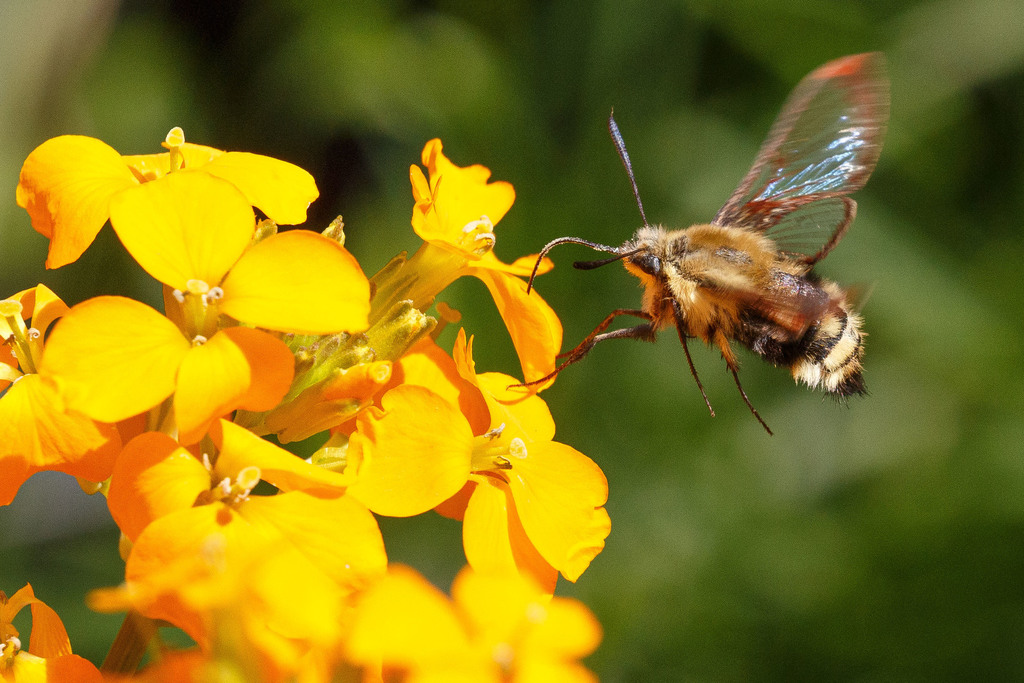
(c) Jeff Bartlett, some rights reserved (CC BY) · licence
Family: Sphingidae · Class: Insecta · Order: Lepidoptera
Hemaris thetis is a California animal in the Sphingidae family.
Hemaris thetis, commonly known as the Rocky Mountain clearwing or western hummingbird clearwing, is a day-flying moth in the family Sphingidae. Adults have a wingspan of 38 to 50 mm (1.5 to 2.0 inches) and exhibit the characteristic clear wings that give clearwing moths their name. The forewings are largely transparent with dark reddish-brown borders, while the hindwings are completely clear with narrow dark margins. The body is robust and covered in dense olive-green to yellowish-green scales on the thorax, with a distinctive reddish-brown band across the abdomen. The antennae are clubbed and slightly hooked at the tips, distinguishing this species from true hummingbirds during flight. Hemaris thetis occurs west of the Continental Divide across much of western North America. The species ranges from British Columbia and Alberta south through Washington, Oregon, Idaho, Montana, Wyoming, Colorado, Utah, Nevada, and into northern California and Arizona. In some locations just east of the Continental Divide, particularly in Colorado and Alberta, H. thetis overlaps with the closely related Hemaris diffinis, creating zones of potential hybridization or competitive interaction. This species inhabits a variety of montane and subalpine ecosystems, typically at elevations between 1,200 and 3,000 meters (4,000 to 10,000 feet). Preferred habitats include mountain meadows, forest clearings, riparian zones, and gardens within coniferous forest landscapes. Adults are commonly observed in areas with abundant flowering plants, particularly where their host plants and nectar sources co-occur. Adult Hemaris thetis are active during daylight hours, typically flying from late morning through early afternoon when temperatures are optimal. They exhibit rapid, hovering flight patterns similar to hummingbirds while feeding on nectar from various flowering plants including lilacs, honeysuckle, and native wildflowers. Larvae feed primarily on plants in the family Caprifoliaceae, including snowberry (Symphoricarpos species), honeysuckle (Lonicera species), and elderberry (Sambucus species). The species is univoltine in most of its range, producing one generation per year. Adults emerge from May through August depending on elevation and local climate conditions. Mating occurs soon after emergence, with females depositing single eggs on the undersides of host plant leaves. Larvae develop through five instars before pupating in the soil. Hemaris thetis does not currently hold any federal or state conservation status listings. Population trends are not well documented, but the species appears to maintain stable populations across much of its range. Primary threats may include habitat fragmentation from development in mountain valleys, climate change effects on montane ecosystems, and potential impacts from forest management practices. The species' dependence on native Caprifoliaceae plants makes it potentially vulnerable to invasive plant species that alter understory plant communities in forested habitats.
Classification
Class: Insecta · Order: Lepidoptera · Family: Sphingidae
Frequently asked questions
How is Hemaris thetis classified?
Hemaris thetis belongs to class Insecta, order Lepidoptera, family Sphingidae.
What family does Hemaris thetis belong to?
Hemaris thetis is in the Sphingidae family.
What is Hemaris thetis?
Hemaris thetis, commonly known as the Rocky Mountain clearwing or western hummingbird clearwing, is a day-flying moth in the family Sphingidae.
Is Hemaris thetis found in California?
Yes. Hemaris thetis is recorded in California in The California Species Project's catalogue.
Related species
Other California species in the same genus, family, or bioregion.
Data from The California Species Project — 14,000+ California species with verified data from CNPS, CDFW, USFWS, and more.