Hemiargus ceraunus
Ceraunus Blue
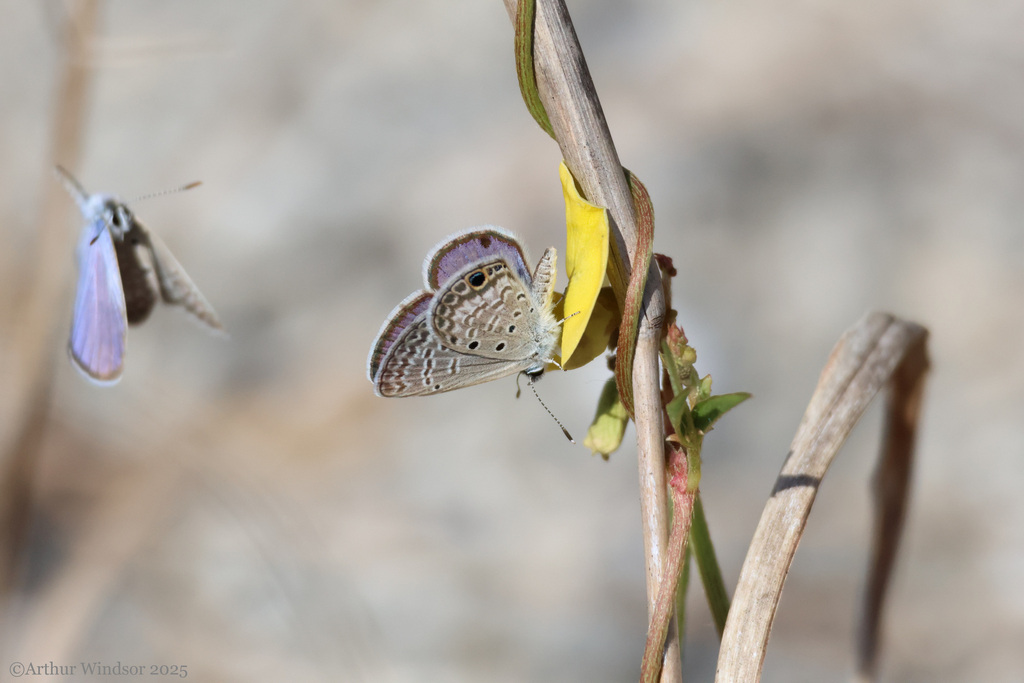
(c) Arthur Windsor, some rights reserved (CC BY) · licence
Family: Lycaenidae · Class: Insecta · Order: Lepidoptera
Hemiargus ceraunus (Ceraunus Blue) is a California animal in the Lycaenidae family.
The Ceraunus Blue (Hemiargus ceraunus) is a small butterfly in the family Lycaenidae with a wingspan ranging from 18 to 25 mm (0.7 to 1.0 inches). Males display bright blue dorsal wing surfaces with narrow black borders, while females are grayish-brown above with blue scaling limited to the wing bases. The ventral surfaces of both sexes are pale gray to white with scattered dark spots and distinctive orange crescents along the hindwing margins. A small tail-like projection extends from each hindwing, characteristic of many hairstreak and blue butterflies. The species can be distinguished from similar blues by its specific wing pattern and the presence of orange markings on the hindwing undersides. The Ceraunus Blue ranges throughout the U.S. Southwest, South Texas, Florida and the Keys, extending south through the West Indies, Mexico, and Central America to South America. The species occasionally strays north to North Carolina, Missouri, Kansas, and Nevada. In California, records are primarily from the southeastern desert regions, though the species appears to be primarily a vagrant rather than a resident breeder in the state. The butterfly's range has expanded northward in recent decades, likely due to climate change and habitat modification. This species inhabits open, disturbed areas including roadsides, vacant lots, agricultural edges, and desert washes where host plants occur. Ceraunus Blues prefer sunny locations with scattered shrubs and trees, typically at elevations below 1,500 meters (4,900 feet). The butterflies are most commonly found in areas with abundant flowering plants that provide nectar sources for adults. Ceraunus Blues utilize a variety of woody legumes as larval host plants, including partridge pea (Cassia brachiata), mesquite (Prosopis species), and rosary pea (Abrus precatorius). Females deposit single white eggs on flower buds, young leaves, or stems of host plants. Larvae are green with diagonal white stripes and feed on flowers, young leaves, and developing seed pods. The species is multivoltine in warmer climates, producing multiple generations per year with continuous breeding activity when conditions are favorable. Adults are active year-round in southern portions of their range, with peak abundance typically occurring during warmer months. Males are territorial and engage in perching behavior, selecting prominent locations to await passing females. The Ceraunus Blue is not federally or state-listed and appears to have stable populations throughout most of its range. The species benefits from human-modified landscapes and the widespread distribution of its leguminous host plants. Climate change may facilitate continued range expansion northward, though the species remains primarily tropical and subtropical in distribution. Populations can fluctuate significantly in response to rainfall patterns and host plant availability, particularly in arid regions where breeding success depends on seasonal precipitation.
Classification
Class: Insecta · Order: Lepidoptera · Family: Lycaenidae
Frequently asked questions
How is Hemiargus ceraunus classified?
Hemiargus ceraunus belongs to class Insecta, order Lepidoptera, family Lycaenidae.
What family does Hemiargus ceraunus belong to?
Hemiargus ceraunus is in the Lycaenidae family.
What is Hemiargus ceraunus?
The Ceraunus Blue (Hemiargus ceraunus) is a small butterfly in the family Lycaenidae with a wingspan ranging from 18 to 25 mm (0.7 to 1.0 inches).
Is Hemiargus ceraunus found in California?
Yes. Hemiargus ceraunus is recorded in California in The California Species Project's catalogue.
Related species
Other California species in the same genus, family, or bioregion.
Data from The California Species Project — 14,000+ California species with verified data from CNPS, CDFW, USFWS, and more.