Hemidactylus turcicus
Mediterranean House Gecko
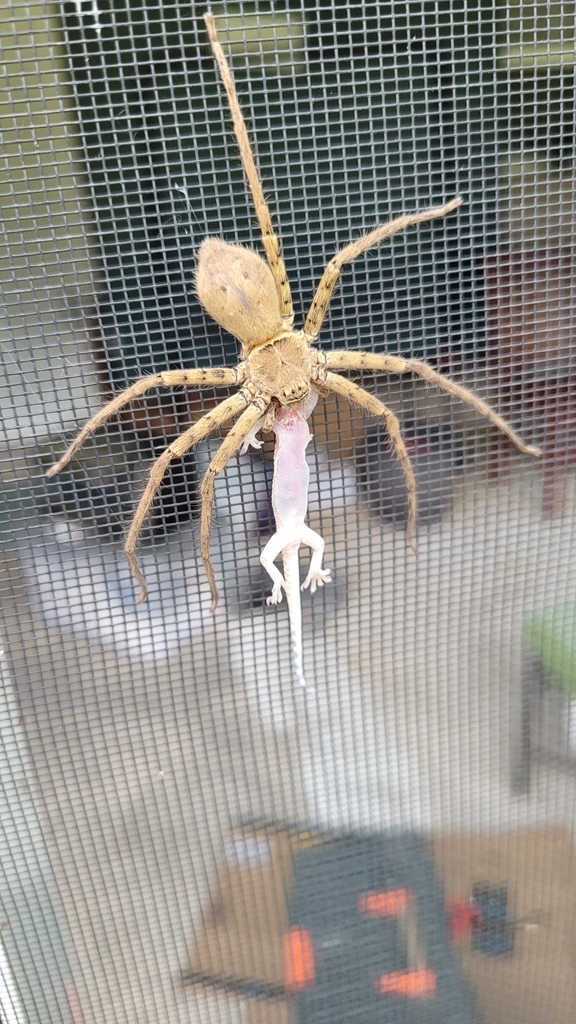
(c) Court Harding, some rights reserved (CC BY) · licence
Family: Gekkonidae · Class: Reptilia · Order: Squamata
Hemidactylus turcicus (Mediterranean House Gecko) is a California animal in the Gekkonidae family.
The Mediterranean house gecko is a small, nocturnal lizard measuring 75 to 120 mm (3.0 to 4.7 inches) in total length, with the tail comprising approximately half the body length. Adults typically weigh 2 to 5 grams. The species displays a flattened body with granular dorsal scales and a pale gray to pinkish-brown coloration marked by darker tubercles and occasional banding patterns. The ventral surface is cream to white. Distinctive features include large, prominent eyes with vertical pupils, lack of eyelids, and specialized toe pads bearing microscopic hairs called setae that enable climbing on smooth vertical surfaces. Native to the Mediterranean Basin and southwestern Asia, the Mediterranean house gecko has established populations throughout California following introductions beginning in the mid-20th century. The species now occurs in urban and suburban areas across much of southern California, including Los Angeles, Orange, Riverside, San Bernardino, and San Diego counties. Northern populations exist in the San Francisco Bay Area and Central Valley. Established populations also occur in coastal areas of central California. This species demonstrates strong association with human-modified environments, particularly residential areas, commercial buildings, and urban landscapes. Mediterranean house geckos inhabit structures including houses, garages, warehouses, and outdoor lighting fixtures. They prefer areas with artificial lighting that attracts insect prey. The species tolerates a wide range of climatic conditions but requires shelter during cooler periods. In California, they occupy elevations from sea level to approximately 500 meters (1,640 feet). Mediterranean house geckos are strictly nocturnal, becoming active shortly after sunset to hunt insects attracted to artificial lights. Their diet consists primarily of moths, flies, mosquitoes, beetles, and other small arthropods. Prey is captured using a rapid tongue projection. The species exhibits territorial behavior, with males producing distinctive chirping vocalizations during breeding season and territorial disputes. Reproduction occurs from spring through early fall in California. Females deposit clutches of one to two hard-shelled eggs in protected locations such as cracks in walls, under roof tiles, or behind outdoor fixtures. Incubation periods range from 45 to 60 days depending on temperature. Juveniles reach sexual maturity at approximately one year of age. The Mediterranean house gecko is not federally or state-listed in California and faces no significant conservation concerns. As an introduced species, it is considered established rather than invasive, showing limited impact on native gecko species due to its preference for human-modified habitats. The species benefits from urban development and artificial lighting, which provide abundant prey resources. Population trends appear stable to increasing in established areas. Climate change may facilitate range expansion into cooler regions of California as temperatures increase. The species' adaptability to urban environments and broad diet suggest continued population stability.
Classification
Class: Reptilia · Order: Squamata · Family: Gekkonidae
Frequently asked questions
How is Hemidactylus turcicus classified?
Hemidactylus turcicus belongs to class Reptilia, order Squamata, family Gekkonidae.
What family does Hemidactylus turcicus belong to?
Hemidactylus turcicus is in the Gekkonidae family.
What is Hemidactylus turcicus?
The Mediterranean house gecko is a small, nocturnal lizard measuring 75 to 120 mm (3.0 to 4.7 inches) in total length, with the tail comprising approximately half the body length.
Is Hemidactylus turcicus found in California?
Yes. Hemidactylus turcicus is recorded in California in The California Species Project's catalogue.
Related species
Other California species in the same genus, family, or bioregion.
Data from The California Species Project — 14,000+ California species with verified data from CNPS, CDFW, USFWS, and more.