Hemigrapsus nudus
Purple Shore Crab
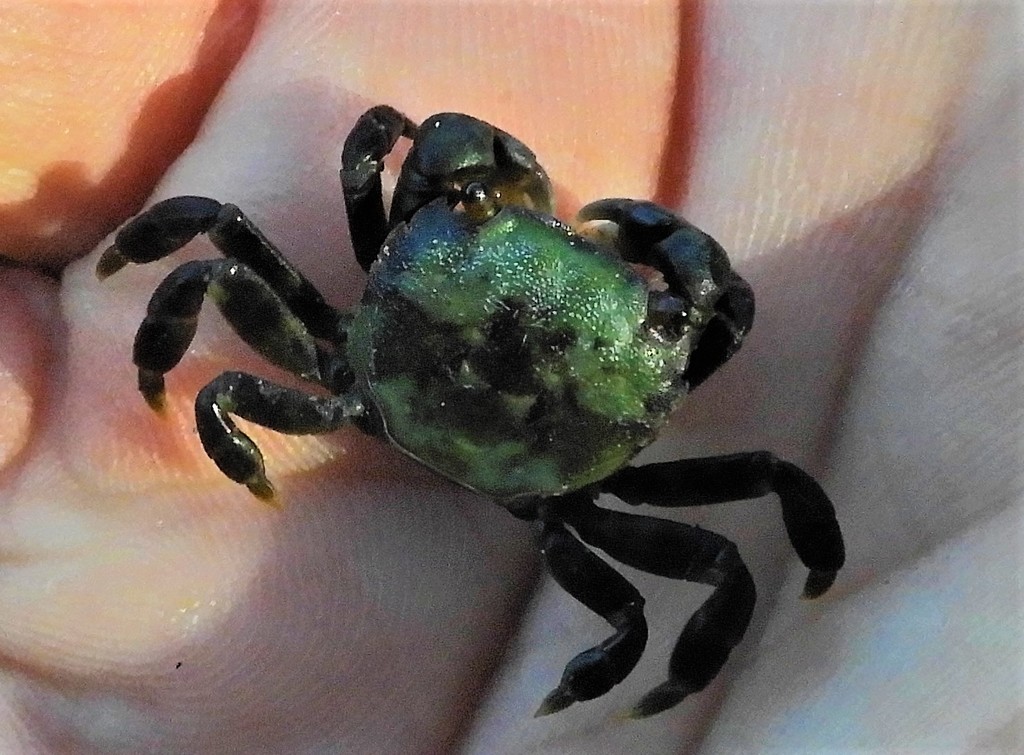
no rights reserved · CC0
Family: Varunidae · Class: Malacostraca · Order: Decapoda
Hemigrapsus nudus (Purple Shore Crab) is a California animal in the Varunidae family.
The purple shore crab is a small, robust decapod crustacean native to the northeastern Pacific coast. Adults typically measure 25 to 56 mm (1.0 to 2.2 inches) in carapace width, with males generally larger than females. The carapace is squarish to slightly rectangular, wider than it is long, with a smooth surface and moderately curved front margin. Coloration varies considerably, ranging from purple, reddish-brown, olive green, to nearly black on the dorsal surface, while the ventral surface is typically lighter. The legs are often banded with purple and white or yellow markings, giving the species its common name. Unlike many shore crabs, H. nudus lacks setae (hairs) on its legs and carapace, reflected in its specific epithet "nudus" meaning naked. Purple shore crabs occur along the Pacific coast from Alaska to Baja California, Mexico, with populations documented throughout California's marine waters. The species inhabits rocky intertidal zones, tide pools, and areas with mixed sand and rock substrates. They are commonly found in Carmel Bay and other central California marine protected areas, occupying both exposed and semi-protected shorelines from the splash zone to depths of approximately 146 meters (480 feet). This species demonstrates broad habitat tolerance, withstanding a wide range of salinity levels from fully marine to brackish conditions (Kozloff 1993). Purple shore crabs prefer areas with crevices, under rocks, and among algae where they can find shelter during low tide. They are well-adapted to the harsh intertidal environment, capable of withstanding exposure to air for extended periods and rapid changes in temperature and salinity. Purple shore crabs are opportunistic omnivores with a diverse diet including algae, small invertebrates, detritus, and occasionally carrion (Morris et al. 1980). They are active foragers, using their chelae (claws) to scrape algae from rocks and capture prey. The species exhibits complex social behaviors, including aggressive interactions over territory and resources (Behrens Yamada & Boulding 1998). Reproduction occurs through internal fertilization, with females carrying eggs externally until hatching. Larvae undergo several planktonic stages before settling and metamorphosing into juvenile crabs. Mating typically occurs after the female molts, when her exoskeleton is still soft (Jensen 1995). Females can produce multiple broods per year under favorable conditions. The species shows seasonal activity patterns, with peak activity during warmer months and reduced activity during winter. Currently, Hemigrapsus nudus has no special conservation status at federal or state levels, reflecting its stable populations and wide distribution. The species appears resilient to moderate environmental perturbations and maintains healthy populations throughout its range. However, like many intertidal species, purple shore crabs face potential threats from coastal development, pollution, ocean acidification, and climate change effects on their rocky shore habitats. Their presence in California's marine protected areas provides some protection for local populations and helps maintain the ecological integrity of intertidal communities where they serve as both predators and prey.
Classification
Class: Malacostraca · Order: Decapoda · Family: Varunidae
Frequently asked questions
How is Hemigrapsus nudus classified?
Hemigrapsus nudus belongs to class Malacostraca, order Decapoda, family Varunidae.
What family does Hemigrapsus nudus belong to?
Hemigrapsus nudus is in the Varunidae family.
What is Hemigrapsus nudus?
The purple shore crab is a small, robust decapod crustacean native to the northeastern Pacific coast.
Is Hemigrapsus nudus found in California?
Yes. Hemigrapsus nudus is recorded in California in The California Species Project's catalogue.
Related species
Other California species in the same genus, family, or bioregion.
Data from The California Species Project — 14,000+ California species with verified data from CNPS, CDFW, USFWS, and more.