Hemileuca burnsi
Burns' buckmoth
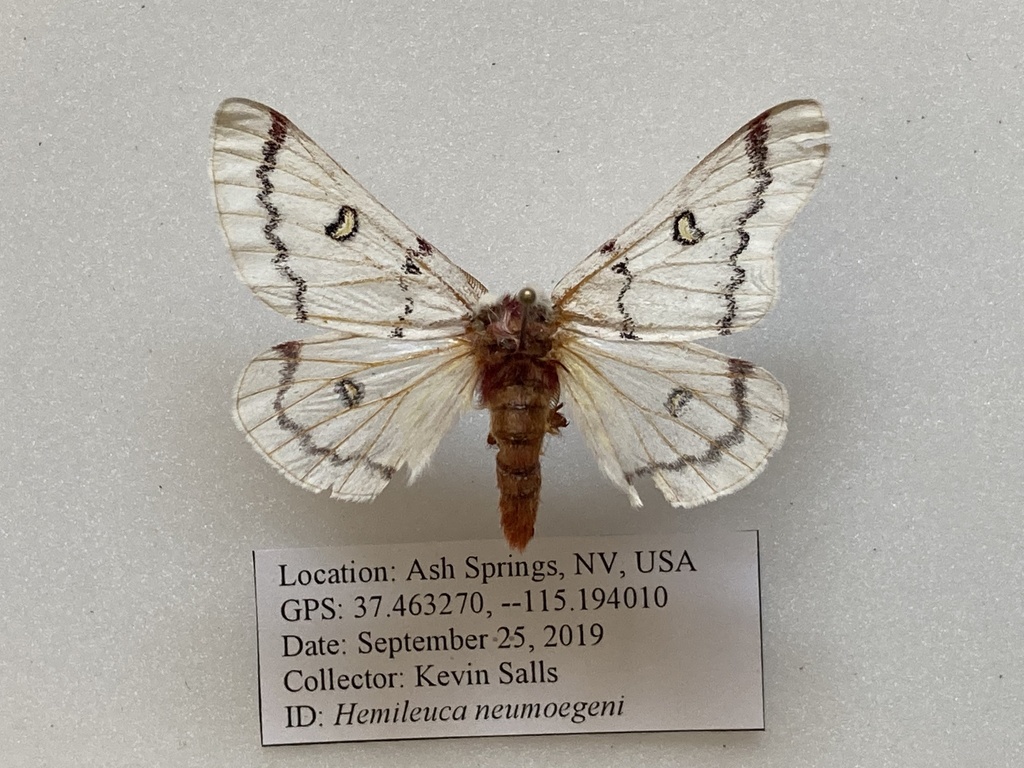
(c) Kevin Salls, some rights reserved (CC BY) · licence
Family: Saturniidae · Class: Insecta · Order: Lepidoptera
Hemileuca burnsi (Burns' buckmoth) is a California animal in the Saturniidae family.
Burns' buckmoth is a medium-sized moth in the family Saturniidae, endemic to the southwestern United States desert regions. Adults exhibit sexual dimorphism in wing coloration and pattern. Males typically display reddish-brown to orange-brown forewings with darker bands and prominent white spots, while females are generally larger with more subdued brown coloration. The wingspan ranges from 50 to 75 mm (2.0 to 3.0 inches). Both sexes possess feathery antennae, though males have more elaborate, heavily branched antennae used for detecting female pheromones. The hindwings feature distinctive eyespots with white centers surrounded by black rings. Burns' buckmoth occurs in the Mojave Desert of California, southern Nevada, southwestern Utah, and northwestern Arizona. In California, the species is documented from desert regions including the Mojave National Preserve and surrounding areas. The distribution follows the range of its host plants across the Great Basin and Mojave Desert ecosystems. Historical records suggest the species may have had a broader distribution before habitat modification in some areas. The species inhabits arid desert scrubland and sagebrush communities at elevations typically ranging from 900 to 1,800 meters (2,950 to 5,900 feet). Burns' buckmoth is closely associated with shrubland dominated by its host plants: longspine horsebrush (Tetradymia axillaris), littleleaf horsebrush (T. glabrata), Fremont indigo bush (Dalea fremontii), and desert almond (Prunus fasciculata). These habitats are characterized by sparse vegetation, sandy or rocky soils, and low annual precipitation of 125 to 250 mm (5 to 10 inches). Adults are active during late summer and early fall, typically emerging in August and September. Males fly during daylight hours searching for females, which release pheromones to attract mates. After mating, females deposit eggs on or near host plant stems. Larvae feed exclusively on the foliage of the host plants, developing through five instars before pupating in the soil. The species completes one generation per year, with pupae overwintering underground for approximately 10 to 11 months. Caterpillars are equipped with urticating spines that can cause skin irritation in humans, a defensive adaptation common among Saturniidae. Burns' buckmoth does not appear on federal or state endangered species lists, though comprehensive population surveys are limited. The species faces potential threats from habitat loss due to urban development, off-road vehicle use, and energy development projects in desert regions. Climate change may affect the distribution and phenology of both the moth and its host plants. Solar and wind energy installations in the Mojave Desert could impact local populations through direct habitat conversion. The species' dependence on specific host plants makes it vulnerable to changes in plant community composition. Conservation efforts would benefit from habitat protection and monitoring programs to assess population trends across the species' range.
Classification
Class: Insecta · Order: Lepidoptera · Family: Saturniidae
Frequently asked questions
How is Hemileuca burnsi classified?
Hemileuca burnsi belongs to class Insecta, order Lepidoptera, family Saturniidae.
What family does Hemileuca burnsi belong to?
Hemileuca burnsi is in the Saturniidae family.
What is Hemileuca burnsi?
Burns' buckmoth is a medium-sized moth in the family Saturniidae, endemic to the southwestern United States desert regions.
Is Hemileuca burnsi found in California?
Yes. Hemileuca burnsi is recorded in California in The California Species Project's catalogue.
Related species
Other California species in the same genus, family, or bioregion.
Data from The California Species Project — 14,000+ California species with verified data from CNPS, CDFW, USFWS, and more.