Hemileuca electra
Electra buckmoth
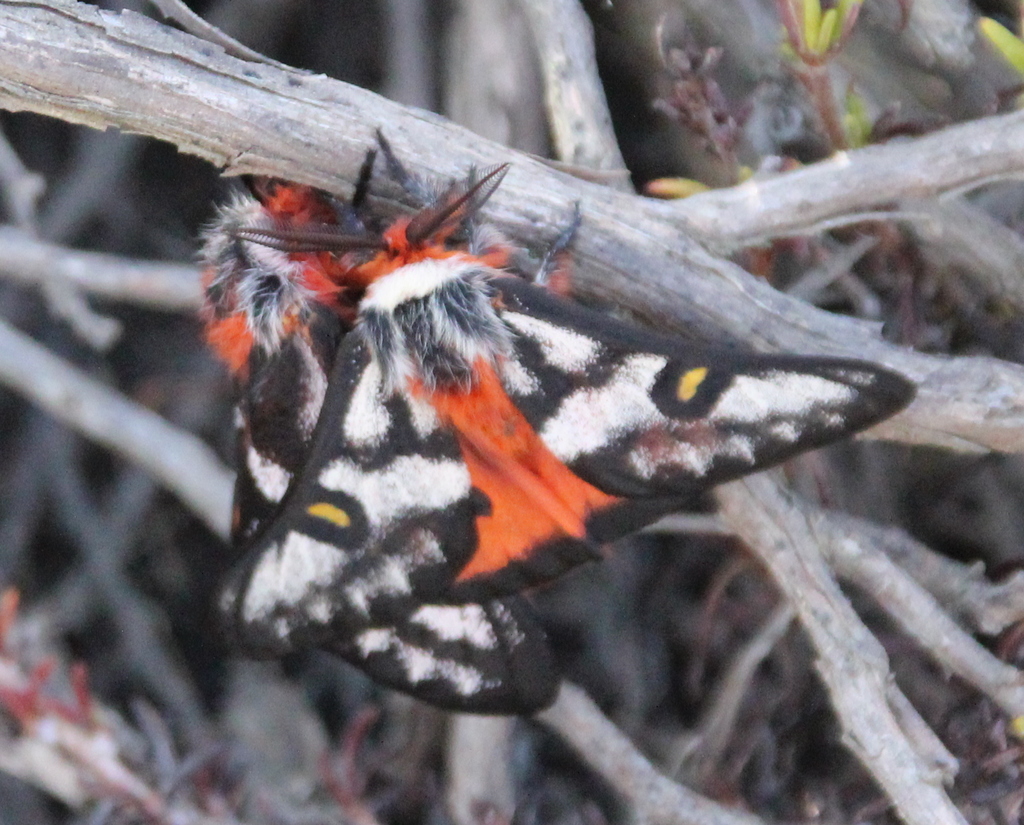
(c) Millie Basden, some rights reserved (CC BY) · licence
Family: Saturniidae · Class: Insecta · Order: Lepidoptera
Hemileuca electra (Electra buckmoth) is a California animal in the Saturniidae family.
The Electra buckmoth (Hemileuca electra) is a medium-sized moth in the family Saturniidae, characterized by distinctive wing patterns and coloration. Adults have a wingspan ranging from 70 to 90 mm (2.8 to 3.5 inches). The forewings are orange-red to reddish-brown with black markings, while the hindwings display similar coloration with prominent eyespots. Males typically have more feathered antennae and are smaller than females. The body is stout and densely covered with hair-like scales. Larvae are gregarious caterpillars covered in branched spines and exhibit warning coloration with black bodies and orange or yellow markings. The species ranges across the southwestern United States and northwestern Mexico, occurring in southwestern Utah, southeastern Nevada, and northwestern Arizona south to central Arizona, southern California, and Baja California Sur. Within California, populations are documented in the Mojave Desert region and adjacent areas where suitable host plants occur. The distribution closely follows the range of its primary host plants across desert and semi-arid environments. Electra buckmoths inhabit desert scrubland and chaparral communities at elevations typically ranging from 300 to 1,500 meters (980 to 4,920 feet). The species requires areas with established populations of its host plants, flat top buckwheat (Eriogonum fasciculatum) and Eastern Mojave buckwheat (Eriogonum fasciculatum polifolium). These moths are found in washes, canyon bottoms, and slopes where buckwheat shrubs form dense stands. The habitat is characterized by well-drained soils, moderate to low rainfall, and temperature extremes typical of desert environments. Electra buckmoths are univoltine, producing one generation per year. Adults emerge in late summer and fall, typically from August through October, coinciding with the flowering period of host plants. Mating occurs shortly after emergence, with females laying eggs in clusters on buckwheat stems and leaves. Eggs overwinter and hatch in spring when new growth appears on host plants. Larvae feed gregariously in early instars, becoming more solitary as they mature through five or six molts. Pupation occurs in the soil, with pupae entering diapause during hot summer months. Adults are primarily nocturnal and are attracted to lights. Males locate females through pheromone detection using their highly developed antennae. The Electra buckmoth is not federally listed or state-listed in California as of December 2025. However, like many desert specialist species, populations may face pressure from habitat loss due to urban development, off-road vehicle use, and invasive plant species that displace native buckwheat communities. Climate change may also affect the synchronization between larval emergence and host plant phenology. The species' dependence on specific host plants makes it vulnerable to any factors that reduce buckwheat populations or alter their distribution patterns across the southwestern deserts.
Classification
Class: Insecta · Order: Lepidoptera · Family: Saturniidae
Frequently asked questions
How is Hemileuca electra classified?
Hemileuca electra belongs to class Insecta, order Lepidoptera, family Saturniidae.
What family does Hemileuca electra belong to?
Hemileuca electra is in the Saturniidae family.
What is Hemileuca electra?
The Electra buckmoth (Hemileuca electra) is a medium-sized moth in the family Saturniidae, characterized by distinctive wing patterns and coloration.
Is Hemileuca electra found in California?
Yes. Hemileuca electra is recorded in California in The California Species Project's catalogue.
Related species
Other California species in the same genus, family, or bioregion.
Data from The California Species Project — 14,000+ California species with verified data from CNPS, CDFW, USFWS, and more.