Hemileuca hera
Hera buckmoth
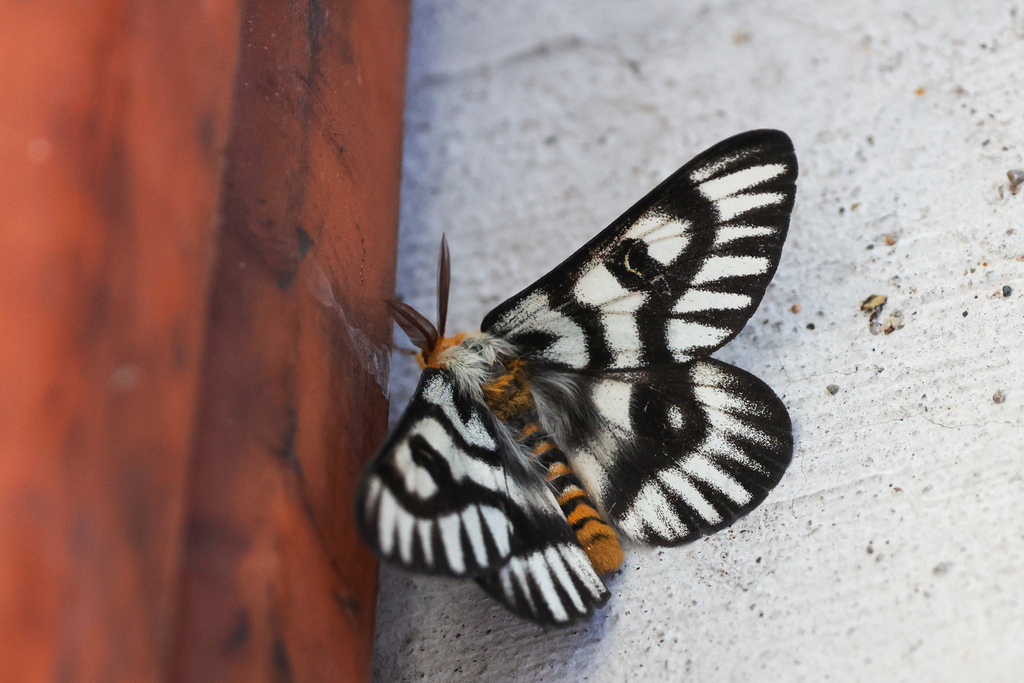
(c) Tom Field, some rights reserved (CC BY) · licence
Family: Saturniidae · Class: Insecta · Order: Lepidoptera
Hemileuca hera (Hera buckmoth) is a California animal in the Saturniidae family.
The Hera buckmoth is a medium-sized moth in the family Saturniidae, distinguished by its distinctive wing patterns and specialized sagebrush associations. Adults have a wingspan of 50 to 75 mm (2.0 to 3.0 inches), with forewings displaying a characteristic eyespot pattern. The wings are typically grayish-brown to tan with darker banding, and males possess more feathery antennae than females. The hindwings feature prominent eyespots that serve as a defense mechanism against predators. This species occurs across the Great Basin region from southwestern Saskatchewan west to southeastern British Columbia, extending south to western Colorado, central Utah, and central Nevada. Two distinct subspecies occupy different portions of this range: subspecies marcata inhabits southern Oregon and northern California, while subspecies magnifica is found in northeastern Arizona, northern New Mexico, and southern Colorado. The distribution closely follows the range of its primary host plants in the sagebrush steppe ecosystem. Hera buckmoths inhabit sagebrush-dominated landscapes, particularly areas with dense stands of basin big sagebrush (Artemisia tridentata) and sand sagebrush (A. filifolia). These moths are typically found at elevations ranging from 1,200 to 2,400 meters (4,000 to 8,000 feet) in semi-arid environments characterized by cold winters and hot, dry summers. The species requires healthy sagebrush communities with mature shrubs that can support larval development. Adult Hera buckmoths are active during late summer and early fall, typically emerging from August through October depending on elevation and local climate conditions. Mating occurs shortly after emergence, with females laying eggs on sagebrush branches. Larvae hatch the following spring and feed exclusively on sagebrush foliage, developing through five instars over approximately 60 to 90 days. The caterpillars are covered in branched spines and display warning coloration with black and orange bands. Pupation occurs in the soil, where the species overwinters as pupae for one year, though some individuals may remain dormant for two years. The Hera buckmoth is not federally or state-listed, and comprehensive population assessments are limited. However, the species faces potential threats from habitat loss due to sagebrush ecosystem conversion, wildfire management practices, and invasive plant species that alter native plant communities. Climate change may affect the synchronization between moth emergence and optimal sagebrush phenology. Agricultural development and urban expansion in some portions of the range have reduced available habitat. The species' dependence on mature sagebrush stands makes it vulnerable to large-scale habitat disturbances, particularly given the slow regeneration rate of sagebrush communities after disturbance.
Classification
Class: Insecta · Order: Lepidoptera · Family: Saturniidae
Frequently asked questions
How is Hemileuca hera classified?
Hemileuca hera belongs to class Insecta, order Lepidoptera, family Saturniidae.
What family does Hemileuca hera belong to?
Hemileuca hera is in the Saturniidae family.
What is Hemileuca hera?
The Hera buckmoth is a medium-sized moth in the family Saturniidae, distinguished by its distinctive wing patterns and specialized sagebrush associations.
Is Hemileuca hera found in California?
Yes. Hemileuca hera is recorded in California in The California Species Project's catalogue.
Related species
Other California species in the same genus, family, or bioregion.
Data from The California Species Project — 14,000+ California species with verified data from CNPS, CDFW, USFWS, and more.