Hemileuca juno
Juno buckmoth
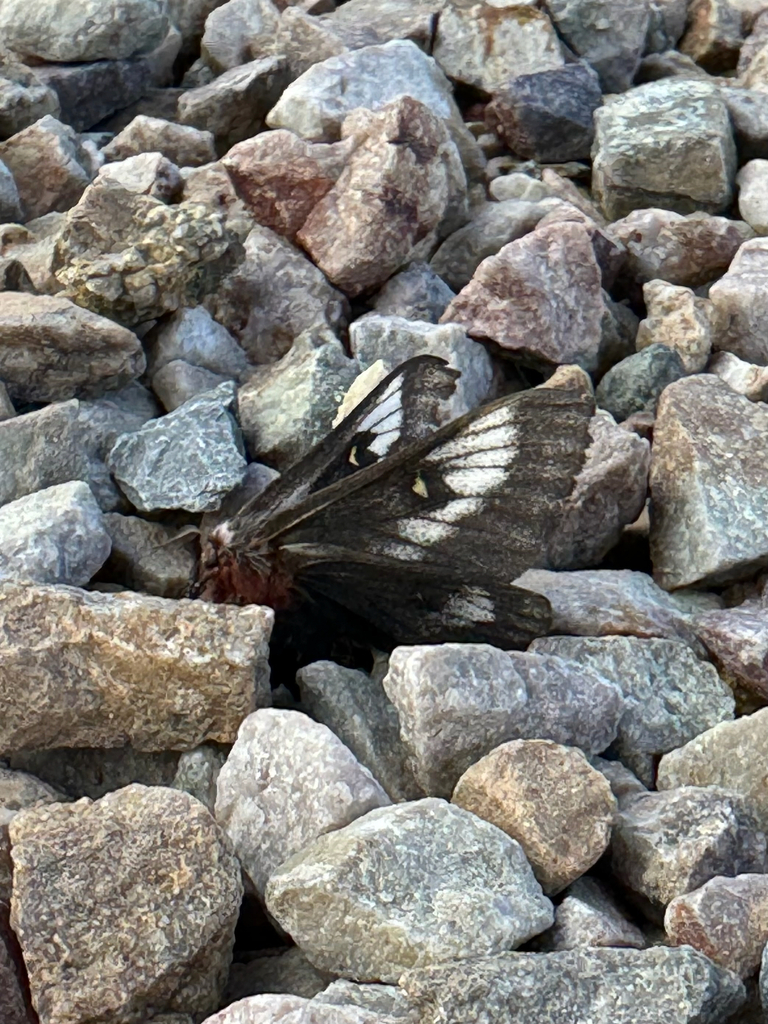
(c) CK2AZ, some rights reserved (CC BY) · licence
Family: Saturniidae · Class: Insecta · Order: Lepidoptera
Hemileuca juno (Juno buckmoth) is a California animal in the Saturniidae family.
The Juno buckmoth is a medium-sized moth in the family Saturniidae, characterized by distinctive wing patterns and coloration. Adults have a wingspan ranging from 60 to 80 mm (2.4 to 3.1 inches). The forewings are gray-brown with white and black bands, while the hindwings display prominent eyespots with yellow, black, and white rings. Males typically have more feathery antennae and slightly smaller body size compared to females. The species exhibits sexual dimorphism, with females generally larger and more robust than males. The Juno buckmoth occurs across a broad range extending from El Paso, Texas west across central and southwestern New Mexico through southern Arizona, and south into Sonora, Mexico. Within this distribution, the species is associated with desert and semi-desert regions where suitable host plants are present. The range encompasses elevations from desert valleys to foothill areas, typically below 1,500 meters (4,900 feet). This species inhabits arid and semi-arid environments dominated by mesquite scrubland and desert grassland communities. The habitat is characterized by low annual precipitation, typically 200 to 400 mm (8 to 16 inches), and hot summers with mild winters. Juno buckmoths are found in areas with scattered mesquite trees and shrubs, often in washes, floodplains, and valley bottoms where these plants are most abundant. The species tolerates disturbed habitats and may persist in areas with moderate grazing or development pressure. Juno buckmoth larvae feed exclusively on various mesquite (Prosopis) species, including honey mesquite (P. glandulosa), velvet mesquite (P. velutina), and screwbean mesquite (P. pubescens). Adults are primarily active during fall months, typically September through November, when mating and egg-laying occur. Females deposit eggs in clusters on mesquite branches, where they overwinter before hatching in spring. Larvae develop through five instars over several months, feeding on mesquite foliage. The species completes one generation per year, with pupation occurring in underground chambers during summer months. Adults are nocturnal and are attracted to artificial lights. The Juno buckmoth does not currently hold federal or state listing status and appears to maintain stable populations across much of its range. The species benefits from the widespread distribution and relative abundance of mesquite host plants throughout the southwestern United States and northwestern Mexico. However, localized threats may include habitat conversion for agriculture and urban development, particularly in rapidly growing desert cities. Drought conditions and climate change could potentially affect host plant availability and distribution. The species' ability to utilize multiple mesquite species and tolerate disturbed habitats likely contributes to its current stability. Conservation efforts focus primarily on maintaining healthy mesquite ecosystems and monitoring population trends in areas experiencing rapid development.
Classification
Class: Insecta · Order: Lepidoptera · Family: Saturniidae
Frequently asked questions
How is Hemileuca juno classified?
Hemileuca juno belongs to class Insecta, order Lepidoptera, family Saturniidae.
What family does Hemileuca juno belong to?
Hemileuca juno is in the Saturniidae family.
What is Hemileuca juno?
The Juno buckmoth is a medium-sized moth in the family Saturniidae, characterized by distinctive wing patterns and coloration.
Is Hemileuca juno found in California?
Yes. Hemileuca juno is recorded in California in The California Species Project's catalogue.
Related species
Other California species in the same genus, family, or bioregion.
Data from The California Species Project — 14,000+ California species with verified data from CNPS, CDFW, USFWS, and more.