Hemileuca neumoegeni
Neumoegen's buckmoth
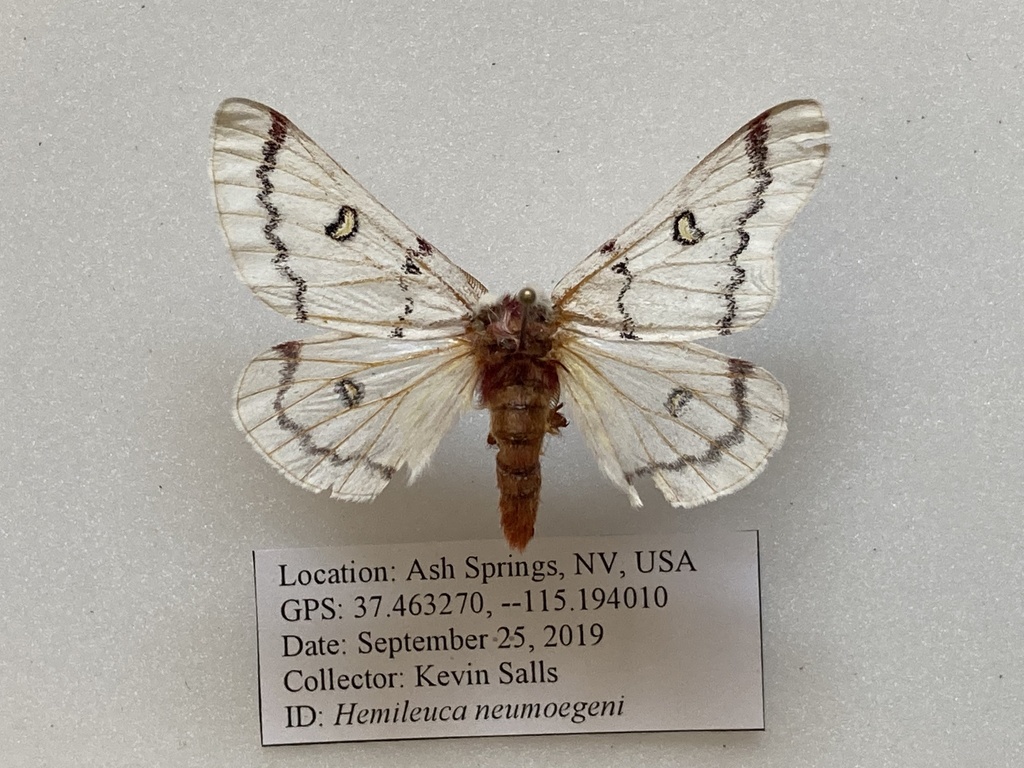
(c) Kevin Salls, some rights reserved (CC BY) · licence
Family: Saturniidae · Class: Insecta · Order: Lepidoptera
Hemileuca neumoegeni (Neumoegen's buckmoth) is a California animal in the Saturniidae family.
Neumoegen's buckmoth is a medium-sized moth in the family Saturniidae, characterized by distinctive eyespots and diurnal flight behavior. Adults have a wingspan of 50 to 75 mm (2.0 to 3.0 inches), with females typically larger than males. The forewings are brownish-gray with prominent eyespots near the apex, while the hindwings display bold black and white banding with orange-red coloration at the base. Males possess feathery antennae and are active day-flying moths, distinguishing them from most nocturnal saturniids. The body is robust and densely covered with hair-like scales. Neumoegen's buckmoth occurs across southeastern California, southern Nevada, northern Arizona, southwestern and eastern Utah, and western Colorado. In California, the species is documented from desert regions of Inyo, Riverside, and San Bernardino counties. The distribution extends eastward through the Great Basin and Colorado Plateau regions, typically at elevations between 1,200 and 2,400 meters (4,000 to 8,000 feet). This species inhabits arid shrubland communities, pinyon-juniper woodlands, and desert scrub ecosystems where host plants are abundant. Adults are most commonly observed in washes, canyon bottoms, and hillsides with dense shrub cover. The habitat typically receives 200 to 400 mm (8 to 16 inches) of annual precipitation and experiences hot summers with cold winters. Rocky soils and well-drained slopes are characteristic features of occupied sites. Larvae feed exclusively on squawbush (Rhus trilobata), desert almond (Prunus fasciculata), and Apache plume (Falluga paradoxa), all native shrubs in the rose family or related families. Adult flight period occurs from October through December, with peak activity in November. Males exhibit territorial behavior, patrolling host plant areas during daylight hours to locate females. Mating occurs on or near host plants, and females deposit clusters of 50 to 100 eggs on twigs and branches. Larvae emerge the following spring and feed throughout the growing season, pupating in late summer within underground pupal chambers. The species completes one generation per year. Neumoegen's buckmoth is not federally listed and lacks formal conservation status designations, though populations may be vulnerable to habitat degradation. Primary threats include urban development in desert areas, livestock grazing that damages host plants, and invasive plant species that alter native shrubland communities. Off-road vehicle use in desert habitats can disturb pupal sites and fragment populations. Climate change poses additional risks through altered precipitation patterns and increased frequency of extreme weather events. The species' dependence on specific host plants and relatively restricted habitat requirements suggest potential sensitivity to environmental changes. Long-term monitoring data are limited, making population trend assessment difficult. Conservation efforts would benefit from habitat protection and restoration of native shrubland ecosystems throughout the species' range.
Classification
Class: Insecta · Order: Lepidoptera · Family: Saturniidae
Frequently asked questions
How is Hemileuca neumoegeni classified?
Hemileuca neumoegeni belongs to class Insecta, order Lepidoptera, family Saturniidae.
What family does Hemileuca neumoegeni belong to?
Hemileuca neumoegeni is in the Saturniidae family.
What is Hemileuca neumoegeni?
Neumoegen's buckmoth is a medium-sized moth in the family Saturniidae, characterized by distinctive eyespots and diurnal flight behavior.
Is Hemileuca neumoegeni found in California?
Yes. Hemileuca neumoegeni is recorded in California in The California Species Project's catalogue.
Related species
Other California species in the same genus, family, or bioregion.
Data from The California Species Project — 14,000+ California species with verified data from CNPS, CDFW, USFWS, and more.