Hemileuca nevadensis
Nevada buckmoth
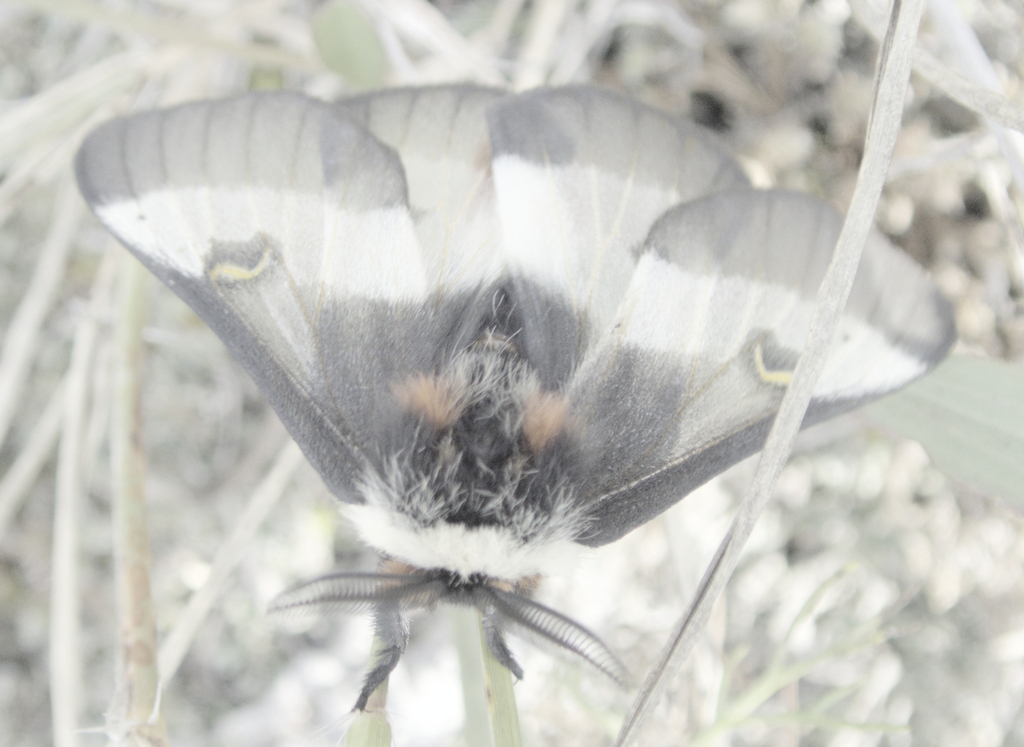
(c) Mary Krieger, some rights reserved (CC BY) · licence
Family: Saturniidae · Class: Insecta · Order: Lepidoptera
Hemileuca nevadensis (Nevada buckmoth) is a California animal in the Saturniidae family.
The Nevada buckmoth is a large moth in the family Saturniidae, with adults exhibiting sexual dimorphism in size and wing patterns. Males have a wingspan of 50 to 75 mm (2.0 to 3.0 inches), while females are larger at 65 to 90 mm (2.6 to 3.5 inches). Males display reddish-brown forewings with distinctive white bands and eyespots, while females are generally darker with more subdued markings. Both sexes have feathery antennae, though males possess more elaborate, branched antennae for detecting female pheromones. The hindwings feature prominent eyespots with white centers surrounded by black rings. The Nevada buckmoth ranges from Wisconsin west across southern Canada to central Oregon, extending south through central Nebraska to New Mexico, northern Arizona, northern Nevada, and inland southern California. In California, the species occurs primarily in the Sierra Nevada, Cascade Range, and mountainous regions of the interior, typically at elevations between 1,200 and 3,000 meters (4,000 to 10,000 feet). The distribution reflects the species' association with riparian corridors and montane environments where host plants are abundant. This moth inhabits riparian zones, streamside areas, and wet meadows where willows and cottonwoods grow. Adults are found in areas adjacent to these riparian habitats, including open woodlands, mountain meadows, and forest edges. The species requires access to flowing water sources that support healthy populations of Salix and Populus species, making it closely tied to watershed health and riparian ecosystem integrity. Nevada buckmoths are univoltine, producing one generation per year. Adults emerge in late summer to early fall, typically from August through October depending on elevation and local climate conditions. Mating occurs shortly after emergence, with females releasing pheromones to attract males. After mating, females deposit eggs on twigs of host plants, where they overwinter. Larvae emerge in spring and feed exclusively on various species of willows (Salix) and cottonwoods (Populus). The caterpillars are gregarious when young, feeding together in groups before dispersing as they mature. Larvae pupate in cocoons attached to host plant branches or nearby vegetation, with the pupal stage lasting through summer until adult emergence. Larvae are notable for their stinging spines, which can cause skin irritation in humans who handle them. The caterpillars feed primarily on new growth and leaves of riparian trees, occasionally causing localized defoliation when populations are high. Natural predators include birds, spiders, and parasitic wasps that help regulate population levels. The Nevada buckmoth does not currently hold federal or state listing status, though local populations may face pressure from riparian habitat degradation, water diversions, and climate change impacts on montane watersheds. The species' dependence on healthy riparian ecosystems makes it potentially vulnerable to drought, altered precipitation patterns, and human modifications to stream systems that affect host plant communities.
Classification
Class: Insecta · Order: Lepidoptera · Family: Saturniidae
Frequently asked questions
How is Hemileuca nevadensis classified?
Hemileuca nevadensis belongs to class Insecta, order Lepidoptera, family Saturniidae.
What family does Hemileuca nevadensis belong to?
Hemileuca nevadensis is in the Saturniidae family.
What is Hemileuca nevadensis?
The Nevada buckmoth is a large moth in the family Saturniidae, with adults exhibiting sexual dimorphism in size and wing patterns.
Is Hemileuca nevadensis found in California?
Yes. Hemileuca nevadensis is recorded in California in The California Species Project's catalogue.
Related species
Other California species in the same genus, family, or bioregion.
Data from The California Species Project — 14,000+ California species with verified data from CNPS, CDFW, USFWS, and more.