Hemileuca nuttalli
Nuttall's sheepmoth
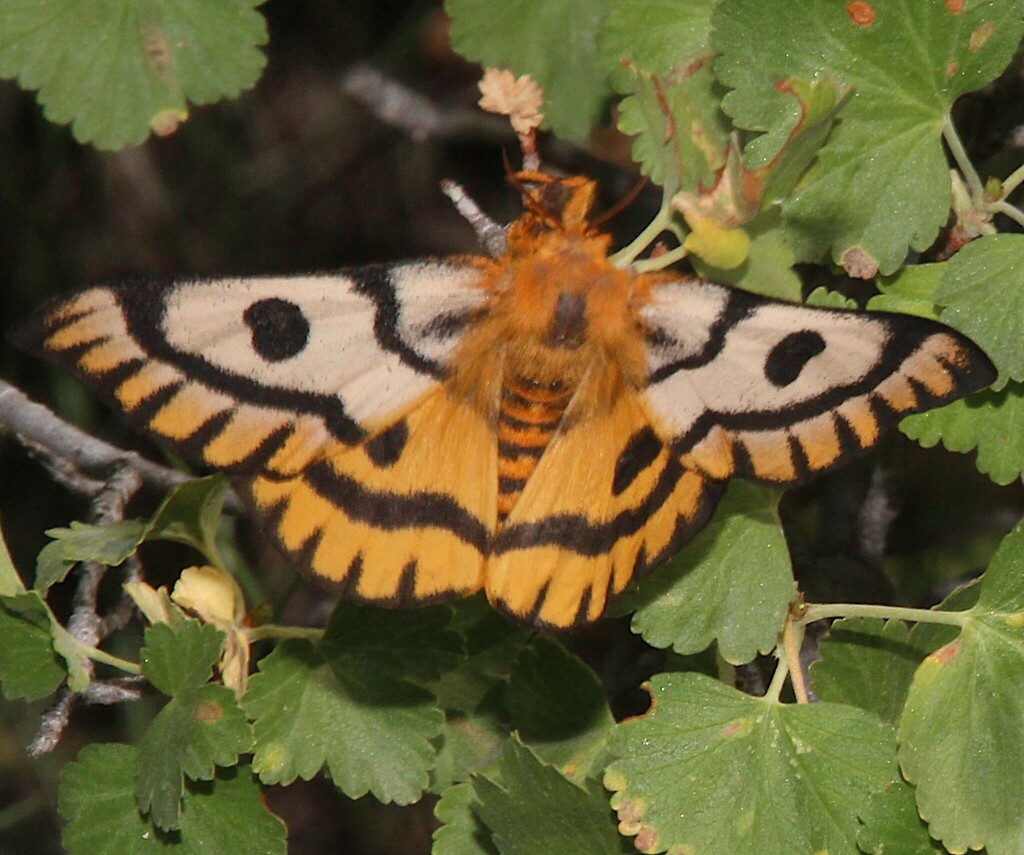
(c) Lon Brehmer, some rights reserved (CC BY) · licence
Family: Saturniidae · Class: Insecta · Order: Lepidoptera
Hemileuca nuttalli (Nuttall's sheepmoth) is a California animal in the Saturniidae family.
Nuttall's sheepmoth (Hemileuca nuttalli) is a large moth in the family Saturniidae, native to western North America. Adults have a wingspan of 60 to 90 mm (2.4 to 3.5 inches), with females typically larger than males. The forewings are pale gray to brown with distinctive black and white banding patterns, while the hindwings display prominent eyespots with black centers surrounded by yellow or orange rings. Males possess feathery, bipectinate antennae that are more elaborate than the simpler antennae of females. The thorax and abdomen are densely covered with grayish-brown scales. Nuttall's sheepmoth ranges from southern British Columbia south down the east side of the Sierra Nevada, extending east to western Montana, western Wyoming, and western Colorado. In California, the species occurs primarily in the eastern Sierra Nevada region and adjacent areas. The distribution follows montane and subalpine zones where suitable host plants are abundant. This species inhabits open shrublands, sagebrush steppe, and montane chaparral communities, typically at elevations between 1,200 and 3,000 meters (4,000 to 10,000 feet). The moths are closely associated with their larval host plants, which include bitterbrush (Purshia tridentata), snowberry (Symphoricarpos species), currant (Ribes species), and desert sweet (Chamaebatiaria millefolium). These habitats are characterized by well-drained soils and moderate to sparse vegetation cover. Nuttall's sheepmoth exhibits a univoltine life cycle, producing one generation per year. Adults emerge in late summer to early fall, typically from August through October, depending on elevation and local climate conditions. Mating occurs shortly after emergence, with females releasing pheromones to attract males. After mating, females deposit eggs in clusters on host plant stems and branches. The eggs overwinter and hatch the following spring. Larvae, known as caterpillars, are gregarious in early instars but become more solitary as they mature. The caterpillars are covered in branched spines and feed on the foliage of host plants throughout the summer before pupating in the soil. Larvae are equipped with urticating spines that can cause skin irritation in humans and serve as defense against predators. The caterpillars undergo five to six molts before reaching maturity. Pupation occurs in underground chambers, where the species overwinters as pupae before adult emergence. Nuttall's sheepmoth is not federally or state listed, and current population trends are not well documented. The species appears to maintain stable populations across much of its range, though habitat modification and development in some areas may pose localized threats. Climate change could potentially affect the species through alterations in host plant communities and shifts in suitable elevation ranges. The moth's dependence on specific shrubland ecosystems makes it vulnerable to large-scale habitat conversion, wildfire regime changes, and prolonged drought conditions that affect host plant survival.
Classification
Class: Insecta · Order: Lepidoptera · Family: Saturniidae
Frequently asked questions
How is Hemileuca nuttalli classified?
Hemileuca nuttalli belongs to class Insecta, order Lepidoptera, family Saturniidae.
What family does Hemileuca nuttalli belong to?
Hemileuca nuttalli is in the Saturniidae family.
What is Hemileuca nuttalli?
Nuttall's sheepmoth (Hemileuca nuttalli) is a large moth in the family Saturniidae, native to western North America.
Is Hemileuca nuttalli found in California?
Yes. Hemileuca nuttalli is recorded in California in The California Species Project's catalogue.
Related species
Other California species in the same genus, family, or bioregion.
Data from The California Species Project — 14,000+ California species with verified data from CNPS, CDFW, USFWS, and more.