Hemipepsis ustulata
Flamed Tarantula-hawk Wasp
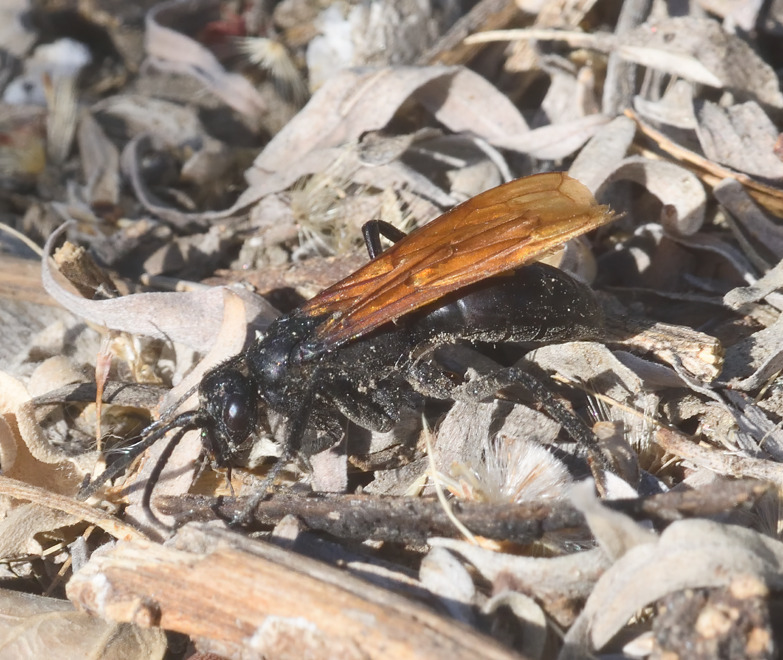
(c) smeckert, some rights reserved (CC BY) · licence
Family: Pompilidae · Class: Insecta · Order: Hymenoptera
Hemipepsis ustulata (Flamed Tarantula-hawk Wasp) is a California animal in the Pompilidae family.
The Flamed Tarantula-hawk Wasp is a large, solitary wasp belonging to the spider wasp family Pompilidae. Adults are robust insects with dark metallic bodies, typically measuring 25-40 mm (1.0-1.6 inches) in length. The species exhibits the characteristic coloration of tarantula hawks, with a dark blue-black to metallic blue body and bright orange or reddish wings that give the species its "flamed" common name. Females are generally larger than males, with powerful mandibles and a prominent stinger adapted for subduing large prey. Hemipepsis ustulata occurs across the southwestern United States, with documented populations in Arizona, California, Colorado, Kansas, Nevada, New Mexico, Texas, and Utah (BugGuide 2025). The species appears most abundant in Arizona and California based on observation records. Its range extends from desert regions to higher elevation areas, overlapping with the distribution of its tarantula prey. This species inhabits arid and semi-arid environments including desert scrub, chaparral, and oak woodlands. Adults are frequently observed nectaring on milkweed species (Asclepias spp.) and other flowering plants in desert and montane habitats (Xerces Society 2011). The wasps show preference for areas with sandy or loose soil suitable for nest construction, often near rocky outcrops or hillsides where tarantulas establish burrows. Flamed Tarantula-hawk Wasps are specialized hunters of tarantulas, primarily targeting mygalomorph spiders. Adult females hunt by locating tarantula burrows, engaging the spider in combat, and paralyzing it with their powerful sting. The paralyzed tarantula is then dragged to a prepared underground nest chamber where the female deposits a single egg on the spider's abdomen. The developing larva feeds on the living but immobilized spider, ensuring fresh food throughout its development. Adults are active primarily during warmer months, with peak activity recorded from May through October based on observation data (BugGuide 2025). Males emerge earlier than females and spend considerable time patrolling territories and seeking mates. Adult wasps are nectarivores, feeding exclusively on flower nectar. They show particular attraction to milkweed flowers, where they serve as important pollinators alongside other native insects (Xerces Society 2015). Mating occurs in late spring and early summer, with females subsequently beginning their solitary hunting and nesting activities. The Flamed Tarantula-hawk Wasp has no formal conservation status at federal or state levels. However, like many native pollinators, the species may face habitat pressures from urban development and agricultural intensification, particularly the loss of native milkweed populations that provide essential nectar resources (Xerces Society 2011). The species' dependence on tarantula prey also makes it vulnerable to factors affecting spider populations, including habitat fragmentation and pesticide use. Current population trends have not been systematically documented, and the species would benefit from monitoring efforts across its range to assess long-term stability.
Classification
Class: Insecta · Order: Hymenoptera · Family: Pompilidae
Frequently asked questions
How is Hemipepsis ustulata classified?
Hemipepsis ustulata belongs to class Insecta, order Hymenoptera, family Pompilidae.
What family does Hemipepsis ustulata belong to?
Hemipepsis ustulata is in the Pompilidae family.
What is Hemipepsis ustulata?
The Flamed Tarantula-hawk Wasp is a large, solitary wasp belonging to the spider wasp family Pompilidae.
Is Hemipepsis ustulata found in California?
Yes. Hemipepsis ustulata is recorded in California in The California Species Project's catalogue.
Related species
Other California species in the same genus, family, or bioregion.
Data from The California Species Project — 14,000+ California species with verified data from CNPS, CDFW, USFWS, and more.