Herpyllus propinquus
Western Parson Spider
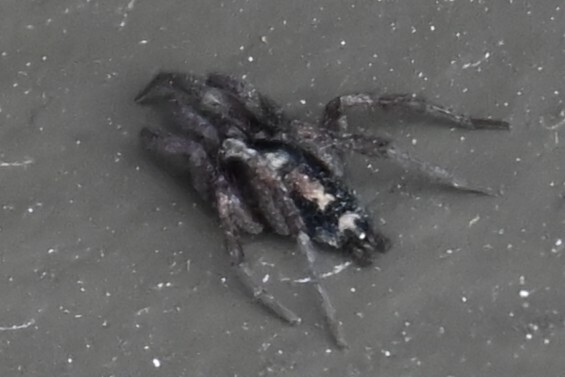
(c) coniferfan07, some rights reserved (CC BY) · licence
Family: Gnaphosidae · Class: Arachnida · Order: Araneae
Herpyllus propinquus (Western Parson Spider) is a California animal in the Gnaphosidae family.
The Western Parson Spider is a medium-sized ground spider measuring approximately 6.0 mm in length for males (BugGuide 2025). The species is distinguished by its characteristic white dorsal stripe running along the abdomen, which resembles the cravat worn by parsons or ministers during the 1800s, giving the spider its common name (Guarisco 2007). The body coloration is typically dark brown to black with the prominent white marking serving as the primary identifying feature. Herpyllus propinquus occurs across western North America, with documented populations in California, Nevada, Arizona, New Mexico, and other western states. In California, the species has been recorded in various counties including those in the southern regions. The distribution extends from lower elevations into montane areas, with records from locations such as Grant County, New Mexico at pine-oak-juniper forest elevations (BugGuide 2025). As a member of the ground spider family Gnaphosidae, this species inhabits diverse terrestrial environments. The Western Parson Spider is found in both natural habitats including pine-oak-juniper forests, chaparral, and desert regions, as well as human-modified environments. The species commonly enters buildings and homes, particularly those surrounded by woodland habitats. They prefer areas with adequate ground cover, including leaf litter, rocks, and debris that provide shelter during daylight hours. Western Parson Spiders are nocturnal hunters that do not construct webs for prey capture. Instead, they actively hunt for small insects and other arthropods during nighttime hours. Like other gnaphosids, they are fast-moving predators that rely on speed and agility to capture prey. During the day, they seek shelter under stones, logs, bark, or within crevices. The species exhibits typical ground spider behavior, remaining hidden during daylight and emerging after dark to forage. Reproduction follows the standard spider pattern, with males seeking females for mating, though specific details about breeding timing and egg-laying behavior for this species are not well documented in the scientific literature. The Western Parson Spider is not listed under any federal or state conservation programs and appears to maintain stable populations throughout its range. As a widespread species adapted to various habitat types, including human-modified environments, it faces fewer conservation challenges than many specialized arachnids. The species' ability to colonize residential areas and its broad habitat tolerance suggest resilience to moderate environmental changes. However, like many arthropods, populations may be affected by habitat loss, pesticide use, and climate change, though specific population trend data are not available. The species serves an important ecological role as both predator of small insects and prey for larger predators in terrestrial food webs across western North American ecosystems.
Classification
Class: Arachnida · Order: Araneae · Family: Gnaphosidae
Frequently asked questions
How is Herpyllus propinquus classified?
Herpyllus propinquus belongs to class Arachnida, order Araneae, family Gnaphosidae.
What family does Herpyllus propinquus belong to?
Herpyllus propinquus is in the Gnaphosidae family.
What is Herpyllus propinquus?
The Western Parson Spider is a medium-sized ground spider measuring approximately 6.0 mm in length for males (BugGuide 2025).
Is Herpyllus propinquus found in California?
Yes. Herpyllus propinquus is recorded in California in The California Species Project's catalogue.
Related species
Other California species in the same genus, family, or bioregion.
Data from The California Species Project — 14,000+ California species with verified data from CNPS, CDFW, USFWS, and more.