Hesperia columbia
Columbian Skipper
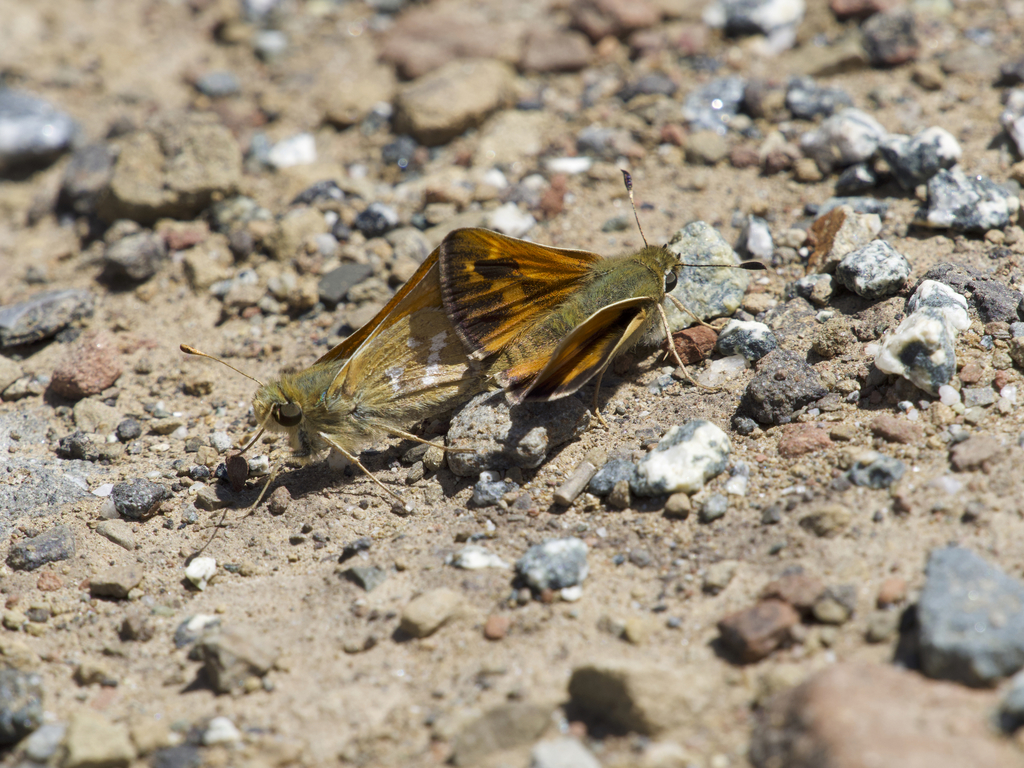
(c) Dee Shea Himes, some rights reserved (CC BY) · licence
Family: Hesperiidae · Class: Insecta · Order: Lepidoptera
Hesperia columbia (Columbian Skipper) is a California animal in the Hesperiidae family.
The Columbian skipper is a small butterfly with adults measuring 25 to 30 mm (1.0 to 1.2 inches) in wingspan. Males display orange-brown dorsal wing surfaces with dark borders and scattered dark spots. Females are typically darker, with more subdued orange coloration and more extensive dark markings. The ventral wing surfaces are pale orange to yellowish with lighter spotting. Like other grass skippers, this species has a robust body relative to its wing size and hooked antennae with pointed tips. The forewings are relatively narrow and triangular, while the hindwings are more rounded. The Columbian skipper ranges from southwest Oregon south through the Coast Ranges and Sierra Nevada foothills of California to Baja California Norte. In California, populations occur primarily in foothill regions of the Coast Ranges from the San Francisco Bay Area south to San Luis Obispo County, and in the Sierra Nevada foothills from Butte County south to Kern County. The species is typically found at elevations between 150 and 1,500 meters (500 to 4,900 feet), though most populations occur below 1,000 meters. This species inhabits open grasslands, oak woodlands, chaparral clearings, and meadows where its host plant occurs. The butterfly shows a strong association with areas containing June grass (Koeleria cristata), its primary larval host plant. Adults are commonly observed on hillsides with scattered shrubs and trees, particularly where native bunch grasses persist. The species appears to prefer areas with some topographic relief and varies in abundance with the availability of suitable grassland habitat. Columbian skippers are univoltine, producing one generation per year. Adults typically fly from May through July, with peak activity occurring in June. Males establish territories on hilltops and ridges, engaging in aerial encounters with other males and patrolling for females. Mating occurs during the day, with females subsequently searching for suitable oviposition sites on or near June grass clumps. Eggs are laid singly on grass blades or nearby vegetation. Larvae feed exclusively on June grass, constructing silk shelters within rolled grass blades. The species overwinters as a mature larva, pupating in spring within a silk-lined shelter at the base of the host plant. The Columbian skipper lacks formal conservation status designations at federal or state levels, though populations may face pressure from habitat conversion and fragmentation. Native grasslands throughout California have experienced significant reduction due to agricultural development, urbanization, and invasion by non-native plants. The species' dependence on June grass, a native perennial bunch grass that has declined in many areas, makes it vulnerable to grassland degradation. Fire suppression and altered grazing regimes may also affect habitat quality by allowing shrub encroachment into open grasslands. While the species maintains a relatively broad distribution, local populations may be declining in areas where native grassland ecosystems have been substantially modified.
Classification
Class: Insecta · Order: Lepidoptera · Family: Hesperiidae
Frequently asked questions
How is Hesperia columbia classified?
Hesperia columbia belongs to class Insecta, order Lepidoptera, family Hesperiidae.
What family does Hesperia columbia belong to?
Hesperia columbia is in the Hesperiidae family.
What is Hesperia columbia?
The Columbian skipper is a small butterfly with adults measuring 25 to 30 mm (1.0 to 1.2 inches) in wingspan.
Is Hesperia columbia found in California?
Yes. Hesperia columbia is recorded in California in The California Species Project's catalogue.
Related species
Other California species in the same genus, family, or bioregion.
Data from The California Species Project — 14,000+ California species with verified data from CNPS, CDFW, USFWS, and more.