Hesperia miriamae longaevicola
White Mountains Skipper
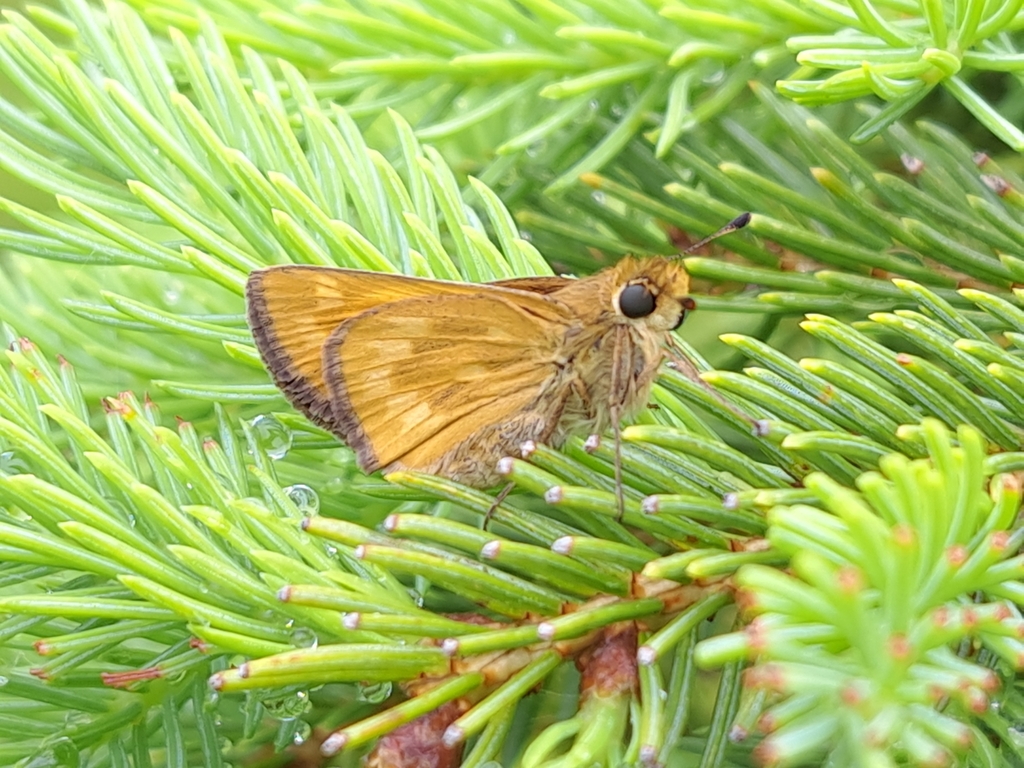
(c) Will Linnard, some rights reserved (CC BY) · licence
Family: Hesperiidae · Class: Insecta · Order: Lepidoptera
Conservation status: G2G3T1T2 S1
Hesperia miriamae longaevicola (White Mountains Skipper) is a California animal in the Hesperiidae family.
The White Mountains Skipper (Hesperia miriamae longaevicola) is a subspecies of skipper butterfly endemic to the White Mountains of eastern California and western Nevada. This small butterfly measures approximately 25-30 mm (1.0-1.2 inches) in wingspan. Males display orange-brown dorsal wing surfaces with dark borders and distinctive orange spots, while females are typically darker brown with lighter spotting patterns. The forewings are relatively narrow and pointed, characteristic of the Hesperiidae family, with a rapid, darting flight pattern typical of skippers. The subspecies occurs exclusively in the White Mountains range of Mono and Inyo counties, California, extending into adjacent portions of Nevada. This represents an extremely restricted range compared to other Hesperia miriamae subspecies. The White Mountains population is geographically isolated from other populations, contributing to its taxonomic distinctiveness and conservation concern. Historical records suggest the subspecies may have had a slightly broader distribution within the White Mountains, but current populations are limited to specific high-elevation sites. White Mountains Skippers inhabit alpine and subalpine environments between 2,400 and 3,400 meters (7,900 and 11,200 feet) elevation. The species requires open, rocky slopes and meadows with sparse vegetation, often associated with areas of exposed granite and volcanic substrates. These high-elevation habitats experience extreme temperature fluctuations, with brief growing seasons and prolonged winter snow cover. The butterflies are typically found in areas with moderate to steep slopes that receive significant solar exposure during the limited summer flight period. The subspecies is univoltine, producing one generation per year with adults flying from late June through August, depending on elevation and seasonal conditions. Males establish territories on prominent rocks or bare ground patches, where they perch and patrol for females. Mating occurs during the brief summer flight period, with females depositing eggs singly on or near host plants. Larvae develop slowly due to the short growing season, likely requiring two years to complete development in this harsh alpine environment. The species feeds on native grasses, though specific host plant relationships for this subspecies require further study. The White Mountains Skipper receives a global rank of G2G3T1T2, indicating it is critically imperiled to imperiled as a subspecies, and S1 in California, meaning it is critically imperiled in the state. The extremely restricted range makes this subspecies particularly vulnerable to climate change, as warming temperatures may force suitable habitat to higher elevations where less area is available. Additional threats include potential habitat degradation from recreational activities and the inherent vulnerability of small, isolated populations to stochastic events. The subspecies represents a unique evolutionary lineage adapted to the harsh conditions of the White Mountains, making its conservation particularly important for maintaining regional biodiversity.
Classification
Class: Insecta · Order: Lepidoptera · Family: Hesperiidae
Conservation status
G2G3T1T2 S1
Frequently asked questions
How is Hesperia miriamae longaevicola classified?
Hesperia miriamae longaevicola belongs to class Insecta, order Lepidoptera, family Hesperiidae.
What family does Hesperia miriamae longaevicola belong to?
Hesperia miriamae longaevicola is in the Hesperiidae family.
Is Hesperia miriamae longaevicola protected or of conservation concern?
Hesperia miriamae longaevicola carries the following status: G2G3T1T2 S1.
What is Hesperia miriamae longaevicola?
The White Mountains Skipper (Hesperia miriamae longaevicola) is a subspecies of skipper butterfly endemic to the White Mountains of eastern California and western Nevada.
Is Hesperia miriamae longaevicola found in California?
Yes. Hesperia miriamae longaevicola is recorded in California in The California Species Project's catalogue.
Related species
Other California species in the same genus, family, or bioregion.
Data from The California Species Project — 14,000+ California species with verified data from CNPS, CDFW, USFWS, and more.