Hesperia pahaska
Pahaska Skipper
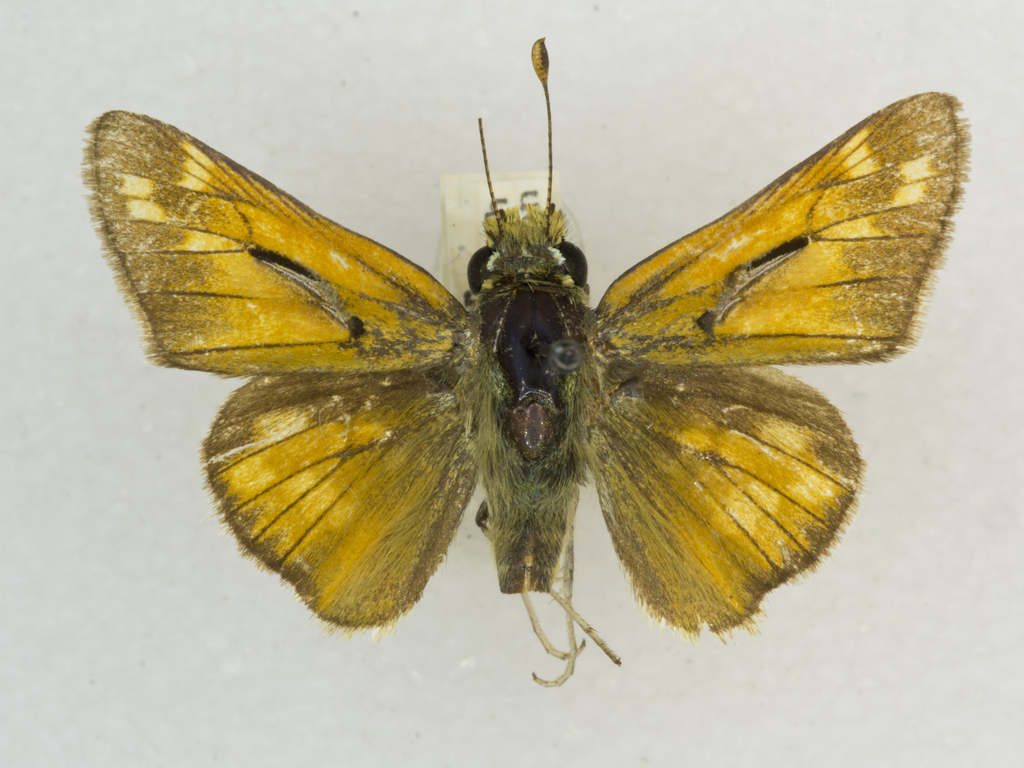
no rights reserved · CC0
Family: Hesperiidae · Class: Insecta · Order: Lepidoptera
Hesperia pahaska (Pahaska Skipper) is a California animal in the Hesperiidae family.
The Pahaska skipper is a small butterfly in the family Hesperiidae, characterized by the rapid, darting flight pattern typical of skippers. Adults have a wingspan of approximately 25 to 32 mm (1.0 to 1.3 inches). Males display orange-brown dorsal wing surfaces with darker borders and a distinctive stigma on the forewings. Females are generally darker with reduced orange coloration and more prominent brown markings. The ventral surfaces of both sexes are pale yellow-brown with light spotting on the hindwings. The antennae are relatively short with curved, hooked clubs. The Pahaska skipper ranges through the Rocky Mountain system from central Montana and northwest North Dakota south to central Mexico, extending west to southeast California. A stray occurrence has been documented in northwest Minnesota. Within California, the species occurs in the southeastern desert regions, primarily in the Mojave Desert and adjacent areas where suitable grassland habitat exists. The distribution follows elevation gradients and precipitation patterns that support appropriate host plant communities. This species inhabits short-grass prairie, desert grasslands, and open areas with scattered bunch grasses. Elevation ranges typically span from 1,000 to 2,400 meters (3,300 to 7,900 feet), though local populations may occur outside these limits depending on microclimate conditions. The butterfly requires areas with its specific host plants and nearby nectar sources. Habitat often includes rocky slopes, mesa tops, and valley floors where native grasses persist. Pahaska skippers utilize various native grasses as larval host plants, including blue grama (Bouteloua gracilis) and fluff grass (Erioneuron pulchellum). Females deposit eggs singly on or near host plants, typically during late spring or early summer. Larvae feed within silken shelters constructed among grass blades and stems. The species likely overwinters as larvae, pupating in spring before adult emergence. Adults are active during daylight hours, with males establishing territories on hilltops or prominent landscape features where they patrol for females. Flight periods generally occur from May through August, varying with elevation and local climate conditions. The Pahaska skipper lacks formal federal or state conservation status listings, indicating populations are currently considered stable across most of its range. However, like many grassland-dependent species, it faces potential threats from habitat conversion, overgrazing, invasive plant species, and altered fire regimes that can degrade native grassland ecosystems. Climate change may affect the species through shifts in precipitation patterns and temperature ranges that influence host plant distribution and phenology. Urban development and agricultural conversion pose localized threats in some portions of the range. Conservation of native grassland habitats benefits this species along with other prairie-dependent wildlife. Monitoring of population trends would help assess long-term conservation needs, particularly in peripheral areas of the range where populations may be more vulnerable to environmental changes.
Classification
Class: Insecta · Order: Lepidoptera · Family: Hesperiidae
Frequently asked questions
How is Hesperia pahaska classified?
Hesperia pahaska belongs to class Insecta, order Lepidoptera, family Hesperiidae.
What family does Hesperia pahaska belong to?
Hesperia pahaska is in the Hesperiidae family.
What is Hesperia pahaska?
The Pahaska skipper is a small butterfly in the family Hesperiidae, characterized by the rapid, darting flight pattern typical of skippers.
Is Hesperia pahaska found in California?
Yes. Hesperia pahaska is recorded in California in The California Species Project's catalogue.
Related species
Other California species in the same genus, family, or bioregion.
Data from The California Species Project — 14,000+ California species with verified data from CNPS, CDFW, USFWS, and more.