Himantopus mexicanus
Black-necked Stilt
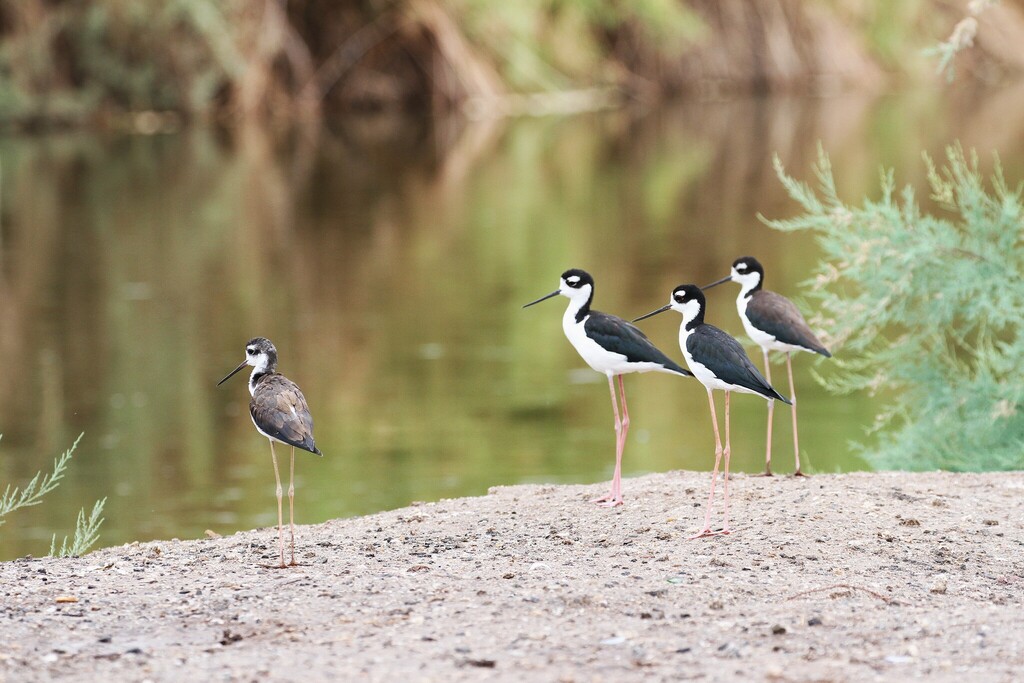
(c) Xochitl Zambrano, some rights reserved (CC BY) · licence
Family: Recurvirostridae · Class: Aves · Order: Charadriiformes
Himantopus mexicanus (Black-necked Stilt) is a California animal in the Recurvirostridae family.
The Black-necked Stilt is a large, distinctive shorebird characterized by its extremely long, thin legs and straight, needle-like bill. Adults measure 35 to 39 cm (14 to 15 inches) in length with a wingspan of 68 to 82 cm (27 to 32 inches). The species exhibits striking sexual dimorphism in size, with females averaging larger than males. Adults display bold black and white plumage, with glossy black upperparts contrasting sharply with pure white underparts. The back of the neck and head are black, creating the characteristic "black-necked" appearance. The long, thin legs are bright pink to red, extending well beyond the tail in flight. The bill is black, straight, and measures 6 to 7 cm in length. Black-necked Stilts have an extensive range throughout the western United States, with California supporting significant breeding populations. The species occurs along the Pacific Coast from southern Oregon to Baja California, and inland throughout the Central Valley, Salton Sea region, and desert areas of southeastern California. Breeding populations are documented in Alameda, Contra Costa, Fresno, Imperial, Kern, Los Angeles, Riverside, Sacramento, San Bernardino, San Diego, San Joaquin, Santa Barbara, Solano, and Tulare counties. The species inhabits shallow wetlands including freshwater and brackish ponds, flooded agricultural fields, managed wetlands, salt ponds, and mudflats. Black-necked Stilts prefer water depths of 9 to 25 cm (3.5 to 10 inches) for optimal foraging. They require areas with exposed mudflats or shallow water edges for feeding, and slightly elevated sites on islands, levees, or marsh edges for nesting. The species adapts well to human-modified habitats, commonly using rice fields, sewage ponds, and restored wetlands. Black-necked Stilts are opportunistic foragers, using their long bills to probe soft substrates and pick prey from water surfaces. Their diet consists primarily of small fish, aquatic insects, larvae, crustaceans, worms, and occasionally amphibians. The species exhibits a distinctive feeding behavior, often wading in deeper water than most shorebirds due to their exceptionally long legs. Breeding occurs from April through August, with peak nesting in May and June. Pairs construct simple scrape nests lined with shells, pebbles, or vegetation on bare ground near water. Females typically lay 3 to 5 eggs, which both parents incubate for 22 to 26 days. Young are precocial and can walk and swim within hours of hatching. The Black-necked Stilt is not federally or state listed in California as of December 2025. Continental populations appear stable, though the species faces ongoing challenges from wetland habitat loss, water diversions, and climate change impacts on wetland ecosystems. In California, agricultural conversion and urban development have eliminated significant portions of historical wetland habitat. However, the species has benefited from wetland restoration projects and management of flooded rice fields, which provide important foraging and breeding habitat throughout the Central Valley.
Classification
Class: Aves · Order: Charadriiformes · Family: Recurvirostridae
Frequently asked questions
How is Himantopus mexicanus classified?
Himantopus mexicanus belongs to class Aves, order Charadriiformes, family Recurvirostridae.
What family does Himantopus mexicanus belong to?
Himantopus mexicanus is in the Recurvirostridae family.
What is Himantopus mexicanus?
The Black-necked Stilt is a large, distinctive shorebird characterized by its extremely long, thin legs and straight, needle-like bill.
Is Himantopus mexicanus found in California?
Yes. Himantopus mexicanus is recorded in California in The California Species Project's catalogue.
Related species
Other California species in the same genus, family, or bioregion.
Data from The California Species Project — 14,000+ California species with verified data from CNPS, CDFW, USFWS, and more.