Hirundo rustica
Barn Swallow
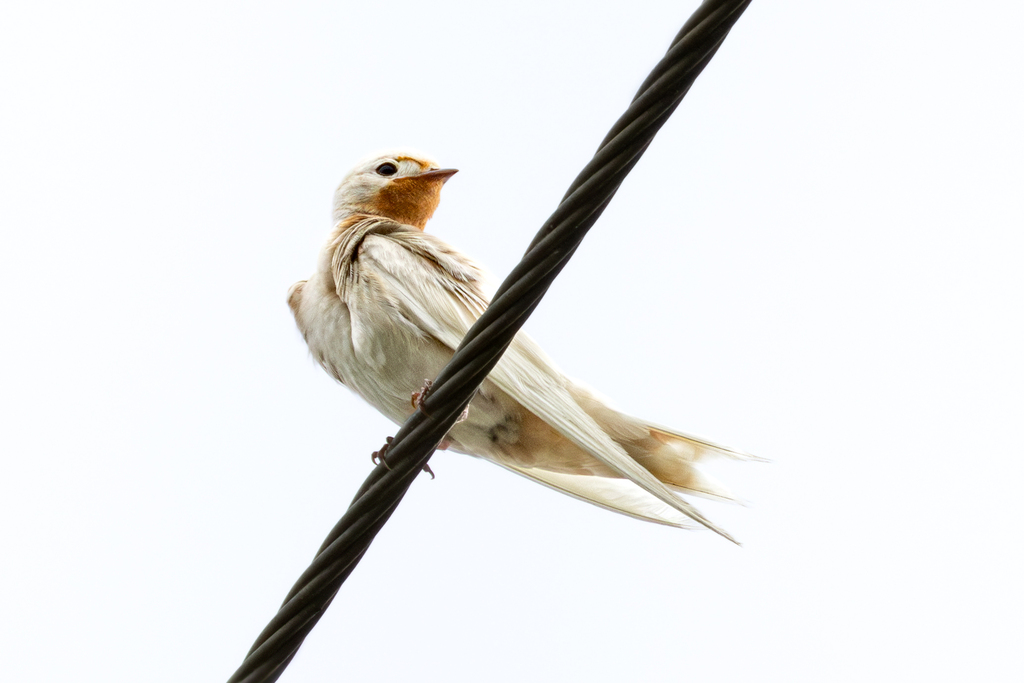
(c) Diego González Dopico, some rights reserved (CC BY) · licence
Family: Hirundinidae · Class: Aves · Order: Passeriformes
Hirundo rustica (Barn Swallow) is a California animal in the Hirundinidae family.
The Barn Swallow is a medium-sized passerine bird measuring 15-19 cm (5.9-7.5 inches) in length with a wingspan of 29-32 cm (11.4-12.6 inches). Adults weigh 16-22 grams. The species displays pronounced sexual dimorphism and seasonal variation in plumage. Males in breeding plumage have glossy blue-black upperparts, a rust-colored forehead and throat, and buffy to rust-colored underparts. The distinctive deeply forked tail features white spots on all but the central feathers. Females are similar but duller, with shorter tail streamers and paler underparts. Juveniles lack the pronounced tail fork and display brownish upperparts with pale, spotted underparts. Historically, Barn Swallows bred throughout most of North America, from Alaska to Mexico. In California, the species breeds in suitable habitat from sea level to approximately 2,800 meters (9,200 feet) elevation, occurring in all counties except those in the most arid southeastern deserts. The species is a long-distance migrant, with North American populations wintering primarily in Central and South America, from Mexico to Argentina. During migration, Barn Swallows can be observed throughout California from March through October. Barn Swallows inhabit open areas near water sources, including agricultural lands, pastures, meadows, and suburban environments. The species requires both foraging areas with abundant aerial insects and suitable nesting sites. Originally nesting on cliff faces and in caves, Barn Swallows have adapted extensively to human-made structures, now predominantly nesting under eaves, in barns, garages, bridges, and other covered structures that provide horizontal surfaces for nest attachment. Barn Swallows are aerial insectivores, capturing prey exclusively on the wing during daylight hours. Their diet consists primarily of flies, beetles, flying ants, moths, and other small flying insects. The species typically forages within 200 meters of the nest site, often flying low over water, fields, and lawns. Breeding occurs from April through August in California. Pairs construct cup-shaped nests from mud pellets mixed with grass and lined with feathers. Females lay 3-6 white eggs spotted with brown, which are incubated for 13-17 days. Both parents feed nestlings for 18-23 days until fledging. Pairs commonly produce two broods per season, with some producing three in favorable conditions. Barn Swallows are not federally or state listed in California and maintain stable populations across much of their range. However, the species has experienced population declines in North America, with Breeding Bird Survey data indicating a 38% decline between 1970 and 2019. Primary threats include loss of nesting habitat due to modern building practices that eliminate traditional nest sites, agricultural intensification reducing insect prey abundance, and pesticide use. Climate change may affect migration timing and insect availability. Despite these challenges, the species' adaptability to human-modified environments has enabled it to maintain widespread distribution across suitable habitat in California.
Classification
Class: Aves · Order: Passeriformes · Family: Hirundinidae
Frequently asked questions
How is Hirundo rustica classified?
Hirundo rustica belongs to class Aves, order Passeriformes, family Hirundinidae.
What family does Hirundo rustica belong to?
Hirundo rustica is in the Hirundinidae family.
What is Hirundo rustica?
The Barn Swallow is a medium-sized passerine bird measuring 15-19 cm (5.9-7.5 inches) in length with a wingspan of 29-32 cm (11.4-12.6 inches).
Is Hirundo rustica found in California?
Yes. Hirundo rustica is recorded in California in The California Species Project's catalogue.
Related species
Other California species in the same genus, family, or bioregion.
Data from The California Species Project — 14,000+ California species with verified data from CNPS, CDFW, USFWS, and more.