Histrionicus histrionicus
Harlequin Duck
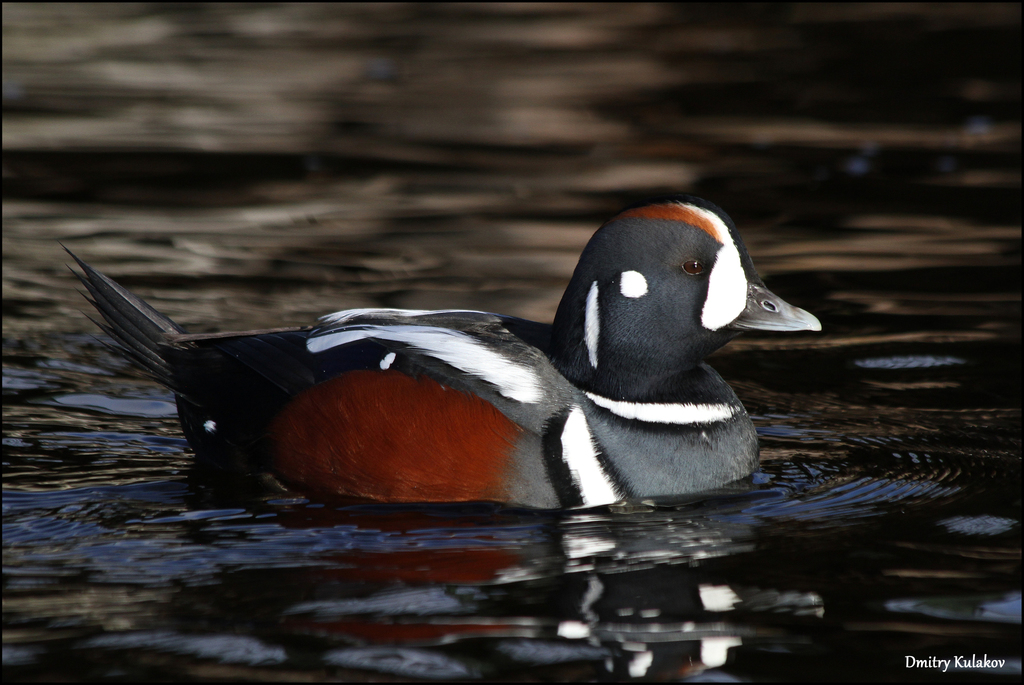
(c) Dmitry Kulakov, some rights reserved (CC BY) · licence
Family: Anatidae · Class: Aves · Order: Anseriformes
Conservation status: G4 S2
Histrionicus histrionicus (Harlequin Duck) is a California animal in the Anatidae family.
The Harlequin Duck is a distinctive medium-sized sea duck with highly specialized adaptations for life in turbulent coastal waters and fast-flowing mountain streams. Adult males measure 38-45 cm (15-18 inches) in length and weigh 450-680 grams (1.0-1.5 pounds), while females are slightly smaller at 425-600 grams. Breeding males display striking plumage with blue-gray body coloration punctuated by white patches outlined in black, creating a distinctive harlequin pattern. Notable features include white crescents behind the eyes, white shoulder patches, and white flank stripes. Females and non-breeding males are predominantly brown with three distinctive white facial patches and white ear spots. In North America, Harlequin Ducks breed in two disjunct populations: a Pacific population ranging from Alaska to central California, and an Atlantic population in eastern Canada and Maine. The Pacific breeding range extends along the coast from the Aleutian Islands south to northern California, with inland populations in mountainous regions of Alaska, western Canada, and the northwestern United States. California represents the southern extent of the Pacific population's range, where the species occurs primarily as a winter visitor along rocky coastlines. Harlequin Ducks occupy two distinct seasonal habitats. During the breeding season, they inhabit fast-flowing mountain streams and rivers with rocky substrates, typically at elevations ranging from sea level to 1,500 meters (4,920 feet). These waterways feature boulder-strewn channels, white-water rapids, and deep pools adjacent to coniferous forests. In winter, the species moves to exposed rocky coastlines with high wave energy, particularly areas with extensive intertidal zones and kelp forests. California's winter populations concentrate along the north coast, especially in Mendocino, Humboldt, and Del Norte counties. Harlequin Ducks are highly specialized feeders adapted to foraging in turbulent waters. During the breeding season, they consume primarily aquatic invertebrates including mayfly nymphs, caddisfly larvae, chironomid larvae, and small fish. Winter diet shifts to marine invertebrates, particularly blue mussels, barnacles, amphipods, and small crustaceans obtained through diving in surf zones. Breeding occurs from May through August, with females constructing nests in rock crevices or under vegetation near streams. Clutch size averages 5-7 cream-colored eggs with an incubation period of 27-29 days. Females provide sole parental care, and broods remain with mothers for 35-42 days until fledging. The species' global conservation status is considered stable with a G4 ranking, but California populations are uncommon with an S2 state ranking indicating imperiled status. According to eBird data, fewer than 200 individuals typically winter in California waters as of December 2025. Primary threats include habitat degradation from mining activities affecting mountain streams, coastal development, oil spills, and climate change impacts on marine food webs. The species' specialized habitat requirements and small California population make it particularly vulnerable to environmental changes affecting rocky coastal ecosystems.
Classification
Class: Aves · Order: Anseriformes · Family: Anatidae
Conservation status
G4 S2
Frequently asked questions
How is Histrionicus histrionicus classified?
Histrionicus histrionicus belongs to class Aves, order Anseriformes, family Anatidae.
What family does Histrionicus histrionicus belong to?
Histrionicus histrionicus is in the Anatidae family.
Is Histrionicus histrionicus protected or of conservation concern?
Histrionicus histrionicus carries the following status: G4 S2.
What is Histrionicus histrionicus?
The Harlequin Duck is a distinctive medium-sized sea duck with highly specialized adaptations for life in turbulent coastal waters and fast-flowing mountain streams.
Is Histrionicus histrionicus found in California?
Yes. Histrionicus histrionicus is recorded in California in The California Species Project's catalogue.
Related species
Other California species in the same genus, family, or bioregion.
Data from The California Species Project — 14,000+ California species with verified data from CNPS, CDFW, USFWS, and more.