Hofmannophila pseudospretella
Brown House Moth
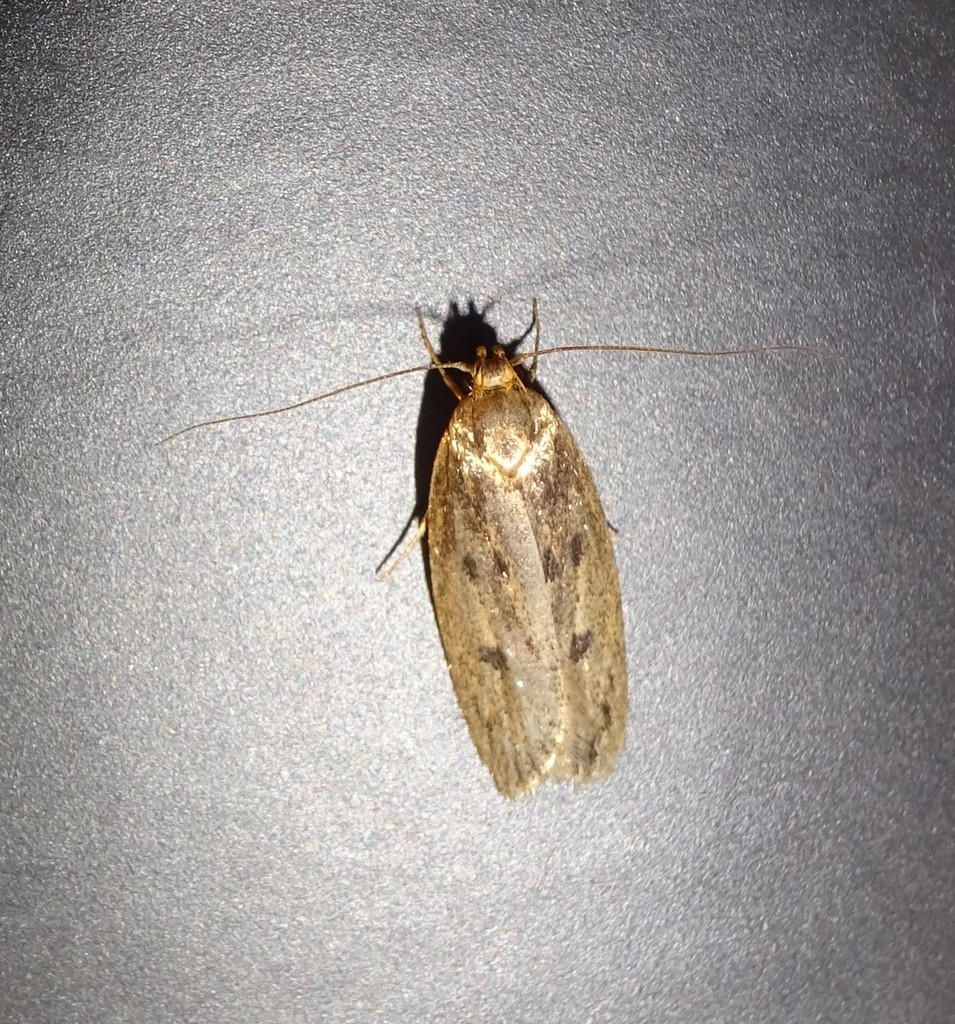
(c) Guillaume Hoffmann, some rights reserved (CC BY) · licence
Family: Oecophoridae · Class: Insecta · Order: Lepidoptera
Hofmannophila pseudospretella (Brown House Moth) is a California animal in the Oecophoridae family.
The brown house moth (Hofmannophila pseudospretella) is a small cosmopolitan lepidopteran species in the family Oecophoridae. Adults measure 8 to 14 mm in length with a wingspan of 15 to 26 mm. The forewings are bronze-brown to dark brown with darker speckled markings and pale cream or whitish spots scattered across the surface. The hindwings are pale gray to light brown and narrower than the forewings. At rest, the moth holds its wings in a characteristic tent-like position over the body. This species has a nearly worldwide distribution, likely originating in the Old World but now established across temperate and subtropical regions. In California, the brown house moth occurs throughout the state from coastal areas to inland valleys, primarily in association with human habitation. The species has been documented in urban, suburban, and rural environments where suitable host materials are present. The brown house moth inhabits indoor environments including homes, warehouses, museums, libraries, and other buildings where organic materials are stored. Unlike many lepidopteran species that require specific host plants, this moth has adapted to utilize a remarkably broad range of materials. Larvae feed on wool, fur, feathers, dried plant materials, stored grains, paper, book bindings, and various organic debris. The species particularly favors materials with high keratin content but readily exploits cellulose-based substrates as well. Adult moths are primarily nocturnal and are attracted to artificial lights. Females lay 50 to 100 small, white eggs singly or in small clusters on or near suitable larval food sources. The larval stage lasts 2 to 24 months depending on temperature, humidity, and food quality. Larvae construct silk-lined galleries or cases within their food substrate and may undergo 5 to 45 molts before pupation. The extended larval development period allows the species to survive in materials with low nutritional value. Pupation occurs within a silken cocoon, often incorporating debris from the feeding site. The species typically completes one to three generations per year in California, with continuous breeding possible under favorable indoor conditions. The brown house moth holds no formal conservation status and is not considered threatened or endangered. As a cosmopolitan pest species, populations are generally stable or expanding in association with human activities. The moth is primarily regarded as a household and commercial pest due to larval damage to textiles, stored products, and museum specimens. Control measures focus on prevention through proper storage of susceptible materials, maintaining low humidity levels, and regular cleaning to remove potential food sources. The species' broad dietary range and ability to complete development on marginal food sources make it particularly successful in human-modified environments, though this same adaptability contributes to its pest status rather than conservation concern.
Classification
Class: Insecta · Order: Lepidoptera · Family: Oecophoridae
Frequently asked questions
How is Hofmannophila pseudospretella classified?
Hofmannophila pseudospretella belongs to class Insecta, order Lepidoptera, family Oecophoridae.
What family does Hofmannophila pseudospretella belong to?
Hofmannophila pseudospretella is in the Oecophoridae family.
What is Hofmannophila pseudospretella?
The brown house moth (Hofmannophila pseudospretella) is a small cosmopolitan lepidopteran species in the family Oecophoridae.
Is Hofmannophila pseudospretella found in California?
Yes. Hofmannophila pseudospretella is recorded in California in The California Species Project's catalogue.
Related species
Other California species in the same genus, family, or bioregion.
Data from The California Species Project — 14,000+ California species with verified data from CNPS, CDFW, USFWS, and more.