Hogna antelucana
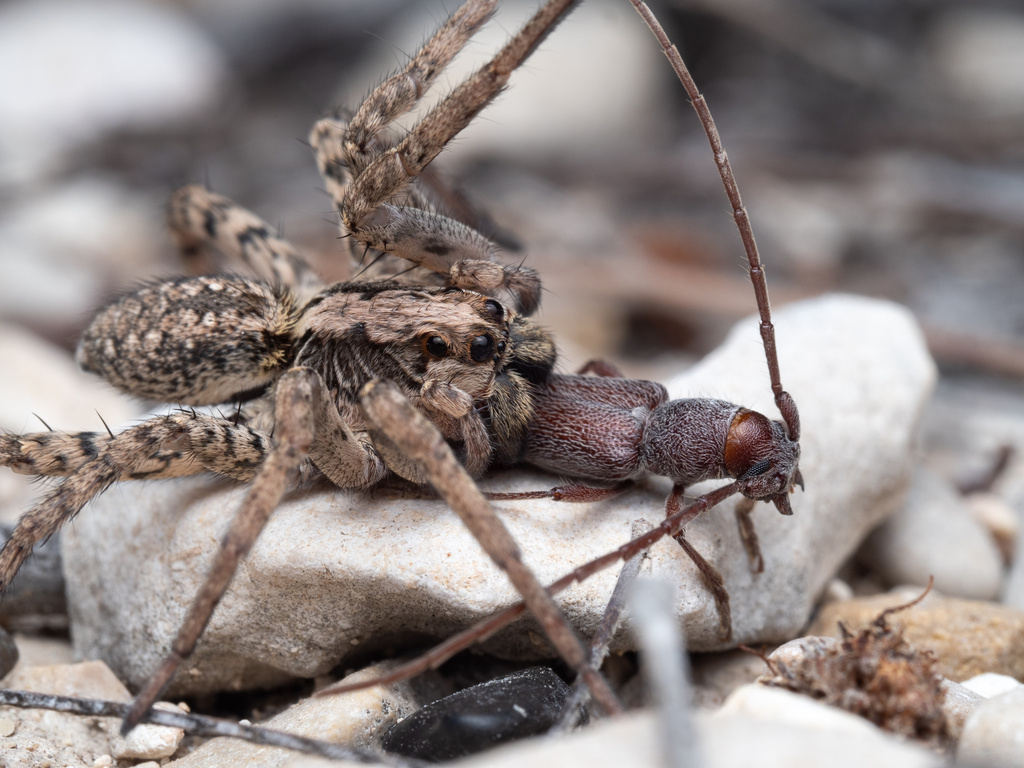
(c) Turner Brockman, some rights reserved (CC BY-SA) · licence
Family: Lycosidae · Class: Arachnida · Order: Araneae
Hogna antelucana is a California animal in the Lycosidae family.
Hogna antelucana is a burrowing wolf spider belonging to the family Lycosidae, one of the largest and most widely distributed spider families. This species represents part of the diverse arachnid fauna found in western North America, though detailed scientific documentation remains limited in the published literature. Wolf spiders in the genus Hogna are typically robust, ground-dwelling hunters characterized by their excellent eyesight and maternal care behaviors. These spiders possess eight eyes arranged in three rows, with the posterior median eyes being notably large and providing acute vision for hunting prey. Body coloration in Hogna species generally consists of cryptic brown and gray patterns that provide effective camouflage against soil and leaf litter substrates. The specific geographic range and distribution of H. antelucana has not been comprehensively documented in available scientific literature. Wolf spiders of this genus are typically found across various terrestrial habitats in western regions, though precise locality records for this species require further research and verification. Habitat preferences for H. antelucana likely include areas suitable for burrow construction, as suggested by observations of burrowing behavior in related Hogna species (Xerces Society 2014). Burrowing wolf spiders typically excavate silk-lined retreats in sandy or loose soil substrates, often in open areas with sparse vegetation. These burrows serve as hunting bases from which the spiders emerge to capture prey, primarily during evening and nighttime hours. Like other wolf spiders, H. antelucana is presumed to be a nocturnal predator that hunts actively rather than constructing webs to capture prey. Their diet likely consists of various ground-dwelling arthropods including beetles, crickets, and other spiders. Mating in wolf spiders involves complex courtship behaviors where males perform species-specific visual and vibratory displays to attract females. After mating, females carry their egg sacs attached to their spinnerets and later transport newly hatched spiderlings on their backs for several days. The conservation status of H. antelucana has not been formally assessed by state or federal wildlife agencies. Like many arachnid species, detailed population data and trend information are not available. Wolf spiders face potential threats from habitat modification, agricultural practices, and urban development, though their often cryptic nature and broad habitat tolerance may provide some resilience to environmental changes. Scientific documentation for this species remains limited. The information presented here synthesizes available sources and general knowledge of wolf spider ecology. Additional research is needed to better understand the specific distribution, habitat requirements, and conservation needs of H. antelucana. Field studies documenting occurrence records, ecological associations, and population status would contribute valuable data for this understudied arachnid species.
Classification
Class: Arachnida · Order: Araneae · Family: Lycosidae
Frequently asked questions
How is Hogna antelucana classified?
Hogna antelucana belongs to class Arachnida, order Araneae, family Lycosidae.
What family does Hogna antelucana belong to?
Hogna antelucana is in the Lycosidae family.
What is Hogna antelucana?
Hogna antelucana is a burrowing wolf spider belonging to the family Lycosidae, one of the largest and most widely distributed spider families.
Is Hogna antelucana found in California?
Yes. Hogna antelucana is recorded in California in The California Species Project's catalogue.
Related species
Other California species in the same genus, family, or bioregion.
Data from The California Species Project — 14,000+ California species with verified data from CNPS, CDFW, USFWS, and more.