Holocnemus pluchei
Marbled Cellar Spider
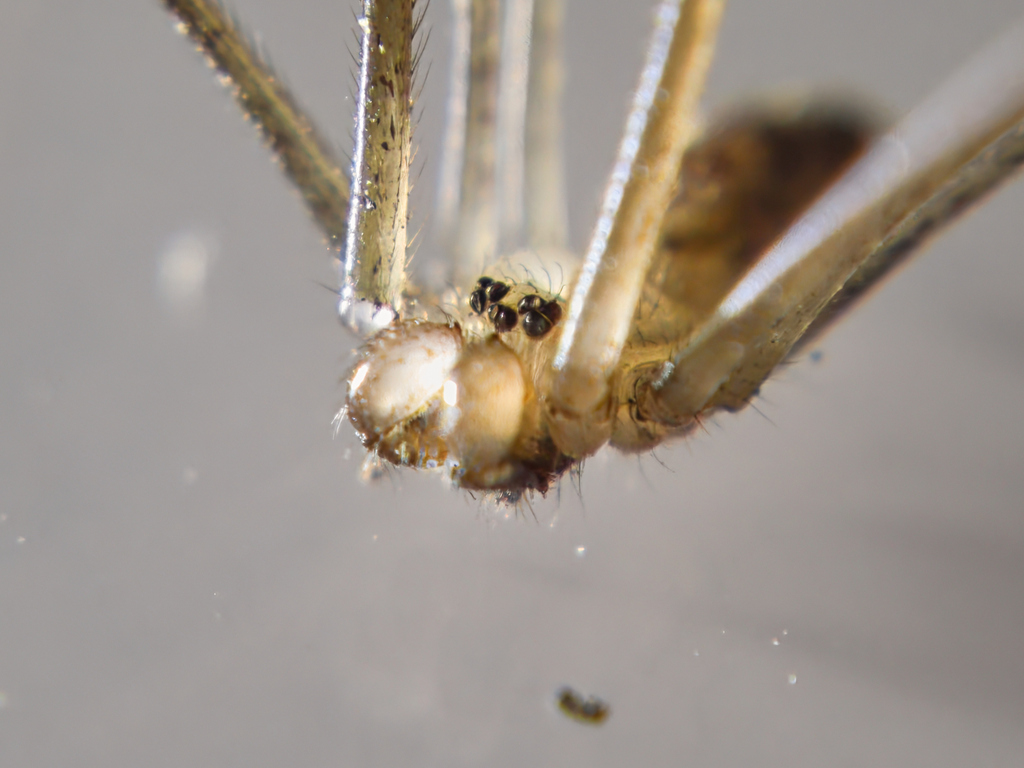
(c) Atalay Karakuş, some rights reserved (CC BY) · licence
Family: Pholcidae · Class: Arachnida · Order: Araneae
Holocnemus pluchei (Marbled Cellar Spider) is a California animal in the Pholcidae family.
Holocnemus pluchei, commonly known as the Marbled Cellar Spider, is a member of the family Pholcidae (cellar spiders or daddy longlegs spiders). This species is distinguished from native North American pholcids by its introduced status and behavioral characteristics. The Marbled Cellar Spider was introduced to the southwestern United States from the Mediterranean region (BugGuide). Unlike many other pholcid species, H. pluchei exhibits a notable preference for constructing webs in exposed areas rather than the typically concealed locations favored by most cellar spiders (BugGuide). This behavioral distinction serves as one identifying characteristic for field identification. As a member of the Pholcidae family, this species likely shares common physical characteristics with other cellar spiders, including long, thin legs relative to body size and the ability to vibrate rapidly in webs when disturbed. However, specific morphological details, size measurements, and distinguishing features of H. pluchei have not been well documented in available scientific literature. The current distribution of the Marbled Cellar Spider in California and the broader southwestern United States remains poorly documented. As an introduced species from the Mediterranean, it likely thrives in similar climatic conditions, potentially favoring areas with mild, Mediterranean-type climates found in coastal and inland valleys of California. Habitat preferences beyond the tendency to build webs in exposed locations have not been thoroughly studied. Like other pholcid spiders, H. pluchei likely constructs irregular, three-dimensional webs and may be found in human-modified environments including buildings, gardens, and other structures where suitable web-building sites exist. Ecological information regarding prey preferences, reproductive behavior, seasonal activity patterns, and life cycle details for H. pluchei is largely undocumented in accessible scientific literature. As a pholcid spider, it presumably feeds on small flying insects caught in its web and likely exhibits typical cellar spider behaviors including egg-carrying by females and communal web-building in some circumstances. The conservation status of H. pluchei has not been formally assessed by federal or state agencies. As an introduced species, it is not protected under endangered species legislation. The ecological impact of this introduction on native spider communities and ecosystems has not been systematically studied. The species' establishment success and population trends in North America remain undocumented. Scientific documentation for this species remains extremely limited. The information presented here is based on available sources including BugGuide community observations. Detailed studies of morphology, distribution, habitat requirements, and ecological role are needed to better understand this introduced species. If you have additional verified information about this species' biology, distribution, or ecology, please contact us to help improve this species account.
Classification
Class: Arachnida · Order: Araneae · Family: Pholcidae
Frequently asked questions
How is Holocnemus pluchei classified?
Holocnemus pluchei belongs to class Arachnida, order Araneae, family Pholcidae.
What family does Holocnemus pluchei belong to?
Holocnemus pluchei is in the Pholcidae family.
What is Holocnemus pluchei?
Holocnemus pluchei, commonly known as the Marbled Cellar Spider, is a member of the family Pholcidae (cellar spiders or daddy longlegs spiders).
Is Holocnemus pluchei found in California?
Yes. Holocnemus pluchei is recorded in California in The California Species Project's catalogue.
Related species
Other California species in the same genus, family, or bioregion.
Data from The California Species Project — 14,000+ California species with verified data from CNPS, CDFW, USFWS, and more.