Holorusia hespera
Giant Western Crane Fly
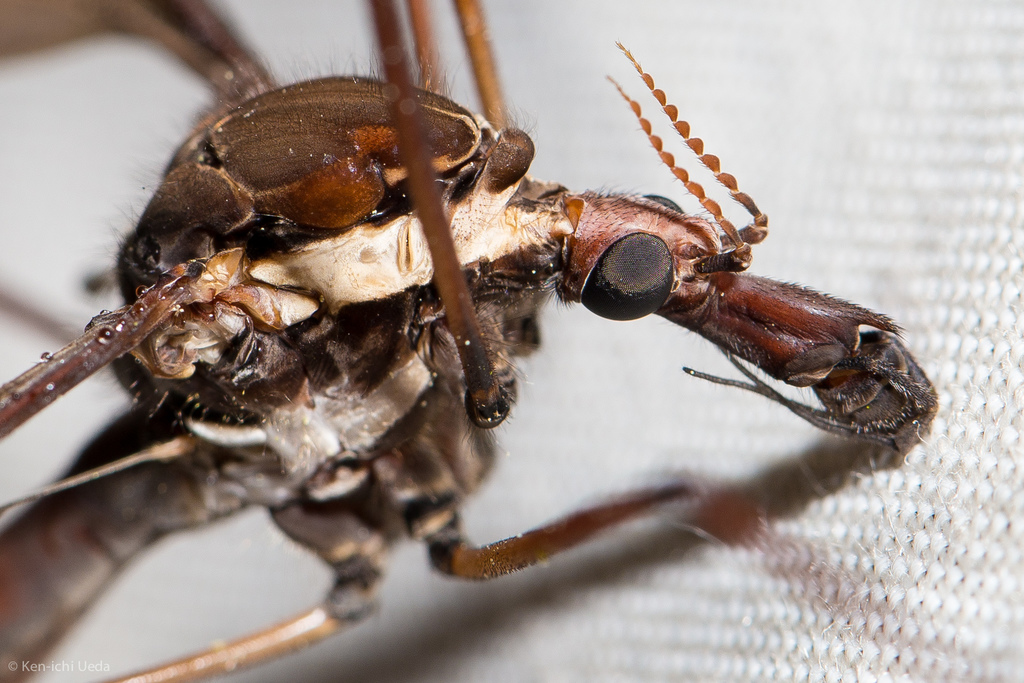
(c) Ken-ichi Ueda, some rights reserved (CC BY) · licence
Family: Tipulidae · Class: Insecta · Order: Diptera
Holorusia hespera (Giant Western Crane Fly) is a California animal in the Tipulidae family.
The Giant Western Crane Fly (Holorusia hespera) is one of the largest crane flies in North America, belonging to the family Tipulidae within the order Diptera. Adults can reach large sizes with wingspans exceeding 75 millimeters (3 inches) and body lengths of 30-40 millimeters (1.2-1.6 inches) (BugGuide 2025). The species displays typical crane fly morphology with extremely long, slender legs that are easily shed when handled, elongated wings, and a narrow body. Adults are generally brown to grayish-brown in coloration with darker wing veins creating a distinctive pattern across the transparent to translucent wings. This species occurs along the Pacific Coast of North America, with documented populations in California, Oregon, and Washington (iNaturalist 2025). In California, the Giant Western Crane Fly has been recorded in coastal and near-coastal areas, particularly in the northern and central regions of the state. The species appears to have a relatively limited distribution compared to smaller crane fly species, with populations concentrated in areas that provide suitable moisture conditions for larval development. Giant Western Crane Flies inhabit areas with high moisture content, including riparian zones, coastal forests, and areas near streams or seeps. Larvae develop in moist soil, decaying organic matter, or semi-aquatic environments where they feed on decomposing plant material and organic debris (Gelhaus et al. 2007). Adult flies are typically encountered in late spring through early fall, with peak activity often occurring during warmer months when conditions favor emergence and reproduction. Larvae, known as leatherjackets, are cylindrical and grayish, living in the soil where they play important ecological roles as decomposers. Adults are short-lived and primarily focused on reproduction, with males often forming mating swarms. Despite their large size, adult crane flies do not bite or sting humans and have very weak mouthparts unsuited for feeding on anything substantial. Their large size makes them frequent subjects of public concern, though they are completely harmless beneficial insects. The conservation status of Holorusia hespera has not been formally evaluated by state or federal agencies, and the species does not appear on any endangered species lists. However, like many insects dependent on specific moisture conditions and undisturbed habitats, populations may face pressure from habitat modification, urban development, and climate change effects on precipitation patterns. The species' relatively large size and specific habitat requirements may make it more vulnerable to environmental changes compared to smaller, more generalist crane fly species. Detailed scientific documentation for this species remains limited despite its notable size and distinctiveness. The information presented here synthesizes available observations from taxonomic databases and community science platforms. Comprehensive ecological studies and systematic surveys would be valuable for better understanding population trends, specific habitat requirements, and conservation needs for this distinctive Pacific Coast species. We welcome contributions of verified scientific data, photographs, or field observations to enhance this species account.
Classification
Class: Insecta · Order: Diptera · Family: Tipulidae
Frequently asked questions
How is Holorusia hespera classified?
Holorusia hespera belongs to class Insecta, order Diptera, family Tipulidae.
What family does Holorusia hespera belong to?
Holorusia hespera is in the Tipulidae family.
What is Holorusia hespera?
The Giant Western Crane Fly (Holorusia hespera) is one of the largest crane flies in North America, belonging to the family Tipulidae within the order Diptera.
Is Holorusia hespera found in California?
Yes. Holorusia hespera is recorded in California in The California Species Project's catalogue.
More California species
This species has no close relatives in our California data — here are other species to explore.
Data from The California Species Project — 14,000+ California species with verified data from CNPS, CDFW, USFWS, and more.