Homalodisca vitripennis
Glassy-winged Sharpshooter
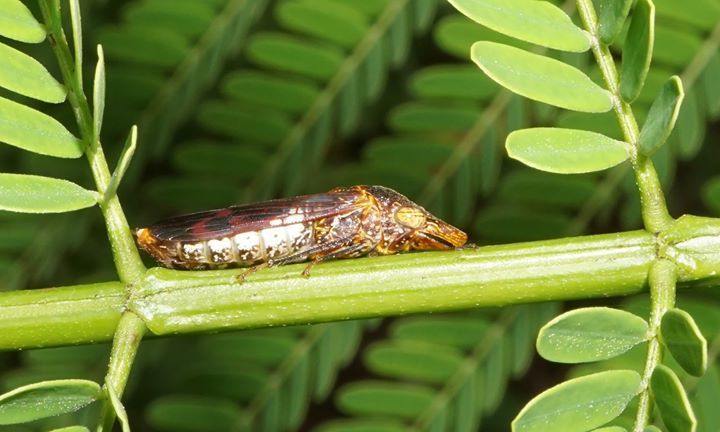
(c) Eridan Xharahi, some rights reserved (CC BY) · licence
Family: Cicadellidae · Class: Insecta · Order: Hemiptera
Homalodisca vitripennis (Glassy-winged Sharpshooter) is a California animal in the Cicadellidae family.
The glassy-winged sharpshooter is a large leafhopper measuring 11-14 mm (0.43-0.55 inches) in length (BugGuide). The species is characterized by its flattened head bearing pale spots on a dark background and distinctive transparent wing patches that give the insect its common name. The forewings display a glassy appearance with tiny spherical structures called brochosomes - microscopic granules composed of proteins and lipids that provide waterproofing (BugGuide). These brochosomes become elongated in females and are used to protect egg clutches. Native to the southeastern United States, the glassy-winged sharpshooter was accidentally introduced to southern California in the 1990s and has since established populations throughout much of the state (Xerces Society 2022). The species has been documented in Orange County and Los Angeles County, with observations extending beyond urban areas into agricultural regions. Unlike the blue-green sharpshooter which is restricted to riparian habitats, this species demonstrates high habitat flexibility. The glassy-winged sharpshooter occupies diverse habitats including agricultural crops, urban landscapes, native woodlands, and riparian vegetation (Xerces Society 2022). It thrives in areas with abundant woody and herbaceous host plants, showing particular association with citrus, eucalyptus, sunflower, hibiscus, xylosma, and cottonwood. The species' broad habitat tolerance has contributed to its successful establishment and spread in California's varied ecosystems. This highly mobile leafhopper feeds by piercing plant tissue and extracting xylem fluid from its hosts. The species has hundreds of documented host plants, making it exceptionally polyphagous (Xerces Society 2022). Females deposit eggs in plant tissue and cover them with protective brochosomes scraped from their wings. The species exhibits seasonal activity patterns typical of temperate leafhoppers, with peak abundance during warmer months. The glassy-winged sharpshooter poses significant agricultural and ecological concerns as an active vector of Xylella fastidiosa, a bacterial pathogen causing Pierce's disease in grapes and other economically important crops including almonds and citrus (Xerces Society 2022). This disease transmission capability has made the species a major pest management priority in California's agricultural regions. The insect's mobility and broad host range facilitate pathogen spread across diverse plant communities. Control strategies focus on monitoring populations and implementing integrated pest management approaches, with insecticide treatment thresholds based simply on the presence of the species due to its disease vector status. The species' establishment in California represents a significant biological invasion with ongoing economic and ecological impacts, particularly in wine-growing regions where Pierce's disease threatens vineyard viability.
Classification
Class: Insecta · Order: Hemiptera · Family: Cicadellidae
Frequently asked questions
How is Homalodisca vitripennis classified?
Homalodisca vitripennis belongs to class Insecta, order Hemiptera, family Cicadellidae.
What family does Homalodisca vitripennis belong to?
Homalodisca vitripennis is in the Cicadellidae family.
What is Homalodisca vitripennis?
The glassy-winged sharpshooter is a large leafhopper measuring 11-14 mm (0.43-0.55 inches) in length (BugGuide).
Is Homalodisca vitripennis found in California?
Yes. Homalodisca vitripennis is recorded in California in The California Species Project's catalogue.
Related species
Other California species in the same genus, family, or bioregion.
Data from The California Species Project — 14,000+ California species with verified data from CNPS, CDFW, USFWS, and more.