Homoglaea carbonaria
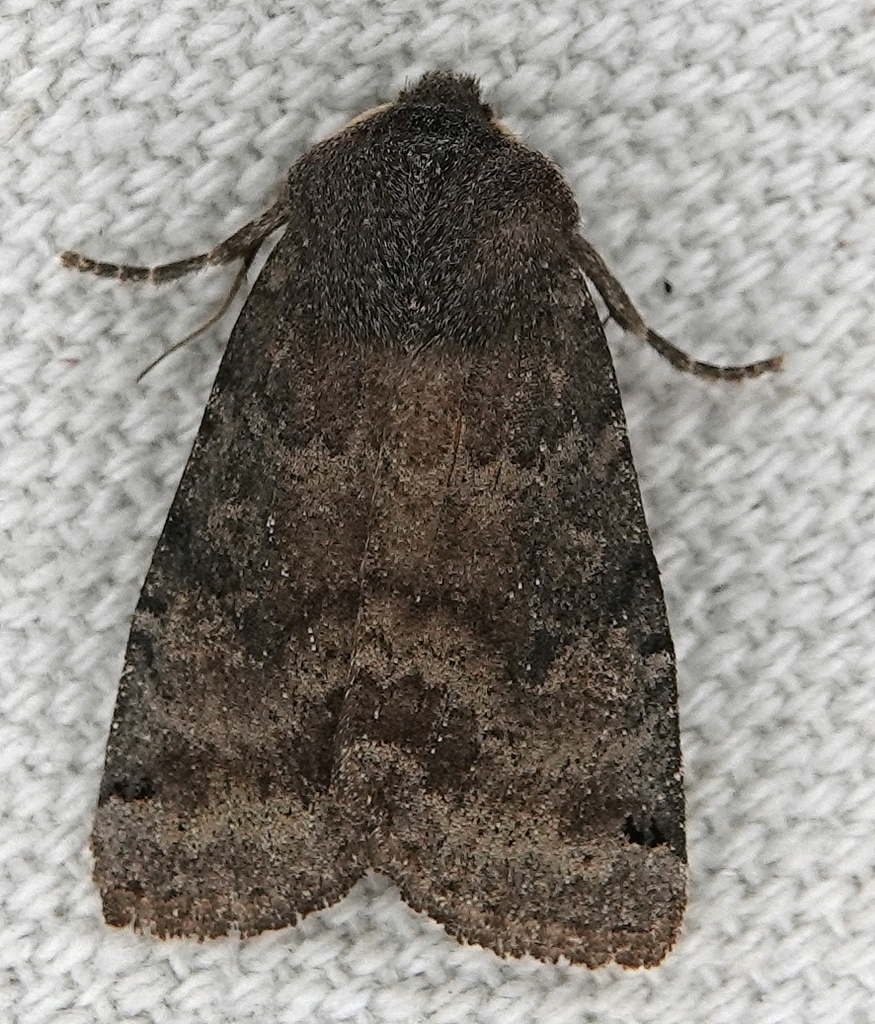
(c) Colin Croft, some rights reserved (CC BY) · licence
Family: Noctuidae · Class: Insecta · Order: Lepidoptera
Homoglaea carbonaria is a California animal in the Noctuidae family.
Homoglaea carbonaria is a nocturnal moth in the family Noctuidae, commonly known as the Carbonaria dart moth or coal-black dart. Adults exhibit a wingspan of approximately 28 to 35 millimeters (1.1 to 1.4 inches). The forewings are typically dark gray to blackish-brown with subtle darker markings, while the hindwings are lighter gray with darker borders. The thorax and abdomen are covered in dark gray to brownish scales, giving the moth its characteristic subdued coloration. Males can be distinguished from females by their more feathered antennae and slightly smaller size. This species ranges from California eastward to Texas, extending north through the western United States and Canada to British Columbia and Alberta. Within California, Homoglaea carbonaria occurs primarily in mountainous and foothill regions where suitable host plants are present. The species is found at elevations ranging from approximately 300 to 2,100 meters (1,000 to 7,000 feet), with populations documented in the Sierra Nevada, Cascade Range, and Coast Ranges. The moth inhabits riparian corridors, canyon bottoms, and moist mountain slopes where willows (Salix species), cottonwoods (Populus species), and quaking aspen (Populus tremuloides) grow. These deciduous trees and shrubs serve as both larval host plants and adult nectar sources. The species shows particular association with areas near streams, springs, and other water sources that support healthy stands of Salicaceae family trees. Preferred habitats include mixed coniferous forests with riparian components, aspen groves, and willow thickets in montane environments. Adults are active from late June through August, with peak flight occurring in July. Males are attracted to lights and pheromone sources during nighttime hours. Females deposit eggs singly or in small clusters on host plant leaves, typically on the undersides. Larvae feed on willow, cottonwood, and aspen foliage from late summer through early fall. The caterpillars are initially green with pale stripes but darken as they mature, reaching approximately 30 to 35 millimeters in length before pupating. The species overwinters as pupae in the soil or leaf litter beneath host trees. Adults emerge the following summer after a single generation per year. Homoglaea carbonaria is not federally listed or state-listed in California. The species appears to maintain stable populations throughout most of its range, though local populations may be affected by habitat loss in riparian areas. Primary threats include water diversions that affect riparian vegetation, urban development in suitable habitat, and forest management practices that reduce native deciduous tree cover. Climate change may impact the species through alterations to precipitation patterns affecting host plant communities and shifts in suitable elevation ranges. Conservation of riparian corridors and maintenance of native Salicaceae stands supports population persistence across the species' range.
Classification
Class: Insecta · Order: Lepidoptera · Family: Noctuidae
Frequently asked questions
How is Homoglaea carbonaria classified?
Homoglaea carbonaria belongs to class Insecta, order Lepidoptera, family Noctuidae.
What family does Homoglaea carbonaria belong to?
Homoglaea carbonaria is in the Noctuidae family.
What is Homoglaea carbonaria?
Homoglaea carbonaria is a nocturnal moth in the family Noctuidae, commonly known as the Carbonaria dart moth or coal-black dart.
Is Homoglaea carbonaria found in California?
Yes. Homoglaea carbonaria is recorded in California in The California Species Project's catalogue.
Related species
Other California species in the same genus, family, or bioregion.
Data from The California Species Project — 14,000+ California species with verified data from CNPS, CDFW, USFWS, and more.