Hubbardia secoensis
Arroyo Seco Short- Tailed Whipscorpion
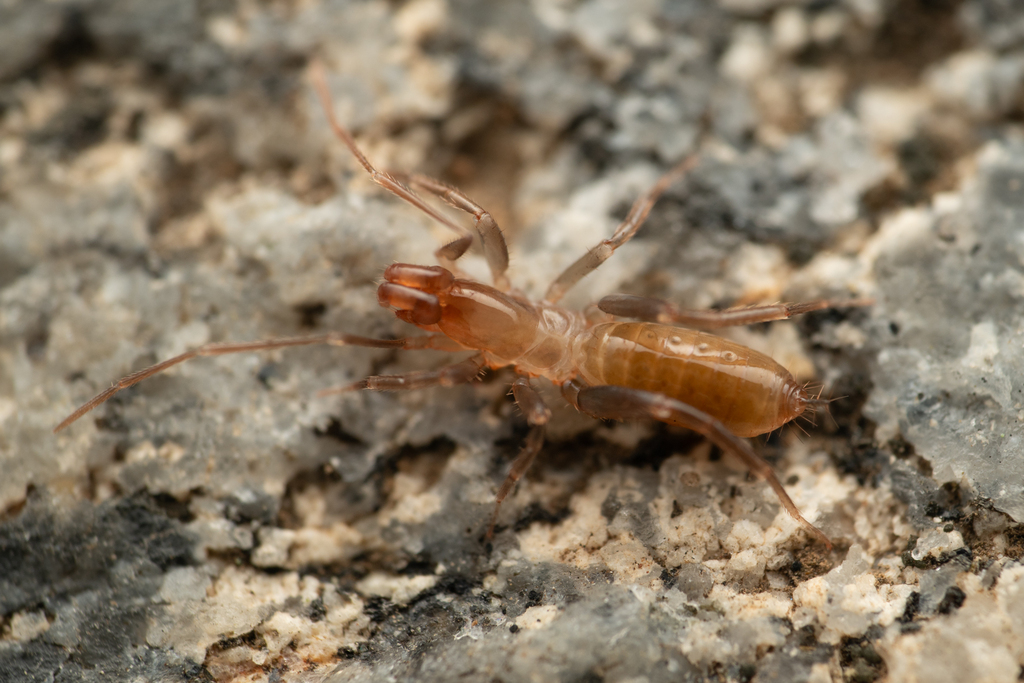
(c) Trevor Van Loon, some rights reserved (CC BY) · licence
Family: Hubbardiidae · Class: Arachnida · Order: Schizomida
Conservation status: G1 S1
Hubbardia secoensis (Arroyo Seco Short- Tailed Whipscorpion) is a California animal in the Hubbardiidae family.
The Arroyo Seco Short-tailed Whipscorpion (Hubbardia secoensis) is a small arachnid belonging to the order Schizomida, family Hubbardiidae. Short-tailed whipscorpions, also known as schizomids, are characterized by their flattened bodies, well-developed pedipalps, and distinctive flagellum-like tail structure. Members of this order typically measure 2-7 mm in body length, with H. secoensis likely falling within this size range. The body is divided into a prosoma (cephalothorax) and opisthosoma (abdomen), with the characteristic segmented flagellum extending from the posterior end. Hubbardia secoensis appears to be endemic to California, though specific distributional data within the state remains poorly documented. The species name 'secoensis' suggests an association with the Arroyo Seco region, which could refer to various locations in California bearing this name, including areas in Los Angeles County, Monterey County, or other regions with similar toponymy. The precise range and number of known populations have not been well established in available literature. Like other schizomids, H. secoensis likely inhabits cryptic microhabitats including leaf litter, soil crevices, under rocks, or within root systems of vegetation. Schizomids are typically found in areas with high humidity and stable microclimatic conditions. They often occur in riparian zones, oak woodlands, or chaparral environments where moisture retention supports their survival. The specific habitat requirements and elevation range for this species have not been thoroughly documented. Short-tailed whipscorpions are predatory arthropods that feed on small invertebrates including springtails, mites, and other soil-dwelling organisms. They are active hunters that use their well-developed pedipalps to capture prey. Reproduction in schizomids involves indirect sperm transfer through spermatophores, with females carrying eggs until hatching. The specific reproductive biology, seasonal activity patterns, and prey preferences of H. secoensis remain largely unstudied. The conservation status of Hubbardia secoensis reflects significant concern, with a global rank of G1 (critically imperiled) and California state rank of S1 (critically imperiled), indicating extreme rarity and vulnerability to extinction. As of December 2025, the species does not appear to have federal listing status under the Endangered Species Act. The G1/S1 ranking suggests fewer than five occurrences or very few remaining individuals. Primary threats likely include habitat loss and degradation, particularly in California's rapidly developing landscapes. The cryptic nature and specialized habitat requirements of schizomids make them particularly vulnerable to environmental disturbance. Scientific documentation for this species remains extremely limited. Detailed ecological studies, population assessments, and habitat characterization are needed to develop effective conservation strategies. The restricted distribution and critical conservation ranking underscore the urgent need for systematic surveys and habitat protection measures. We welcome contributions of verified scientific data, field observations, or photographic documentation to enhance understanding of this rare California endemic.
Classification
Class: Arachnida · Order: Schizomida · Family: Hubbardiidae
Conservation status
G1 S1
Frequently asked questions
How is Hubbardia secoensis classified?
Hubbardia secoensis belongs to class Arachnida, order Schizomida, family Hubbardiidae.
What family does Hubbardia secoensis belong to?
Hubbardia secoensis is in the Hubbardiidae family.
Is Hubbardia secoensis protected or of conservation concern?
Hubbardia secoensis carries the following status: G1 S1.
What is Hubbardia secoensis?
The Arroyo Seco Short-tailed Whipscorpion (Hubbardia secoensis) is a small arachnid belonging to the order Schizomida, family Hubbardiidae.
Is Hubbardia secoensis found in California?
Yes. Hubbardia secoensis is recorded in California in The California Species Project's catalogue.
Related species
Other California species in the same genus, family, or bioregion.
Data from The California Species Project — 14,000+ California species with verified data from CNPS, CDFW, USFWS, and more.