Hyalophora cecropia
Cecropia silkmoth
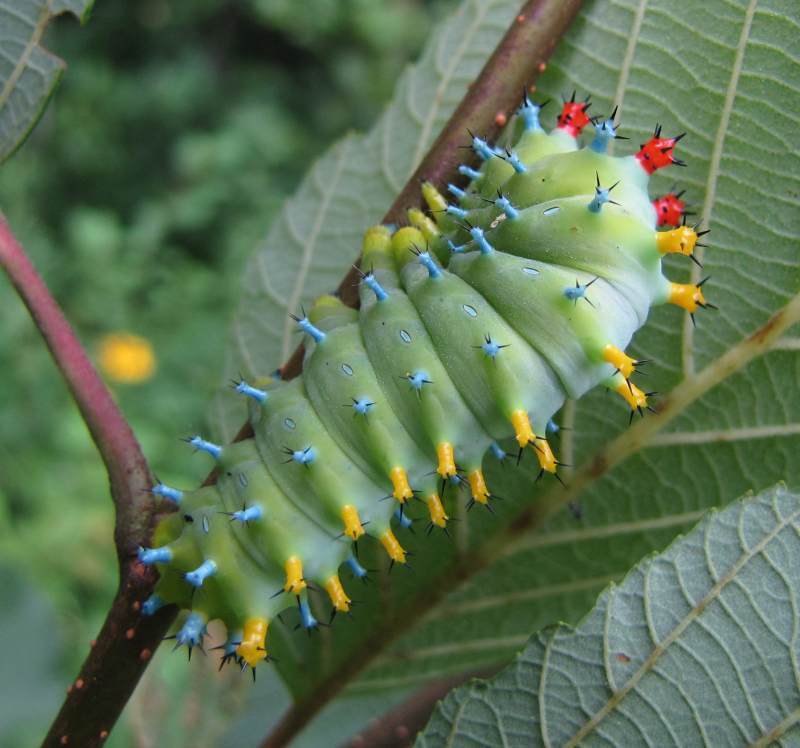
(c) christine123, some rights reserved (CC BY) · licence
Family: Saturniidae · Class: Insecta · Order: Lepidoptera
Hyalophora cecropia (Cecropia silkmoth) is a California animal in the Saturniidae family.
The Cecropia silkmoth (Hyalophora cecropia) is North America's largest native moth, with females reaching wingspans of 127 to 152 mm (5 to 6 inches) and males typically measuring 102 to 127 mm (4 to 5 inches). Adults display distinctive reddish-brown wings marked with white crescents and prominent red, white, and black eyespots on each wing. The forewings feature a kidney-shaped clear window near the tip, while the hindwings bear similar transparent patches. Males possess feathery, bipectinate antennae that are significantly broader than those of females, enabling them to detect female pheromones from considerable distances. Cecropia silkmoths range from Nova Scotia and Maine south to Florida, extending west across southern Canada and the eastern United States to the Rocky Mountains. In California, the species occurs primarily in the northern regions where suitable host plants are present. The species has experienced range contractions in some areas, particularly around urban centers where light pollution and habitat fragmentation have impacted populations. This species inhabits deciduous and mixed forests, forest edges, parks, and suburban areas where host plants are abundant. Larvae develop on various trees and shrubs including box elder (Acer negundo), sugar maple (Acer saccharinum), wild cherries and plums (Prunus species), apples (Malus species), alder and birch (Betulaceae), dogwoods (Cornus species), and willows (Salix species). Adults are found from sea level to moderate elevations, typically below 1,500 meters where host vegetation thrives. Cecropia silkmoths undergo complete metamorphosis with a univoltine life cycle, producing one generation per year. Adults emerge from late May through July, with peak activity in June. Mating occurs at night, with females releasing pheromones to attract males. After mating, females deposit 200 to 300 eggs singly or in small clusters on host plant leaves. Larvae progress through five instars over 8 to 10 weeks, reaching lengths of 76 to 102 mm (3 to 4 inches) before pupating. The distinctive caterpillars are blue-green with rows of colorful tubercles - blue on the dorsal surface and yellow, orange, and red laterally. Pupation occurs in brown, papery cocoons attached to host plant branches. Adults are nocturnal and do not feed, living approximately 7 to 10 days solely to reproduce. The Cecropia silkmoth is not federally or state-listed but has experienced population declines across portions of its range. Primary threats include habitat loss from urbanization and forest fragmentation, light pollution that disrupts mating behavior, pesticide use that affects larvae, and parasitism by introduced tachinid flies (Compsilura concinnata). Climate change may also impact the species through altered host plant phenology and extreme weather events. Conservation efforts focus on habitat preservation, reducing light pollution, and monitoring population trends through citizen science initiatives.
Classification
Class: Insecta · Order: Lepidoptera · Family: Saturniidae
Frequently asked questions
How is Hyalophora cecropia classified?
Hyalophora cecropia belongs to class Insecta, order Lepidoptera, family Saturniidae.
What family does Hyalophora cecropia belong to?
Hyalophora cecropia is in the Saturniidae family.
What is Hyalophora cecropia?
The Cecropia silkmoth (Hyalophora cecropia) is North America's largest native moth, with females reaching wingspans of 127 to 152 mm (5 to 6 inches) and males typically measuring 102 to 127 mm (4 to 5 inches).
Is Hyalophora cecropia found in California?
Yes. Hyalophora cecropia is recorded in California in The California Species Project's catalogue.
Related species
Other California species in the same genus, family, or bioregion.
Data from The California Species Project — 14,000+ California species with verified data from CNPS, CDFW, USFWS, and more.