Hyalophora columbia
Columbia silkmoth
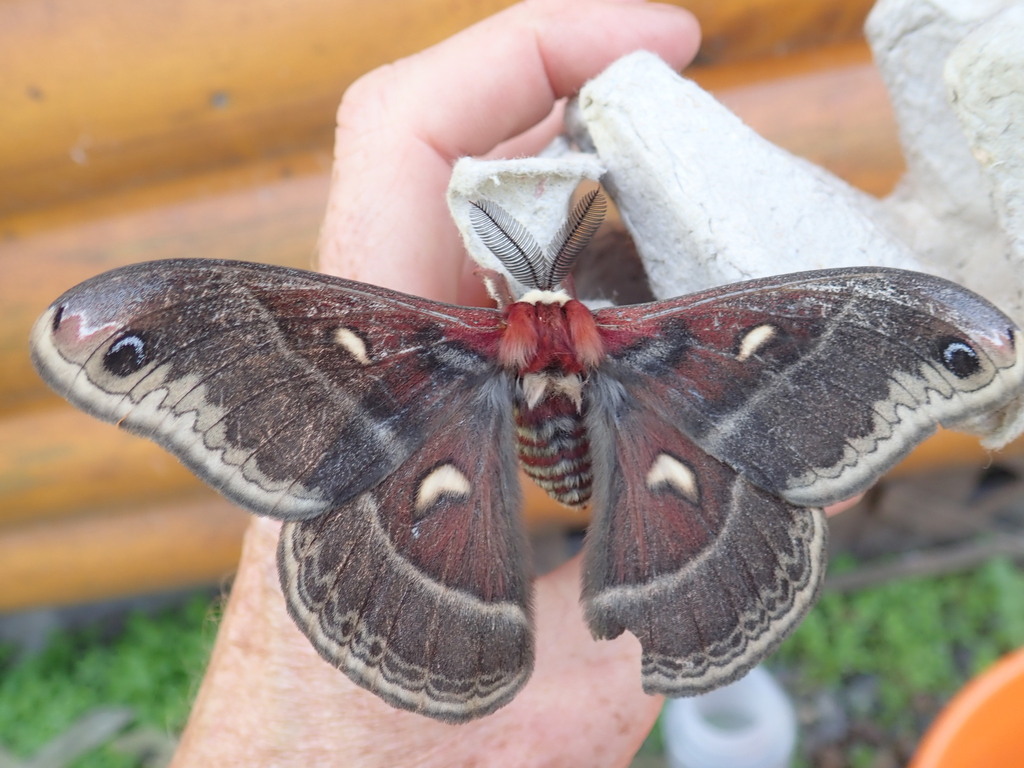
(c) Rob Foster, some rights reserved (CC BY) · licence
Family: Saturniidae · Class: Insecta · Order: Lepidoptera
Hyalophora columbia (Columbia silkmoth) is a California animal in the Saturniidae family.
The Columbia silkmoth is a large moth in the giant silk moth family Saturniidae, with adults displaying distinctive reddish-brown wings marked by prominent white-centered eyespots. The wingspan typically ranges from 90 to 130 mm (3.5 to 5.1 inches), making it one of North America's larger moths. Wings feature a mottled pattern of reddish-brown, cream, and darker brown bands, with each wing bearing a translucent window-like eyespot bordered in white and black. Males possess more feathery antennae than females and are generally smaller in size. The species exhibits a transcontinental distribution across northern North America. In eastern regions, Columbia silkmoths occur from Quebec and Ontario south to Michigan, northern Wisconsin, and southeastern Manitoba. Western populations range from Alberta and Montana south through the Rocky Mountain region to southwest Texas, extending into central Mexico. The subspecies H. c. gloveri, historically known as Glover's silkmoth and once considered a separate species, represents the western form of this moth. Columbia silkmoths inhabit diverse forest ecosystems corresponding to their host plant distributions. Eastern populations are associated with coniferous and mixed forests where tamarack grows, while western populations occupy mountain forests, riparian zones, and shrublands. The species occurs from low elevations in northern regions to higher mountain elevations in southern portions of its range, adapting to various forest types from boreal to montane environments. Host plant associations vary significantly between eastern and western populations. Eastern caterpillars feed primarily on tamarack (Larix laricina), though western Ontario populations also utilize pin cherry (Prunus pensylvanica), speckled alder (Alnus rugosa), and white birch (Betula papyrifera). Western populations demonstrate broader host plant usage, feeding on western choke cherry (Prunus demissa), bitter cherry (P. emarginata), bitterbrush (Purshia tridentata), wild roses (Rosa species), willows (Salix species), buffalo berry (Shepherdia argentea), Russian olive (Eleagnus angustifolius), and buckbrush (Ceanothus species). The species follows a univoltine life cycle, producing one generation annually. Adults emerge in late spring to early summer, typically from May through July depending on latitude and elevation. Females release pheromones to attract males, with mating occurring shortly after emergence. Eggs are deposited singly or in small groups on host plant foliage. Caterpillars develop through five instars over summer months, reaching lengths of 75 to 100 mm before pupating. The species overwinters as pupae in cocoons attached to branches or hidden in leaf litter. Columbia silkmoths currently lack federal or state conservation listing status. However, like many native moths, populations may face pressure from habitat loss, forest management practices, and light pollution. The species' broad host plant range and transcontinental distribution suggest relative stability, though regional population monitoring is limited. Forest fragmentation and conversion to non-native vegetation may impact local populations, particularly where specialized host plants become scarce.
Classification
Class: Insecta · Order: Lepidoptera · Family: Saturniidae
Frequently asked questions
How is Hyalophora columbia classified?
Hyalophora columbia belongs to class Insecta, order Lepidoptera, family Saturniidae.
What family does Hyalophora columbia belong to?
Hyalophora columbia is in the Saturniidae family.
What is Hyalophora columbia?
The Columbia silkmoth is a large moth in the giant silk moth family Saturniidae, with adults displaying distinctive reddish-brown wings marked by prominent white-centered eyespots.
Is Hyalophora columbia found in California?
Yes. Hyalophora columbia is recorded in California in The California Species Project's catalogue.
Related species
Other California species in the same genus, family, or bioregion.
Data from The California Species Project — 14,000+ California species with verified data from CNPS, CDFW, USFWS, and more.