Hyalophora euryalus
Ceanothus Silk Moth
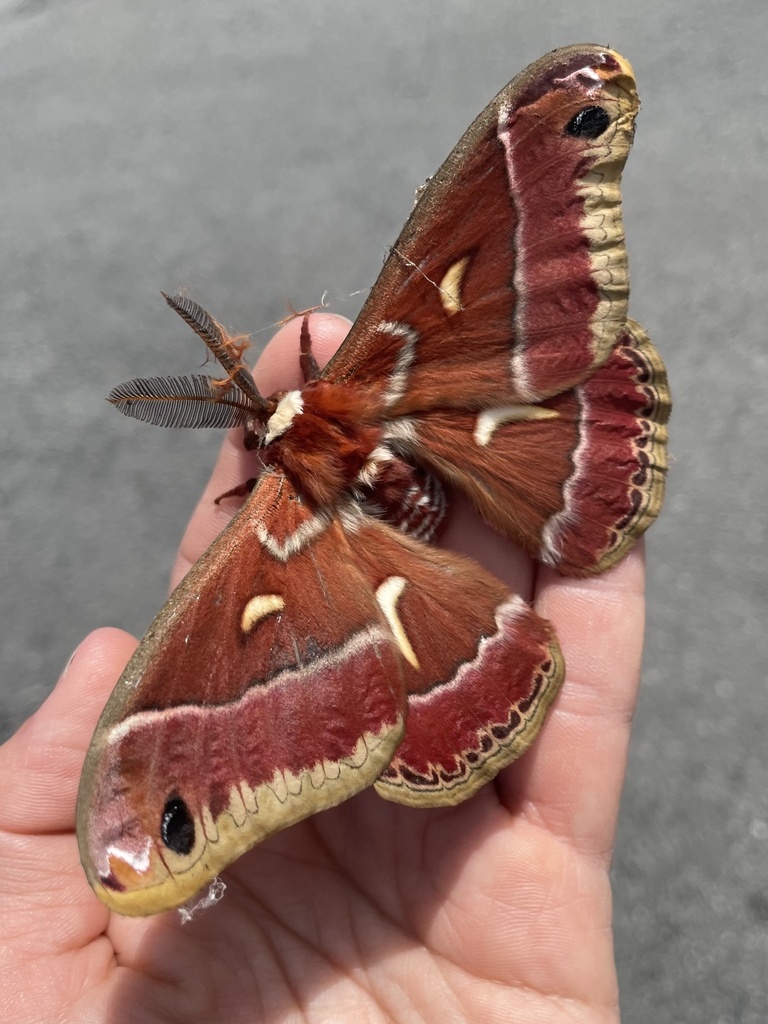
(c) Cricket Raspet, some rights reserved (CC BY) · licence
Family: Saturniidae · Class: Insecta · Order: Lepidoptera
Hyalophora euryalus (Ceanothus Silk Moth) is a California animal in the Saturniidae family.
The Ceanothus silk moth (Hyalophora euryalus) is a large saturniid moth with a wingspan ranging from 100 to 125 mm (3.9 to 4.9 inches). Adults display striking reddish-brown forewings marked with prominent white-centered eyespots and distinctive white striping. The hindwings feature similar eyespots with blue centers surrounded by black rings. Males are distinguished by their more feathery, bipectinate antennae and slightly smaller size compared to females. The robust, segmented abdomen is covered in dense, reddish-brown scales. Caterpillars reach 70 to 80 mm in length when mature, appearing bright green with rows of tubercles bearing spines and distinctive orange, yellow, and blue markings along the body segments. This species ranges from British Columbia east to western Montana, extending south through Washington, western Oregon, and California to Baja California Sur. Within California, the Ceanothus silk moth occurs throughout much of the state, from coastal regions to montane forests. The distribution closely follows the presence of suitable host plants, particularly in areas with Mediterranean and montane climates. Populations are documented from sea level to elevations exceeding 2,000 meters (6,600 feet) in mountainous regions. Ceanothus silk moths inhabit diverse ecosystems including chaparral, mixed conifer forests, oak woodlands, and riparian corridors. The species demonstrates extensive host plant flexibility, utilizing a wide range of plants including buckbrush (Ceanothus), manzanita (Arctostaphylos), gooseberry (Ribes), madrone (Arbutus menziesii), willows (Salix), alder (Alnus), and mountain mahogany (Cercocarpus betuloides). This broad host range contributes to the moth's ability to colonize varied habitats across its extensive geographic distribution. Adults are typically found in areas adjacent to larval host plants, often in edge habitats between forest and open spaces. Ceanothus silk moths are univoltine, producing one generation per year. Adults emerge primarily from April through July, with peak flight activity occurring from May to June depending on elevation and local climate conditions. Mating typically occurs shortly after emergence, with females releasing pheromones to attract males during evening hours. After mating, females deposit eggs singly or in small clusters on host plant foliage. Caterpillars feed throughout summer and early fall, undergoing five instars before pupating in tough, brown cocoons attached to host plant branches. The species overwinters in the pupal stage, with adult emergence synchronized to coincide with new host plant growth the following spring. Adults are attracted to lights and are primarily active during nighttime hours. The Ceanothus silk moth is not federally or state-listed as threatened or endangered. While specific population data are limited, the species appears relatively stable across much of its range due to its broad host plant usage and adaptability to various habitats. However, localized populations may face pressures from habitat fragmentation, urbanization, and wildfire management practices that alter natural vegetation communities. The moth's dependence on native plant communities makes it potentially vulnerable to invasive species and climate-driven vegetation changes in some regions.
Classification
Class: Insecta · Order: Lepidoptera · Family: Saturniidae
Frequently asked questions
How is Hyalophora euryalus classified?
Hyalophora euryalus belongs to class Insecta, order Lepidoptera, family Saturniidae.
What family does Hyalophora euryalus belong to?
Hyalophora euryalus is in the Saturniidae family.
What is Hyalophora euryalus?
The Ceanothus silk moth (Hyalophora euryalus) is a large saturniid moth with a wingspan ranging from 100 to 125 mm (3.9 to 4.9 inches).
Is Hyalophora euryalus found in California?
Yes. Hyalophora euryalus is recorded in California in The California Species Project's catalogue.
Related species
Other California species in the same genus, family, or bioregion.
Data from The California Species Project — 14,000+ California species with verified data from CNPS, CDFW, USFWS, and more.