Hydriomena nubilofasciata
Oak Winter Highflier Moth
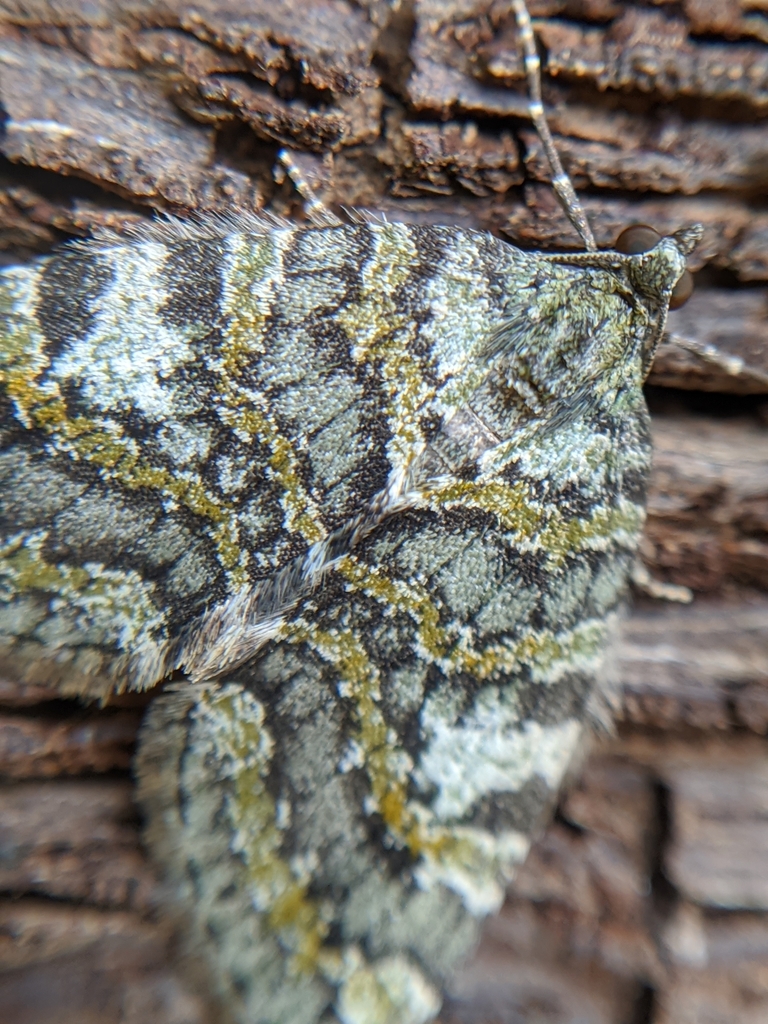
no rights reserved · CC0
Family: Geometridae · Class: Insecta · Order: Lepidoptera
Hydriomena nubilofasciata (Oak Winter Highflier Moth) is a California animal in the Geometridae family.
The Oak Winter Highflier Moth (Hydriomena nubilofasciata) is a geometrid moth in the family Geometridae, subfamily Larentiinae. Adults exhibit the typical characteristics of winter-active geometrids, with forewings measuring approximately 15-20 mm in length. The forewings display a complex pattern of brown, gray, and white markings, with distinctive wavy crosslines that give the species its common name reference to 'nubilofasciata' meaning cloudy-banded. The hindwings are typically paler than the forewings, with reduced markings. Males possess feathery antennae, while females have thread-like antennae. The species can be distinguished from related Hydriomena by specific wing pattern details and genital characteristics. The Oak Winter Highflier Moth ranges from Vancouver Island south through western North America to California and Arizona. In California, the species occurs throughout oak-dominated regions including the Coast Ranges, Sierra Nevada foothills, and southern California mountains where suitable host plants are present. The distribution closely follows the range of native oak species, particularly in mixed oak woodlands and oak-pine forests. This species inhabits oak woodlands, mixed evergreen forests, and chaparral communities where Quercus species serve as the primary host plants. Adults are active during winter months, typically from November through February, when most other Lepidoptera are dormant. The species occurs from sea level to approximately 2,000 meters elevation, corresponding to the elevational range of California oak species. Microhabitat preferences include areas with diverse oak age classes and mixed canopy structure. Oak Winter Highflier Moths are univoltine, producing one generation per year. Larvae feed exclusively on oak (Quercus) species, with documented hosts including coast live oak (Q. agrifolia), interior live oak (Q. wislizeni), blue oak (Q. douglasii), and valley oak (Q. lobata). Caterpillars are loopers, characteristic of Geometridae, and feed on oak leaves during spring and early summer months. Pupation occurs in soil or leaf litter, with adults emerging during the following winter. The winter flight period represents an ecological adaptation that reduces competition with other herbivorous insects and takes advantage of favorable moisture conditions. Adults are attracted to artificial lights and can be found feeding on tree sap, overripe fruit, and other sugar sources when available. The Oak Winter Highflier Moth currently lacks formal conservation status at federal or state levels. Population trends are not well-documented, but the species faces potential threats associated with oak woodland habitat loss and fragmentation throughout California. Urban development, agricultural conversion, and altered fire regimes have reduced oak woodland extent across the species' range. Climate change may affect the timing of adult emergence and larval development, potentially disrupting synchronization with host plant phenology. The species' dependence on oak ecosystems makes it vulnerable to sudden oak death syndrome and other oak pathogens. Conservation of oak woodlands through habitat preservation and restoration programs would benefit this species along with the broader oak-associated fauna. Monitoring programs focused on winter-active Lepidoptera could provide valuable population trend data for this and other geometrid species.
Classification
Class: Insecta · Order: Lepidoptera · Family: Geometridae
Frequently asked questions
How is Hydriomena nubilofasciata classified?
Hydriomena nubilofasciata belongs to class Insecta, order Lepidoptera, family Geometridae.
What family does Hydriomena nubilofasciata belong to?
Hydriomena nubilofasciata is in the Geometridae family.
What is Hydriomena nubilofasciata?
The Oak Winter Highflier Moth (Hydriomena nubilofasciata) is a geometrid moth in the family Geometridae, subfamily Larentiinae.
Is Hydriomena nubilofasciata found in California?
Yes. Hydriomena nubilofasciata is recorded in California in The California Species Project's catalogue.
Related species
Other California species in the same genus, family, or bioregion.
Data from The California Species Project — 14,000+ California species with verified data from CNPS, CDFW, USFWS, and more.