Hydrochara rickseckeri
Ricksecker's Water Scavenger Beetle
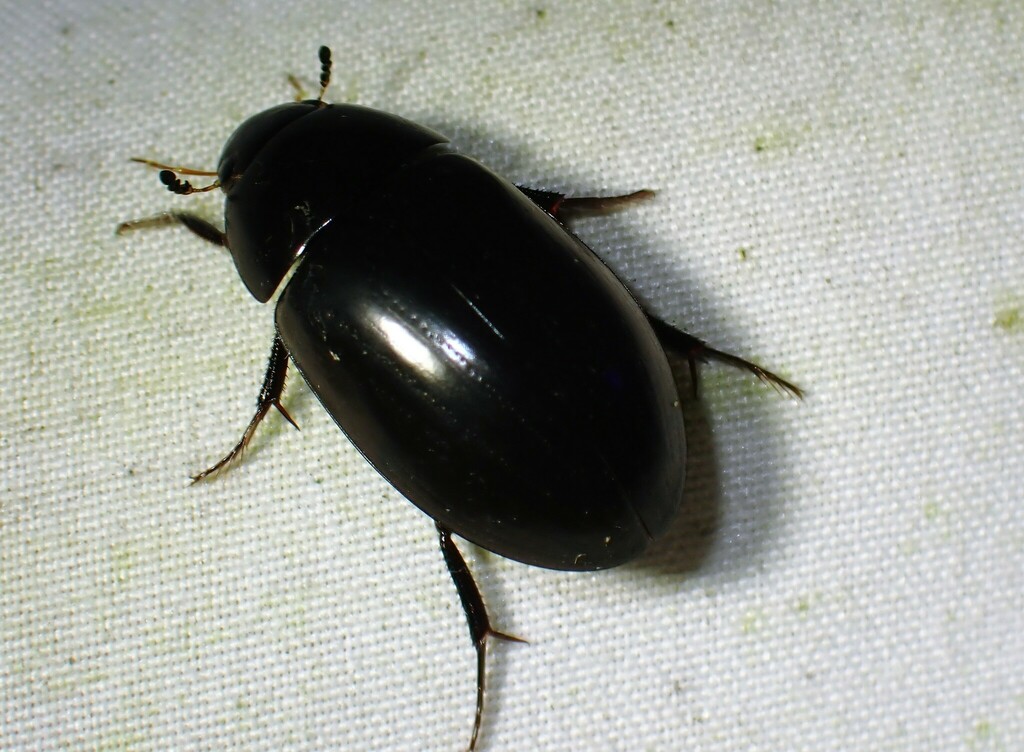
(c) Louis Imbeau, some rights reserved (CC BY) · licence
Family: Hydrophilidae · Class: Insecta · Order: Coleoptera
Conservation status: G2? S2?
Hydrochara rickseckeri (Ricksecker's Water Scavenger Beetle) is a California animal in the Hydrophilidae family.
Ricksecker's water scavenger beetle (Hydrochara rickseckeri) is a small aquatic beetle in the family Hydrophilidae. Adults typically measure 8-12 mm (0.3-0.5 inches) in length and display the characteristic oval, convex body shape common to water scavenger beetles. The dorsal surface is dark brown to black with a metallic sheen, while the ventral surface is typically lighter. The antennae are clubbed, and the legs are adapted for swimming with fringed tarsal segments that aid in aquatic locomotion. This species is endemic to California's Central Valley, with confirmed populations in the San Francisco Bay Area and Central Valley regions. According to NatureServe, the species has a global conservation ranking of G2?, indicating it is imperiled globally with 6-20 known occurrences or few remaining individuals (NatureServe Explorer 2025). The beetle's distribution appears to be highly fragmented, with isolated populations scattered across suitable aquatic habitats in the region. Ricksecker's water scavenger beetle inhabits freshwater wetland systems including shallow ponds, marshes, and slow-moving streams. The species requires permanent or semi-permanent water bodies with abundant organic matter and vegetation. Adults are typically found among emergent and submerged aquatic plants, where they feed and seek shelter. The beetle shows a preference for habitats with moderate water depths and soft substrate bottoms that support diverse invertebrate communities. As members of the Hydrophilidae family, these beetles are primarily detritivorous, feeding on decaying organic matter, algae, and small invertebrates. Adults are strong swimmers but also capable of flight between water bodies. Reproduction occurs in aquatic environments, where females lay eggs in silken cocoons attached to vegetation or debris. Larvae are predaceous and develop through several instars before pupating in moist soil adjacent to water bodies. The species likely has one generation per year, with adults overwintering in protected aquatic habitats. The U.S. Fish and Wildlife Service maintains a species profile for Ricksecker's water scavenger beetle, indicating federal conservation concern (USFWS ECOS 2025). The species faces significant threats from habitat loss due to wetland destruction, agricultural conversion, and urban development throughout California's Central Valley. Water diversions and altered hydrology have eliminated or degraded many historically occupied sites. Climate change poses additional challenges through altered precipitation patterns and increased drought frequency. Pollution from agricultural runoff and urban sources may further impact water quality in remaining habitats. The species' limited distribution and apparent rarity make it particularly vulnerable to localized disturbances. Conservation efforts focus on protecting existing wetland habitats and maintaining water quality standards in areas where populations persist. The fragmented nature of suitable habitat emphasizes the importance of landscape-level conservation planning to ensure long-term species persistence.
Classification
Class: Insecta · Order: Coleoptera · Family: Hydrophilidae
Conservation status
G2? S2?
Frequently asked questions
How is Hydrochara rickseckeri classified?
Hydrochara rickseckeri belongs to class Insecta, order Coleoptera, family Hydrophilidae.
What family does Hydrochara rickseckeri belong to?
Hydrochara rickseckeri is in the Hydrophilidae family.
Is Hydrochara rickseckeri protected or of conservation concern?
Hydrochara rickseckeri carries the following status: G2? S2?.
What is Hydrochara rickseckeri?
Ricksecker's water scavenger beetle (Hydrochara rickseckeri) is a small aquatic beetle in the family Hydrophilidae.
Is Hydrochara rickseckeri found in California?
Yes. Hydrochara rickseckeri is recorded in California in The California Species Project's catalogue.
Related species
Other California species in the same genus, family, or bioregion.
Data from The California Species Project — 14,000+ California species with verified data from CNPS, CDFW, USFWS, and more.