Hydrocoloeus minutus
Little Gull
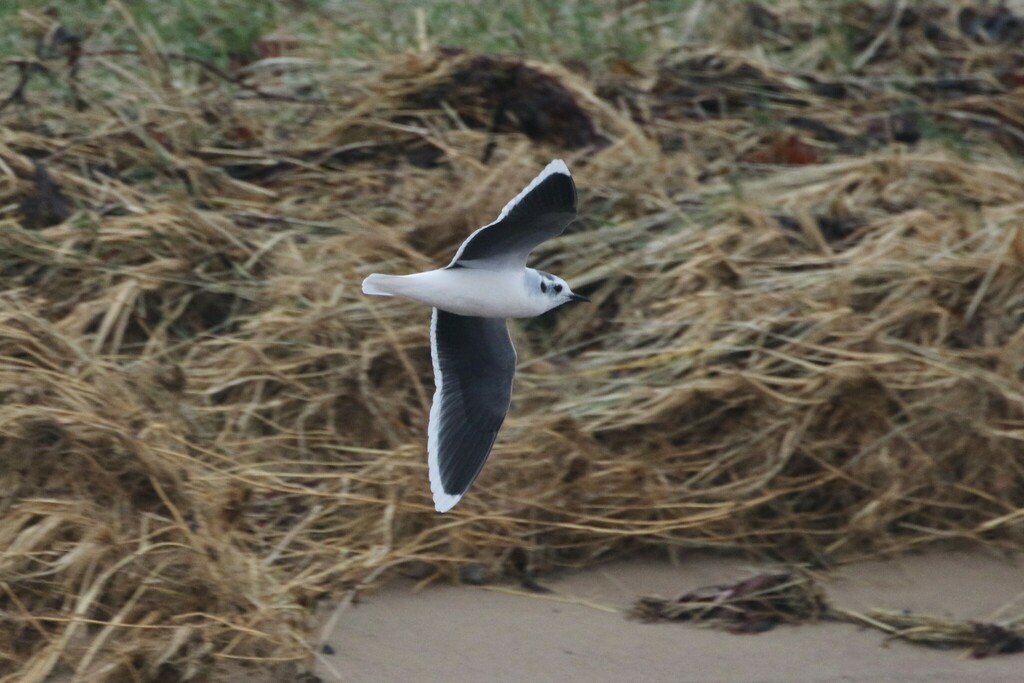
(c) scaup, some rights reserved (CC BY) · licence
Family: Laridae · Class: Aves · Order: Charadriiformes
Hydrocoloeus minutus (Little Gull) is a California animal in the Laridae family.
The Little Gull is the world's smallest gull species, measuring 24-27 cm (9.4-10.6 inches) in length with a wingspan of 61-78 cm (24-31 inches). Adults weigh 68-162 grams (2.4-5.7 ounces). Breeding adults display a distinctive black hood that extends below the eye, contrasting with white underparts and pale gray upperparts. The underwings show a characteristic dark pattern, appearing nearly black in flight. Non-breeding adults lose the black hood, retaining only a dark ear spot and partial cap. The bill is dark red to black, and legs are bright red to orange. Juveniles show a distinctive 'W' pattern across the upperwings formed by dark markings on the wing coverts and flight feathers. The Little Gull breeds primarily in northern Eurasia, from Scandinavia east through Siberia. In North America, the species has a limited breeding range in the Great Lakes region, particularly around Lakes Superior and Michigan. The species expanded its North American range westward during the 20th century, with first breeding records in Wisconsin in 1962. California records represent non-breeding occurrences, typically during fall and winter months. The species appears irregularly along the Pacific Coast from British Columbia to Baja California, with most California sightings concentrated in the San Francisco Bay area, Monterey Bay, and the Salton Sea. Little Gulls inhabit freshwater and brackish environments during breeding season, favoring marshy areas, lake shores, and river deltas with emergent vegetation. They nest in small colonies or isolated pairs in wet meadows, sedge marshes, and floating vegetation mats. During migration and winter, the species occurs in coastal waters, estuaries, large lakes, and reservoirs. In California, they are typically observed in harbors, bays, and offshore waters, often associating with other small gull species. Little Gulls exhibit tern-like feeding behavior, frequently hovering and dipping to capture prey from the water surface. Their diet consists primarily of small fish, aquatic insects, crustaceans, and marine invertebrates. During breeding season, they consume significant quantities of flying insects caught in aerial pursuit. Nesting occurs from May through July, with females laying 2-3 olive-brown eggs with dark markings in a shallow depression lined with vegetation. Both parents incubate eggs for 20-21 days and care for young, which fledge after 21-24 days. The Little Gull is not federally listed in the United States and maintains stable global populations. The species is classified as Least Concern by the International Union for Conservation of Nature. North American populations remain small but stable, with breeding restricted to the Great Lakes region. Climate change may affect the species through alterations to breeding habitat conditions and prey availability. In California, the species remains an uncommon visitor, with sightings typically occurring during fall and winter months when individuals disperse from northern breeding areas.
Classification
Class: Aves · Order: Charadriiformes · Family: Laridae
Frequently asked questions
How is Hydrocoloeus minutus classified?
Hydrocoloeus minutus belongs to class Aves, order Charadriiformes, family Laridae.
What family does Hydrocoloeus minutus belong to?
Hydrocoloeus minutus is in the Laridae family.
What is Hydrocoloeus minutus?
The Little Gull is the world's smallest gull species, measuring 24-27 cm (9.4-10.6 inches) in length with a wingspan of 61-78 cm (24-31 inches).
Is Hydrocoloeus minutus found in California?
Yes. Hydrocoloeus minutus is recorded in California in The California Species Project's catalogue.
Related species
Other California species in the same genus, family, or bioregion.
Data from The California Species Project — 14,000+ California species with verified data from CNPS, CDFW, USFWS, and more.