Hydroprogne caspia
Caspian Tern
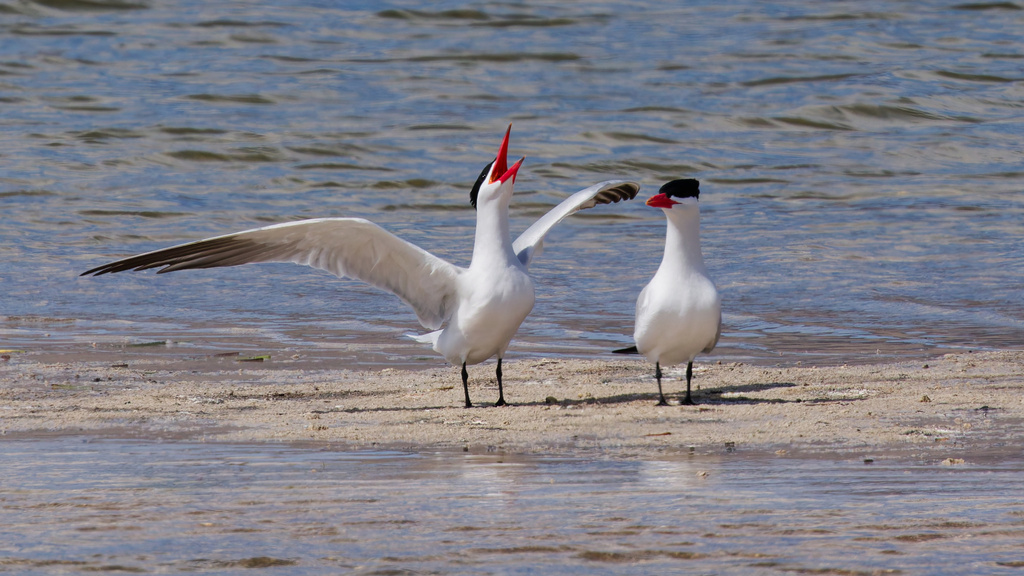
(c) Daughter Dad, some rights reserved (CC BY) · licence
Family: Laridae · Class: Aves · Order: Charadriiformes
Conservation status: G5 S4
Hydroprogne caspia (Caspian Tern) is a California animal in the Laridae family.
The Caspian Tern is the world's largest tern species, measuring 48 to 60 cm (19 to 24 inches) in length with a wingspan reaching 127 to 145 cm (50 to 57 inches). Adults weigh between 530 to 782 grams (1.2 to 1.7 pounds). The species displays a distinctive black cap during breeding season that extends from the forehead to the nape, contrasting with white underparts and pale gray upperparts. The massive, thick bill is bright orange-red with a dark tip. During non-breeding season, the black cap becomes streaked with white, particularly on the forehead. Juveniles show brownish markings on the wings and back with a mottled crown. Caspian Terns breed across scattered locations in California, with major colonies historically found in San Francisco Bay, particularly on artificial islands and salt pond levees. The species also nests at inland locations including the Salton Sea, Clear Lake, and various Central Valley reservoirs. During migration and winter, Caspian Terns occur along the entire California coast and at inland water bodies. The species demonstrates a nearly cosmopolitan distribution globally, breeding across North America, Europe, Asia, Africa, and Australia. The species requires large, open water bodies for foraging, including coastal bays, estuaries, large lakes, and reservoirs. Nesting occurs on isolated islands, artificial structures, or remote shorelines with minimal vegetation. Colonies are typically established on sandy, gravelly, or shell substrates. Salt ponds, dredged material islands, and pier structures provide important nesting habitat in California. Foraging areas must support adequate fish populations within commuting distance of colony sites. Caspian Terns are piscivorous, feeding primarily on fish measuring 10 to 15 cm (4 to 6 inches) in length. The species employs a plunge-diving hunting technique, diving from heights of 1 to 6 meters (3 to 20 feet) above the water surface. Common prey species include anchovy, sardine, smelt, and various cyprinids in freshwater habitats. Breeding occurs from April through August, with colonies ranging from several pairs to over 1,000 pairs. Females typically lay 1 to 3 eggs in shallow scrapes on bare ground. Incubation lasts 20 to 22 days, with both parents sharing duties. Chicks fledge after 25 to 35 days but continue to receive parental care for several additional weeks. The Caspian Tern maintains a stable global population and is not federally or state listed in California. However, the species faces ongoing challenges from habitat loss due to development of bay shorelines and inland water bodies. Human disturbance at colony sites can cause nest abandonment, particularly during early breeding stages. Climate change impacts on prey fish distributions and sea level rise affecting low-lying nesting areas represent emerging threats. Conservation efforts focus on protecting existing colony sites and maintaining artificial nesting platforms where natural habitat has been lost.
Classification
Class: Aves · Order: Charadriiformes · Family: Laridae
Conservation status
G5 S4
Frequently asked questions
How is Hydroprogne caspia classified?
Hydroprogne caspia belongs to class Aves, order Charadriiformes, family Laridae.
What family does Hydroprogne caspia belong to?
Hydroprogne caspia is in the Laridae family.
Is Hydroprogne caspia protected or of conservation concern?
Hydroprogne caspia carries the following status: G5 S4.
What is Hydroprogne caspia?
The Caspian Tern is the world's largest tern species, measuring 48 to 60 cm (19 to 24 inches) in length with a wingspan reaching 127 to 145 cm (50 to 57 inches).
Is Hydroprogne caspia found in California?
Yes. Hydroprogne caspia is recorded in California in The California Species Project's catalogue.
Related species
Other California species in the same genus, family, or bioregion.
Data from The California Species Project — 14,000+ California species with verified data from CNPS, CDFW, USFWS, and more.