Hyles lineata
White-lined Sphinx
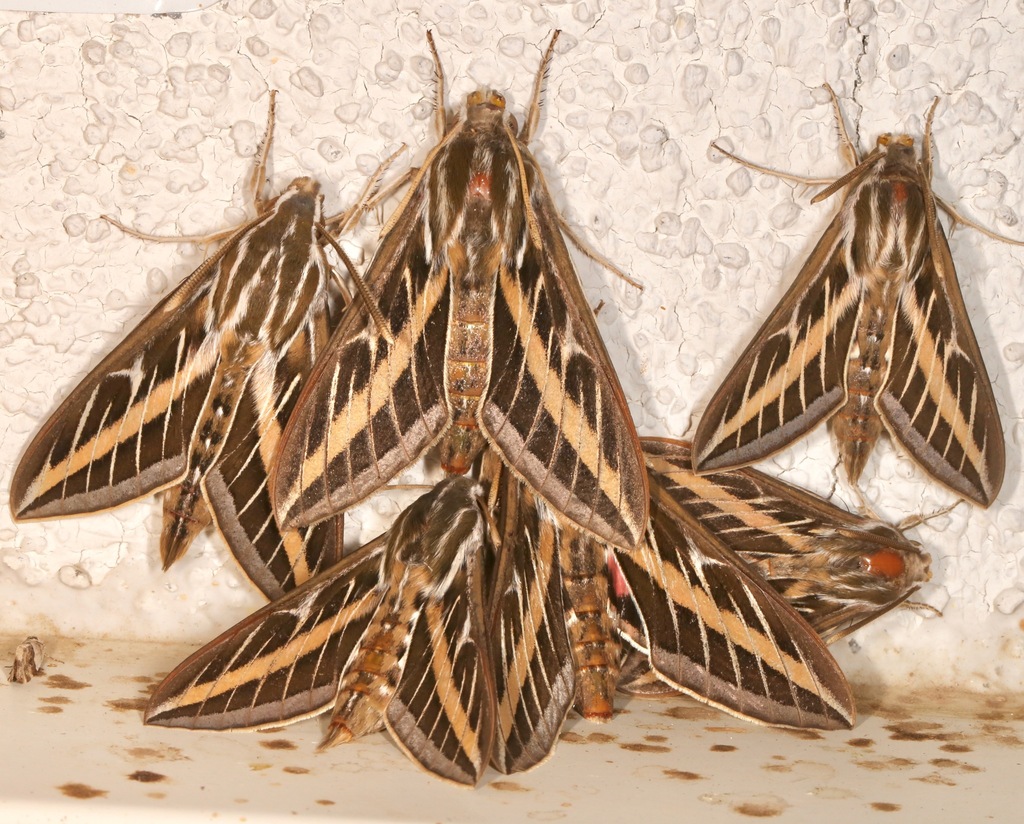
(c) Laura Gaudette, some rights reserved (CC BY) · licence
Family: Sphingidae · Class: Insecta · Order: Lepidoptera
Hyles lineata (White-lined Sphinx) is a California animal in the Sphingidae family.
The white-lined sphinx (Hyles lineata) is a medium to large hawkmoth with a wingspan ranging from 65 to 95 mm (2.6 to 3.7 inches). The forewings are olive-brown to dark brown with distinctive white or cream-colored veining that creates the characteristic lined pattern for which the species is named. A prominent white stripe runs along the forewing's leading edge, and additional pale lines traverse the wing surface. The hindwings are pink to rose-colored with black borders and white fringes. The robust body displays alternating light and dark stripes, with the thorax bearing six distinct longitudinal white lines against a brown background. This species exhibits one of the most extensive distributions among North American sphingids, occurring from Central America north through Mexico and the West Indies to most of the United States and southern Canada. The range extends beyond the Americas, with populations also found in Eurasia and Africa. In California, the white-lined sphinx occurs statewide from sea level to elevations exceeding 2,400 meters (8,000 feet), inhabiting diverse environments from coastal areas to desert regions and montane forests. The species demonstrates exceptional habitat flexibility, occupying agricultural areas, gardens, desert washes, riparian corridors, chaparral, and disturbed sites. Adults are commonly observed in urban and suburban environments where host plants are available. The white-lined sphinx thrives in areas with abundant flowering plants that provide nectar sources, particularly favoring open habitats with diverse plant communities. White-lined sphinx moths are strong migrants capable of long-distance flights, sometimes traveling hundreds of kilometers. Adults are active during twilight and nighttime hours, feeding on nectar from deep-throated flowers using their extended proboscis. The species exhibits extensive host plant diversity, with larvae feeding on willow weed (Epilobium), four o'clock (Mirabilis), apple (Malus), evening primrose (Oenothera), elm (Ulmus), grape (Vitis), tomato (Lycopersicon), purslane (Portulaca), and Fuchsia, among numerous other plant families. This polyphagous feeding strategy contributes significantly to the species' widespread success. Females deposit eggs singly on host plant leaves, typically during late spring through early fall. The large caterpillars, known as hornworms, are highly variable in coloration but typically display green or black forms with yellow or orange spots and a characteristic horn projecting from the eighth abdominal segment. Larvae pupate in soil chambers, with the species producing multiple generations annually in warmer regions. In California, two to three broods occur per year, with continuous breeding possible in southern areas. The white-lined sphinx is not listed under federal or state endangered species legislation and maintains stable populations throughout its range. The species benefits from human activities that create disturbed habitats and introduce non-native host plants. Agricultural areas often support substantial populations, though pesticide applications can cause local population fluctuations. Climate change may be expanding the species' northern range limits, with increased sighting reports from previously marginal habitats. The moth's adaptability to diverse environments and host plants suggests continued population stability under current environmental conditions.
Classification
Class: Insecta · Order: Lepidoptera · Family: Sphingidae
Frequently asked questions
How is Hyles lineata classified?
Hyles lineata belongs to class Insecta, order Lepidoptera, family Sphingidae.
What family does Hyles lineata belong to?
Hyles lineata is in the Sphingidae family.
What is Hyles lineata?
The white-lined sphinx (Hyles lineata) is a medium to large hawkmoth with a wingspan ranging from 65 to 95 mm (2.6 to 3.7 inches).
Is Hyles lineata found in California?
Yes. Hyles lineata is recorded in California in The California Species Project's catalogue.
Related species
Other California species in the same genus, family, or bioregion.
Data from The California Species Project — 14,000+ California species with verified data from CNPS, CDFW, USFWS, and more.