Hylocichla mustelina
Wood Thrush
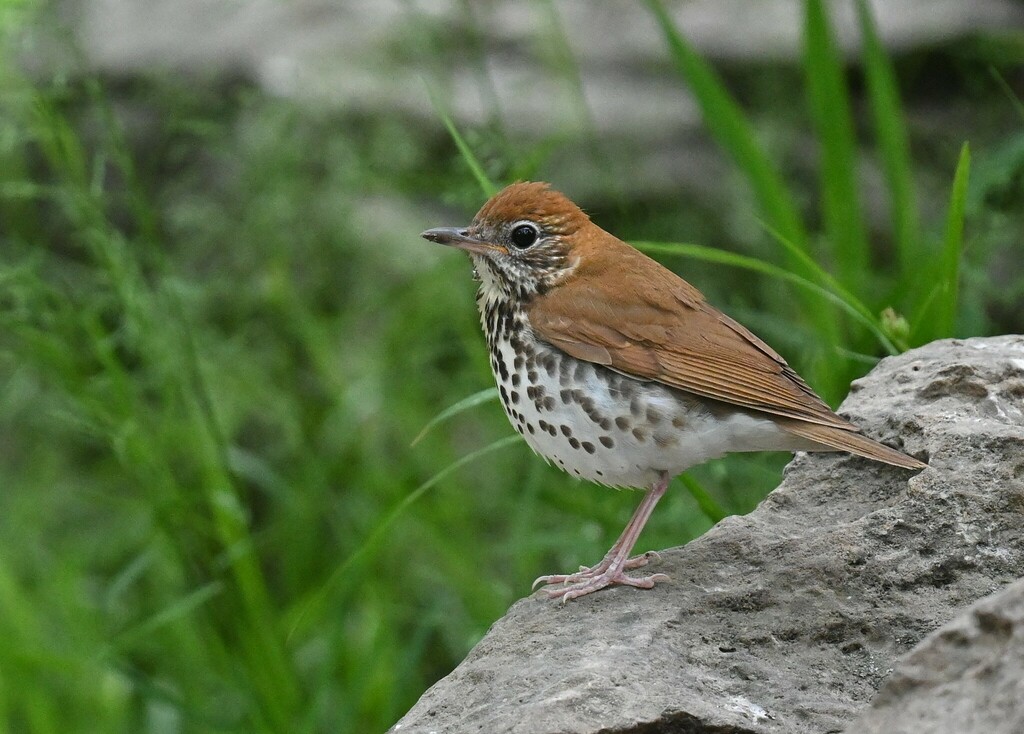
no rights reserved · CC0
Family: Turdidae · Class: Aves · Order: Passeriformes
Hylocichla mustelina (Wood Thrush) is a California animal in the Turdidae family.
The Wood Thrush is a medium-sized songbird measuring 19 to 21 centimeters (7.5 to 8.3 inches) in length with a wingspan of 30 to 40 centimeters (12 to 16 inches). Adults weigh 40 to 50 grams (1.4 to 1.8 ounces). The species displays distinctive plumage with a warm, cinnamon-brown head and back that transitions to olive-brown on the wings and tail. The white breast and flanks are marked with large, dark brown spots that increase in size from throat to belly. The bill is straight and pointed, yellow-orange at the base with a dark tip. Both sexes appear similar, though males may show slightly brighter coloration during breeding season. Historically, Wood Thrush bred throughout eastern North America from southern Canada to the Gulf Coast. In California, the species occurs as a rare vagrant, primarily during migration periods. Most California records originate from coastal counties including San Diego, Orange, Los Angeles, Ventura, and Monterey, with occasional sightings in the Central Valley and desert regions. The species typically appears in California from late April through October, with peak occurrences in May and September corresponding to spring and fall migration. Wood Thrush inhabits mature deciduous and mixed forests with dense canopy cover and well-developed understory. The species requires forest tracts of at least 5 to 10 hectares for successful breeding, preferring areas with 70 to 80 percent canopy closure. In their breeding range, they occupy forests dominated by oak, maple, beech, and hickory, often near water sources. During migration and as vagrants in California, Wood Thrush may utilize riparian woodlands, mature urban parks, and oak woodlands that provide similar structural characteristics to their preferred breeding habitat. Wood Thrush are primarily insectivorous during the breeding season, foraging on the forest floor by turning over leaf litter to locate beetles, caterpillars, ants, and other invertebrates. They also consume fruits and berries, particularly during migration and winter months. The species exhibits a distinctive foraging behavior of running short distances, then stopping to listen and probe the substrate. Males are renowned for their complex, flute-like song consisting of multiple phrases with harmonics. Breeding occurs from May through July, with females constructing cup-shaped nests 2 to 4 meters above ground in the fork of deciduous trees. Clutches typically contain 3 to 4 pale blue eggs, and pairs may produce two broods per season. The Wood Thrush is not federally listed but has experienced significant population decline across its range. According to the North American Breeding Bird Survey, populations declined by approximately 60 percent between 1966 and 2019. The species is listed as Near Threatened by the International Union for Conservation of Nature. Primary threats include habitat fragmentation, forest loss to development and agriculture, and increased nest predation and brood parasitism by Brown-headed Cowbirds in fragmented landscapes. Climate change may further impact the species by altering forest composition and shifting suitable habitat northward. In California, Wood Thrush remains a rare vagrant with no established breeding population.
Classification
Class: Aves · Order: Passeriformes · Family: Turdidae
Frequently asked questions
How is Hylocichla mustelina classified?
Hylocichla mustelina belongs to class Aves, order Passeriformes, family Turdidae.
What family does Hylocichla mustelina belong to?
Hylocichla mustelina is in the Turdidae family.
What is Hylocichla mustelina?
The Wood Thrush is a medium-sized songbird measuring 19 to 21 centimeters (7.5 to 8.3 inches) in length with a wingspan of 30 to 40 centimeters (12 to 16 inches).
Is Hylocichla mustelina found in California?
Yes. Hylocichla mustelina is recorded in California in The California Species Project's catalogue.
Related species
Other California species in the same genus, family, or bioregion.
Data from The California Species Project — 14,000+ California species with verified data from CNPS, CDFW, USFWS, and more.