Hyperaeschra georgica
Georgian Prominent
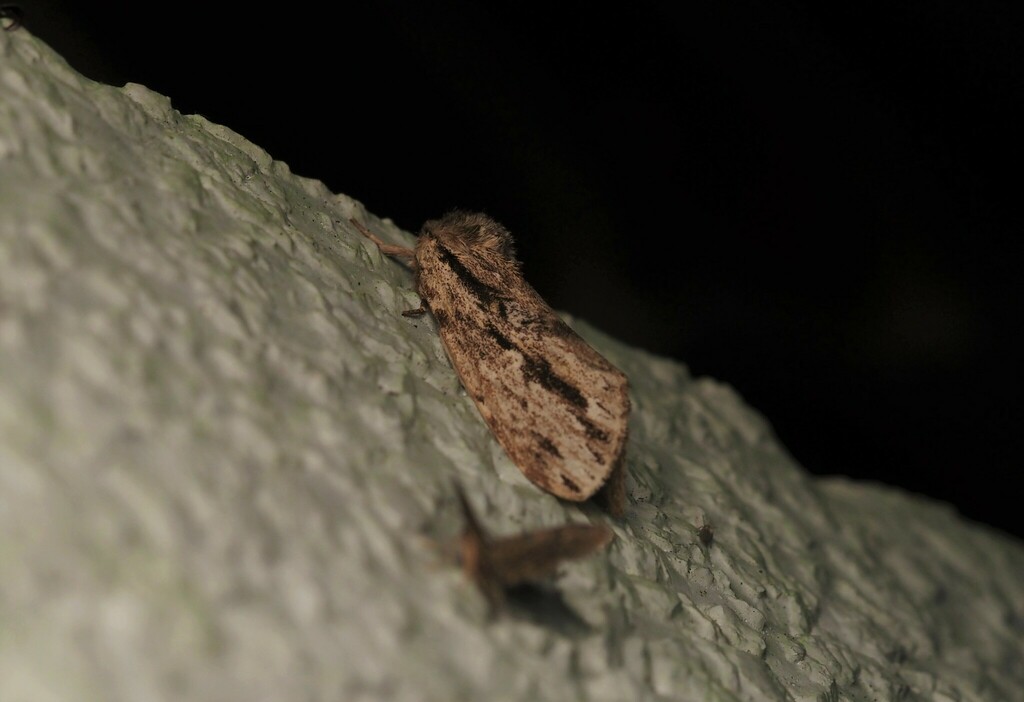
(c) camellia_l, some rights reserved (CC BY) · licence
Family: Notodontidae · Class: Insecta · Order: Lepidoptera
Hyperaeschra georgica (Georgian Prominent) is a California animal in the Notodontidae family.
The Georgian prominent is a nocturnal moth in the family Notodontidae, characterized by its medium size and cryptic coloration. Adults have a wingspan of approximately 35 to 45 millimeters (1.4 to 1.8 inches). The forewings are grayish-brown with darker zigzag lines and patches that provide effective camouflage against tree bark. The hindwings are lighter, typically pale gray to whitish. At rest, the moth holds its wings in a tent-like position, with the forewings concealing most of the hindwings. The thorax and abdomen are densely covered with grayish-brown scales that match the wing coloration. The Georgian prominent has an extensive North American distribution, ranging from New Brunswick to Florida, and extending west to eastern California and north to Manitoba. Notably absent from the Pacific Northwest, the species demonstrates a continental distribution pattern that spans temperate and subtropical regions. In California, populations occur primarily in the eastern portions of the state, representing the western edge of the species' range. This species inhabits deciduous and mixed forests where suitable host plants are abundant. Georgian prominent moths are typically found in woodland areas with oak species, as larvae feed on various Quercus species including white oak, red oak, and related species. Adults are attracted to artificial lights and may be encountered near residential areas adjacent to forested habitats. The species occurs from sea level to moderate elevations in mountainous regions. Georgian prominent moths are univoltine in northern portions of their range and bivoltine in southern areas, producing one to two generations annually depending on local climate conditions. Adults are active from late spring through early fall, with peak flight periods occurring in May through July for the first generation and August through September for the second generation where applicable. Mating occurs at night, with females depositing eggs singly or in small clusters on host plant foliage. Larvae develop through five instars, feeding on oak leaves during summer months. Mature caterpillars are approximately 40 millimeters long, green to brown in coloration with subtle striping patterns. The species overwinters as pupae in soil chambers or leaf litter beneath host trees. The Georgian prominent is not currently listed under federal or state endangered species legislation and appears to maintain stable populations throughout most of its range. The species benefits from the widespread distribution of oak forests across North America, though local populations may be affected by habitat fragmentation and forest management practices. Urban development and conversion of oak woodlands to other land uses represent the primary potential threats to regional populations. Climate change may influence the northern and southern extent of the species' range over time, potentially affecting distribution patterns and voltinism. The moth's broad host plant range among oak species provides some resilience against environmental changes affecting specific oak populations.
Classification
Class: Insecta · Order: Lepidoptera · Family: Notodontidae
Frequently asked questions
How is Hyperaeschra georgica classified?
Hyperaeschra georgica belongs to class Insecta, order Lepidoptera, family Notodontidae.
What family does Hyperaeschra georgica belong to?
Hyperaeschra georgica is in the Notodontidae family.
What is Hyperaeschra georgica?
The Georgian prominent is a nocturnal moth in the family Notodontidae, characterized by its medium size and cryptic coloration.
Is Hyperaeschra georgica found in California?
Yes. Hyperaeschra georgica is recorded in California in The California Species Project's catalogue.
Related species
Other California species in the same genus, family, or bioregion.
Data from The California Species Project — 14,000+ California species with verified data from CNPS, CDFW, USFWS, and more.