Hypomesus transpacificus
Delta smelt
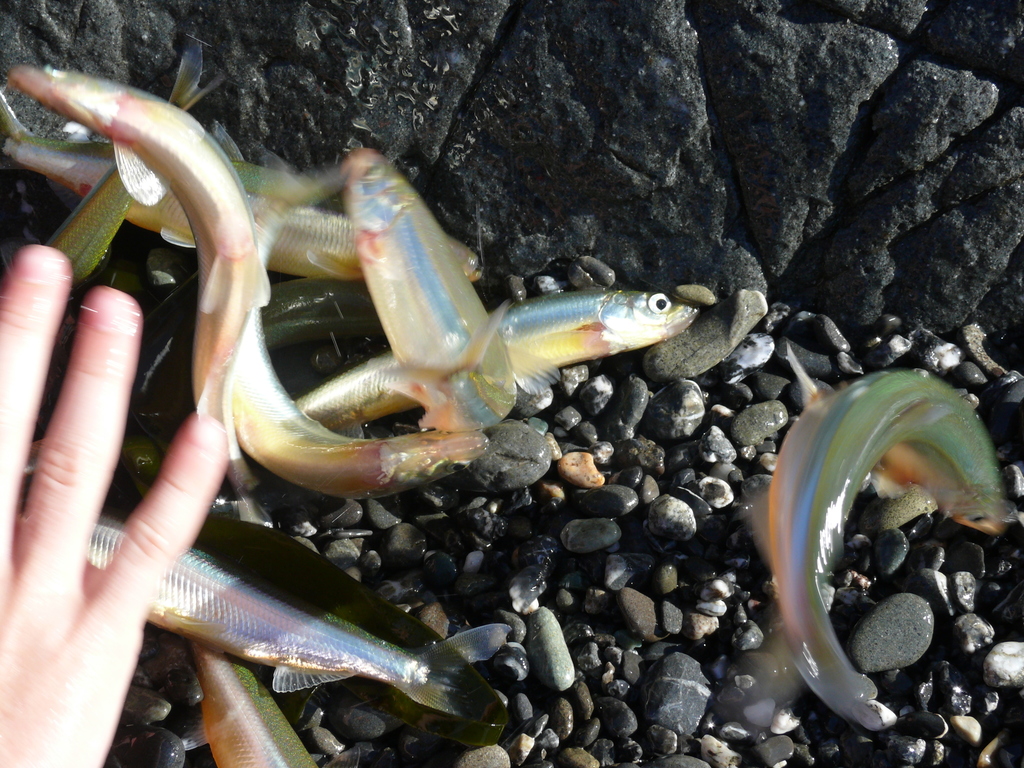
(c) Matt Bowser, some rights reserved (CC BY) · licence
Family: Osmeridae · Class: Actinopterygii · Order: Osmeriformes
Conservation status: SE ST · Threatened · G1 S1
Hypomesus transpacificus (Delta smelt) is a California animal in the Osmeridae family.
The Delta smelt (Hypomesus transpacificus) is a small, slender fish endemic to the Sacramento-San Joaquin Delta estuary in California. Adults typically measure 60 to 70 mm (2.4 to 2.8 inches) in standard length, though some individuals may reach 90 mm (3.5 inches). The body is nearly translucent with a steely blue-green sheen on the dorsal surface and silvery sides. The species possesses a single dorsal fin positioned midway along the back and is distinguished from other osmerid species by its pectoral fin ray count of 13 to 16. When handled, Delta smelt emit a distinctive cucumber-like odor due to their high moisture content. Historically, Delta smelt ranged throughout the upper Sacramento-San Joaquin Delta, Suisun Bay, and occasionally San Pablo Bay. Their current distribution has contracted significantly and is now largely confined to the northern and western Delta and Suisun Bay. The species occurs primarily in Contra Costa, Sacramento, San Joaquin, Solano, and Yolo counties, with occasional individuals detected in adjacent areas during high-flow years. Delta smelt inhabit the mixing zone where fresh and brackish waters converge, typically in areas with salinity levels ranging from 0 to 14 parts per thousand. They prefer open-water habitats with low to moderate turbidity and gentle to moderate currents. The species demonstrates seasonal movement patterns, migrating upstream to freshwater areas during fall and winter for spawning. Spawning occurs in shallow, low-velocity areas along channel margins and in dead-end sloughs with suitable substrate. The species exhibits a largely annual life cycle, with spawning occurring from December through July, peaking between February and May. Females deposit adhesive eggs on submerged vegetation, woody debris, and other hard substrates in water depths of 1 to 7 meters. Larvae drift downstream toward more saline waters where they develop. Delta smelt are opportunistic planktivores, feeding primarily on copepods, cladocerans, and mysid shrimp, with diet varying seasonally based on prey availability. Delta smelt were federally listed as threatened in 1993 and are classified as endangered by California (SE). According to the California Department of Fish and Wildlife, the U.S. Fish and Wildlife Service determined in 2016 that uplisting to federally endangered status is 'warranted-but-precluded,' with a Listing Priority Number of 2. Population estimates from the fall midwater trawl survey have declined precipitously from indices exceeding 1,000 in the 1970s to critically low levels in recent decades. Primary threats include water diversions that alter natural flow patterns, entrainment in pumping facilities, habitat degradation, invasive species, contaminants, and climate change effects including increased water temperatures and altered precipitation patterns. Current conservation efforts focus on flow management, habitat restoration, and captive breeding programs to prevent extinction.
Classification
Class: Actinopterygii · Order: Osmeriformes · Family: Osmeridae
Conservation status
SE ST · Threatened · G1 S1
Frequently asked questions
How is Hypomesus transpacificus classified?
Hypomesus transpacificus belongs to class Actinopterygii, order Osmeriformes, family Osmeridae.
What family does Hypomesus transpacificus belong to?
Hypomesus transpacificus is in the Osmeridae family.
Is Hypomesus transpacificus protected or of conservation concern?
Hypomesus transpacificus carries the following status: SE ST · Threatened · G1 S1.
What is Hypomesus transpacificus?
The Delta smelt (Hypomesus transpacificus) is a small, slender fish endemic to the Sacramento-San Joaquin Delta estuary in California.
Is Hypomesus transpacificus found in California?
Yes. Hypomesus transpacificus is recorded in California in The California Species Project's catalogue.
Related species
Other California species in the same genus, family, or bioregion.
Data from The California Species Project — 14,000+ California species with verified data from CNPS, CDFW, USFWS, and more.