Icaricia icarioides albihalos
White Mountains Icarioides Blue Butterfly
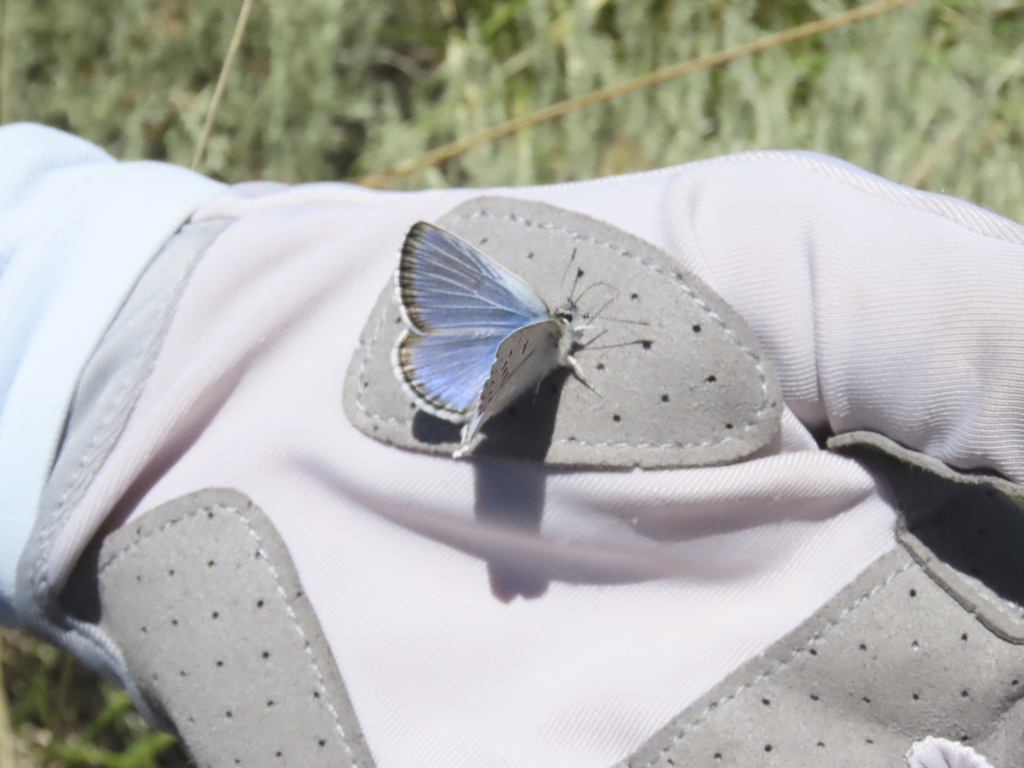
(c) Nancy Overholtz, some rights reserved (CC BY-SA) · licence
Family: Lycaenidae · Class: Insecta · Order: Lepidoptera
Conservation status: G5T2T3 S1
Icaricia icarioides albihalos (White Mountains Icarioides Blue Butterfly) is a California animal in the Lycaenidae family.
Icaricia icarioides albihalos, the White Mountains Icarioides Blue Butterfly, is a subspecies of the widespread Icarioides Blue complex found in western North America. This small butterfly belongs to the family Lycaenidae and represents one of several geographically isolated subspecies of Icaricia icarioides, which includes the federally endangered Mission Blue Butterfly (I. i. missionensis) and the federally threatened Fender's Blue Butterfly (I. i. fenderi). Like other members of this species complex, males typically display bright blue dorsal wing surfaces while females are generally brown with orange marginal spots on the hindwings. The White Mountains Icarioides Blue is endemic to California's White Mountains, a high-elevation range in the eastern Sierra Nevada along the California-Nevada border. This subspecies occupies one of the most restricted ranges within the I. icarioides complex, contributing to its conservation concern. The White Mountains are characterized by extreme elevation gradients, ranging from desert valleys to peaks exceeding 4,300 meters (14,100 feet), creating unique ecological conditions that have likely driven the evolution of this distinct subspecies. This butterfly inhabits montane ecosystems within the White Mountains, typically occurring in areas where suitable host plants are present. Like other Icarioides Blues, this subspecies likely depends on lupine species (Lupinus spp.) as larval host plants, though specific host plant relationships for the White Mountains population have not been thoroughly documented. The harsh mountain environment, with its short growing seasons and extreme temperature fluctuations, constrains the butterfly's activity period and likely influences its life history characteristics. The ecology and behavior of I. i. albihalos remain poorly studied due to its limited range and remote habitat. Based on knowledge of closely related subspecies, adults likely emerge during the brief mountain summer, with males patrolling territories to locate females. Eggs are presumably deposited on or near lupine host plants, with larvae developing through multiple instars before overwintering. The extreme elevation and harsh climate of the White Mountains likely result in a univoltine (single-generation) annual life cycle, with extended development periods compared to lower-elevation populations. The White Mountains Icarioides Blue is not federally listed under the Endangered Species Act, unlike its close relatives the Mission Blue and Fender's Blue butterflies. However, its global rank of G5T2T3 indicates that while the full species (G5) is secure, this particular subspecies (T2T3) is imperiled to vulnerable. The California state rank of S1 designates it as critically imperiled within the state, reflecting its extremely limited distribution and small population size. Primary conservation concerns likely include habitat fragmentation, climate change impacts on high-elevation ecosystems, and the subspecies' naturally restricted range. The remote location of its habitat may provide some protection from direct human disturbance, but climate-driven changes to montane ecosystems pose long-term threats to this geographically isolated population.
Classification
Class: Insecta · Order: Lepidoptera · Family: Lycaenidae
Conservation status
G5T2T3 S1
Frequently asked questions
How is Icaricia icarioides albihalos classified?
Icaricia icarioides albihalos belongs to class Insecta, order Lepidoptera, family Lycaenidae.
What family does Icaricia icarioides albihalos belong to?
Icaricia icarioides albihalos is in the Lycaenidae family.
Is Icaricia icarioides albihalos protected or of conservation concern?
Icaricia icarioides albihalos carries the following status: G5T2T3 S1.
What is Icaricia icarioides albihalos?
Icaricia icarioides albihalos, the White Mountains Icarioides Blue Butterfly, is a subspecies of the widespread Icarioides Blue complex found in western North America.
Is Icaricia icarioides albihalos found in California?
Yes. Icaricia icarioides albihalos is recorded in California in The California Species Project's catalogue.
Related species
Other California species in the same genus, family, or bioregion.
Data from The California Species Project — 14,000+ California species with verified data from CNPS, CDFW, USFWS, and more.