Icaricia icarioides fenderi
Fender's blue butterfly
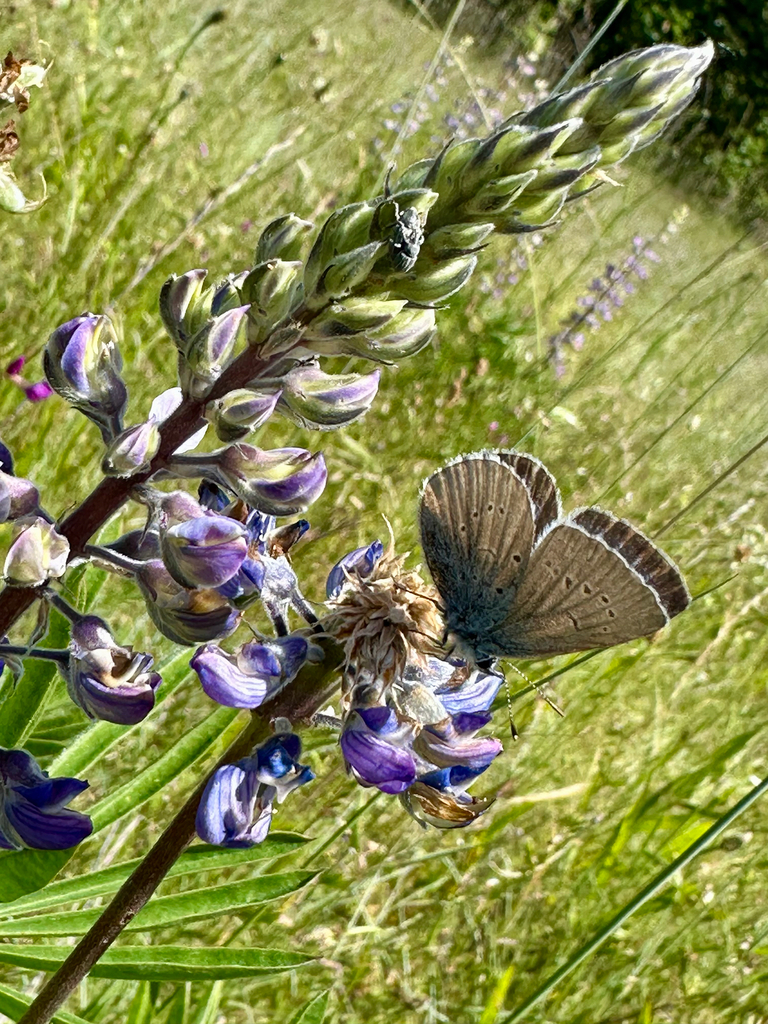
no rights reserved · CC0
Family: Lycaenidae · Class: Insecta · Order: Lepidoptera
Conservation status: Threatened
Icaricia icarioides fenderi (Fender's blue butterfly) is a California animal in the Lycaenidae family.
Fender's blue butterfly is a small lycaenid butterfly with sexually dimorphic wing coloration. Males display bright blue dorsal wing surfaces with narrow black borders, while females exhibit brownish-blue wings with broader dark margins and orange spots along the hindwing borders. The wingspan ranges from 22 to 28 mm (0.9 to 1.1 inches). The ventral wing surfaces of both sexes are pale gray with distinctive black spots ringed in white, and orange marginal spots on the hindwings. This subspecies is endemic to Oregon's Willamette Valley, where it occurs in scattered prairie remnants and oak savanna habitats from Eugene in the south to Hagg Lake in the north (Xerces Society 2024). Once thought extinct after the last specimens were collected between 1929 and 1937, the butterfly was rediscovered in 1989 by Paul Hammond. Historical records indicate the species likely occurred throughout the valley's native prairie ecosystem before widespread habitat conversion. Fender's blue occupies remnant native prairies and oak savanna habitats within the Willamette Valley. The species requires the presence of its primary host plant, Kincaid's lupine (Lupinus sulphureus var. kincaidii), which is also federally listed as threatened. Adults are typically found in open grassland areas with scattered oak trees and native wildflower communities. The butterfly appears to prefer sites with moderate grazing or periodic disturbance that maintains open prairie conditions while supporting lupine populations. Adult flight period occurs from late May through early July, with peak activity in June. Females deposit eggs singly on or near Kincaid's lupine plants. Larvae feed exclusively on the host plant, developing through four instars before pupating in the soil or leaf litter. The species completes one generation per year, overwintering as pupae. Adults are active during warm, sunny conditions and males exhibit territorial behavior around lupine patches. Both sexes nectar on various native wildflowers including their host plant. Fender's blue was federally listed as endangered in 2000 but was reclassified to threatened status in 2021, marking the first butterfly species in Endangered Species Act history to be downlisted due to recovery progress (USFWS 2021). An estimated 99 percent of the Willamette Valley's native prairie habitat has been converted to agriculture or urban development over the past 140 years. Primary threats include continued habitat loss, invasive plant species such as Himalayan blackberry and Scotch broom that displace native lupine, and habitat fragmentation. Invasive species outcompete Kincaid's lupine and other native wildflowers essential to the butterfly's survival. Conservation efforts focus on habitat restoration, invasive species control, and protection of remaining prairie fragments. Recovery partnerships involve federal and state agencies, private landowners, and conservation organizations working to restore and manage prairie habitats. Grazing management using livestock that avoid consuming lupine has proven effective in some locations for maintaining suitable habitat conditions.
Classification
Class: Insecta · Order: Lepidoptera · Family: Lycaenidae
Conservation status
Threatened
Frequently asked questions
How is Icaricia icarioides fenderi classified?
Icaricia icarioides fenderi belongs to class Insecta, order Lepidoptera, family Lycaenidae.
What family does Icaricia icarioides fenderi belong to?
Icaricia icarioides fenderi is in the Lycaenidae family.
Is Icaricia icarioides fenderi protected or of conservation concern?
Icaricia icarioides fenderi carries the following status: Threatened.
What is Icaricia icarioides fenderi?
Fender's blue butterfly is a small lycaenid butterfly with sexually dimorphic wing coloration.
Is Icaricia icarioides fenderi found in California?
Yes. Icaricia icarioides fenderi is recorded in California in The California Species Project's catalogue.
Related species
Other California species in the same genus, family, or bioregion.
Data from The California Species Project — 14,000+ California species with verified data from CNPS, CDFW, USFWS, and more.