Icaricia icarioides missionensis
Mission blue butterfly
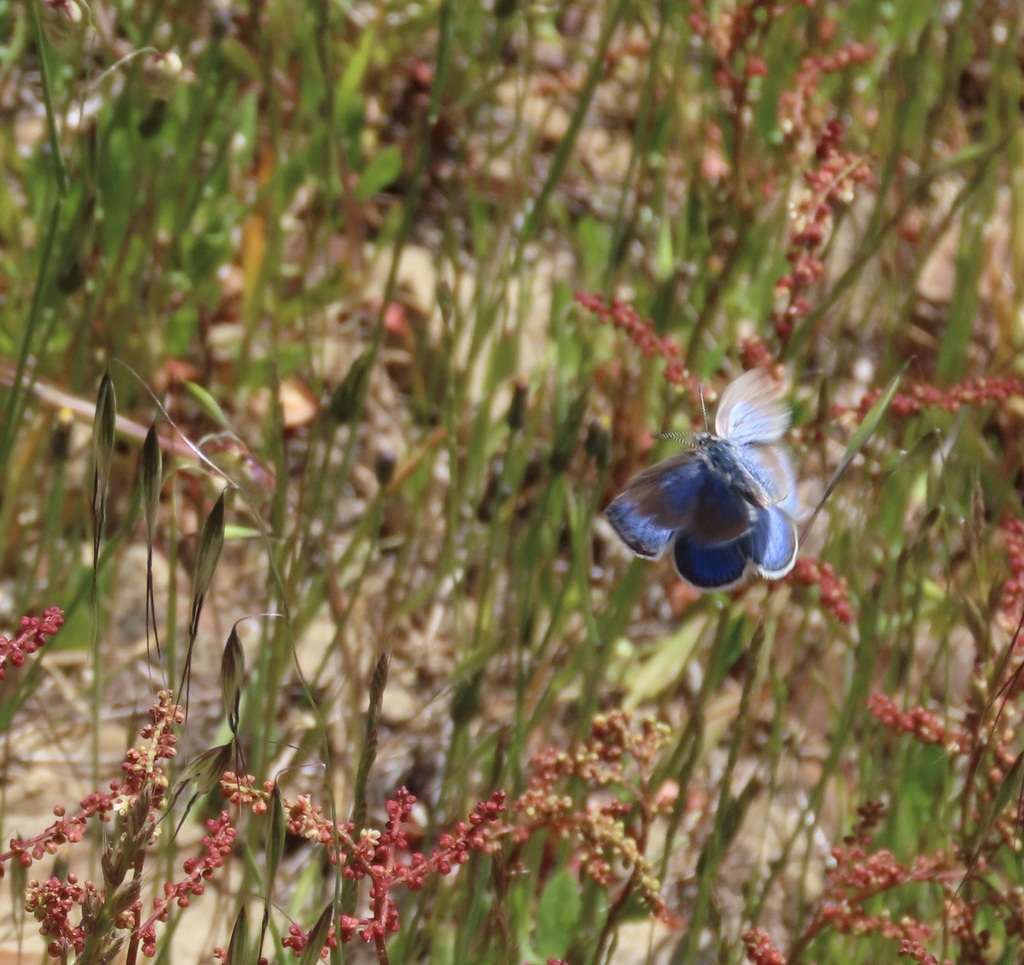
(c) John Hibbard, some rights reserved (CC BY) · licence
Family: Lycaenidae · Class: Insecta · Order: Lepidoptera
Conservation status: Endangered · G5T2 S2
Icaricia icarioides missionensis (Mission blue butterfly) is a California animal in the Lycaenidae family.
The Mission blue butterfly is a small subspecies of the Boisduval's blue butterfly endemic to the San Francisco Bay Area. Adult males display predominantly blue wings, while females exhibit brown coloration with blue patches. Both sexes have a wingspan of approximately 25 to 32 millimeters (1.0 to 1.3 inches). The species is distinguished from other Icaricia icarioides subspecies by its intermediate phenotype between darker inland populations and extremely pale coastal forms. Historically found throughout coastal areas of the San Francisco Peninsula, the Mission blue butterfly currently occurs in fragmented populations across Marin, San Francisco, and San Mateo counties. Specific locations include Fort Baker and Oakwood Valley in Marin County, Twin Peaks in San Francisco County, and San Bruno Mountain in San Mateo County, extending from Milagra Ridge through the San Francisco Peninsula Watershed (USFWS 2019). The species has experienced considerable range retraction since the early 20th century, with many historical sites no longer supporting populations. Mission blue butterflies inhabit coastal prairie grasslands and scrublands containing their required lupine host plants. These habitats are characterized by well-drained soils and exposure to coastal fog and wind patterns. The species' host lupines depend on natural disturbances such as rodent burrows, rockslides, and periodic fires to establish seedlings and maintain suitable breeding sites (USFWS 2019). The Mission blue butterfly exhibits a univoltine life cycle, flying from March through early July. Adults live approximately seven to eight days, with females slightly outliving males. Larvae feed exclusively on three lupine species: silver lupine (Lupinus albifrons), summer lupine (L. formosus), and varicolored lupine (L. varicolor). Adult butterflies are nectarivores, feeding on various flowering plants within their habitat. Females deposit eggs directly on lupine leaves, where larvae develop through several instars before pupating in soil or leaf litter. Listed as federally endangered on June 1, 1976, the Mission blue butterfly was among the first invertebrates to receive protection under the Endangered Species Act. Current population estimates range from 1,000 to 2,500 individuals across all remaining sites (NatureServe 2023). Most populations occur on protected lands, including the Golden Gate National Recreation Area in the Marin Headlands. Primary threats include habitat loss from urban development, invasive plant species that displace native lupines, habitat fragmentation, and altered fire regimes that prevent lupine establishment. Climate change poses additional risks through modified coastal fog patterns and temperature increases. Conservation efforts focus on habitat management, invasive species control, prescribed burning to maintain lupine populations, and population monitoring. The species benefits from habitat restoration projects and translocation efforts to establish new populations within its historical range.
Classification
Class: Insecta · Order: Lepidoptera · Family: Lycaenidae
Conservation status
Endangered · G5T2 S2
Frequently asked questions
How is Icaricia icarioides missionensis classified?
Icaricia icarioides missionensis belongs to class Insecta, order Lepidoptera, family Lycaenidae.
What family does Icaricia icarioides missionensis belong to?
Icaricia icarioides missionensis is in the Lycaenidae family.
Is Icaricia icarioides missionensis protected or of conservation concern?
Icaricia icarioides missionensis carries the following status: Endangered · G5T2 S2.
What is Icaricia icarioides missionensis?
The Mission blue butterfly is a small subspecies of the Boisduval's blue butterfly endemic to the San Francisco Bay Area.
Is Icaricia icarioides missionensis found in California?
Yes. Icaricia icarioides missionensis is recorded in California in The California Species Project's catalogue.
Related species
Other California species in the same genus, family, or bioregion.
Data from The California Species Project — 14,000+ California species with verified data from CNPS, CDFW, USFWS, and more.